Asian House Shrew
Suncus murinus
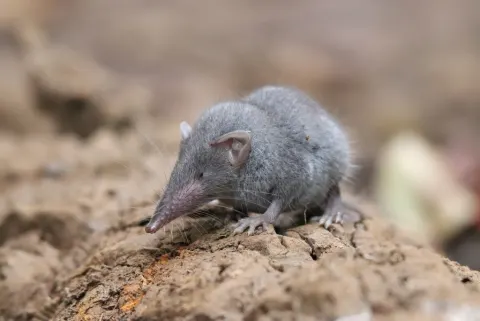
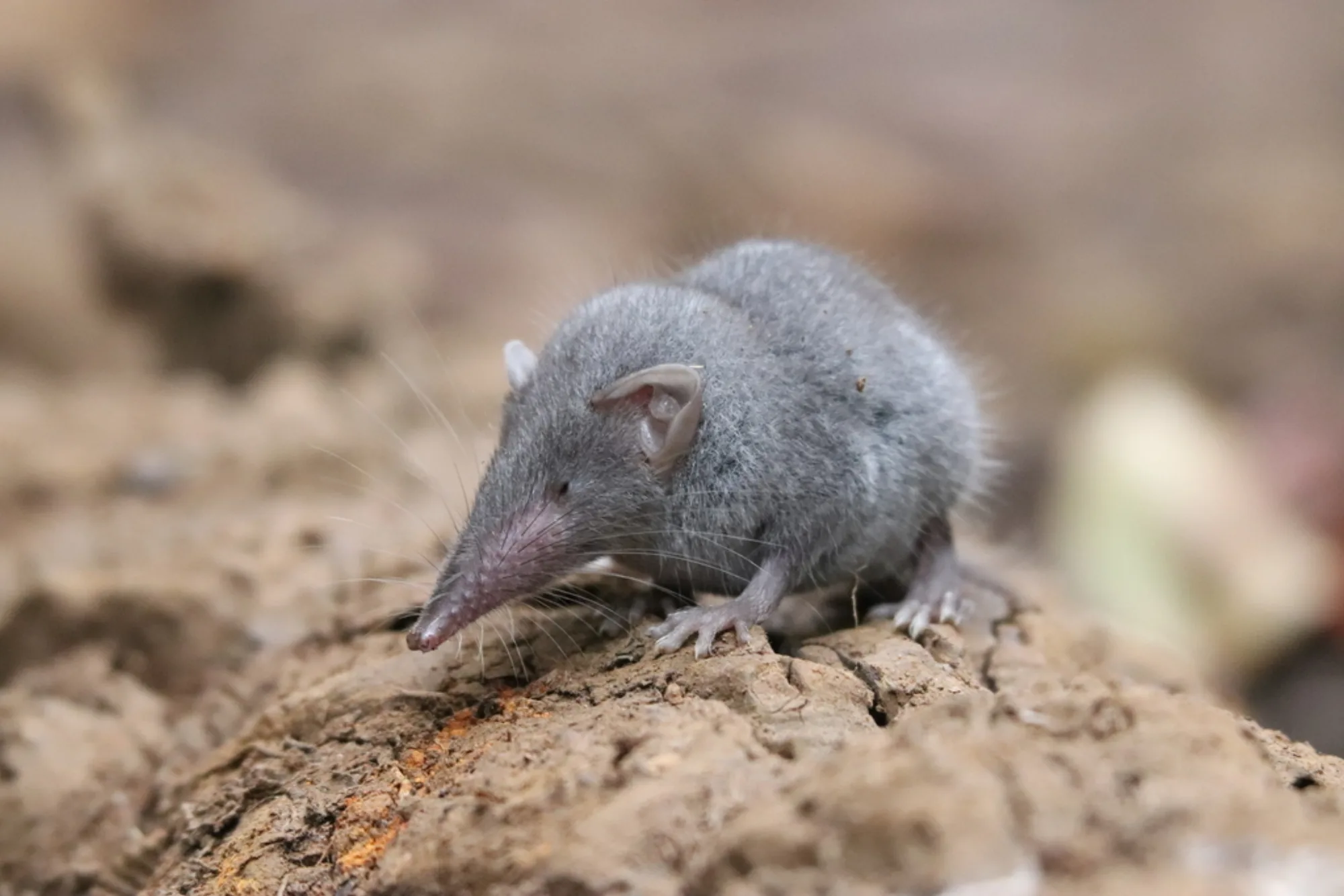
With short, dense fur ranging from mid-grey to brownish-grey, the Asian House Shrew has a long snout, small ears and short legs. Its tail is thick at the base, narrowing towards the tip, with a sparse scattering of long, bristly hairs. It is the largest shrew species, weighing 50 to 100 g and measuring about 15 cm from snout to tail tip. A strong musky smell can give it away, especially during the breeding season.
Native to South and Southeast Asia, it has been introduced to Arabia, eastern Africa, Madagascar, the Philippines and other islands across the Indian and Pacific Oceans. It lives across a wide range of habitats, from deserts to human homes. Active at night, it spends the day in a burrow or another hiding place, sometimes inside a building. Indoors, it tends to run quickly along wall edges, chattering as it goes. When alarmed, it gives a piercing shriek; its musk also discourages predators, which rarely eat one even if they catch it.
Insects make up much of its diet, including cockroaches, but it also eats other invertebrates, house mice and plant material. In homes it may take meat or pet food. Breeding takes place throughout the year, with females averaging two litters annually. After a month of gestation, one to eight young are born in a nest built by both parents; they stay there until nearly adult. A mother and her young sometimes travel in a chain, each youngster holding the fur of the animal ahead with its teeth. People often mistake this shrew for a rat or mouse and kill it as vermin.
Written from the English Wikipedia article Asian house shrew (CC BY-SA 4.0).
- Records
- 1,681
- Countries
- 25
- Atlas places
- 1
These are open occurrence records, so they show where people looked for and recorded the Asian House Shrew as much as where it lives. Cells are up to 25 km across, and every location is generalised to its cell.
Generalised encounter areas, not exact locations. Each shape is a grid cell coloured by how likely the species is there.
- Very likelyTaiwan25 km zone · medium confidence · 1108 records · updated 80 days ago
- Very likelyPhilippines25 km zone · medium confidence · 159 records · updated 80 days ago
- Very likelyMauritius25 km zone · medium confidence · 34 records · updated 80 days ago
- Very likelyPakistan25 km zone · medium confidence · 32 records · updated 80 days ago
- Very likelySri Lanka25 km zone · medium confidence · 30 records · updated 80 days ago
- LikelyMadagascar25 km zone · medium confidence · 61 records · updated 80 days ago
- LikelyMyanmar (Burma)25 km zone · medium confidence · 43 records · updated 80 days ago
- LikelyVietnam25 km zone · medium confidence · 41 records · updated 80 days ago
- LikelyNepal25 km zone · medium confidence · 27 records · updated 80 days ago
- LikelyIndia25 km zone · medium confidence · 24 records · updated 80 days ago
Conservation status not assessed here yet, so every location is generalised to its grid cell.