Etruscan Shrew
Suncus etruscus
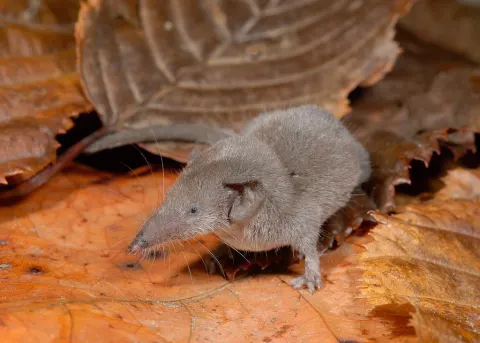
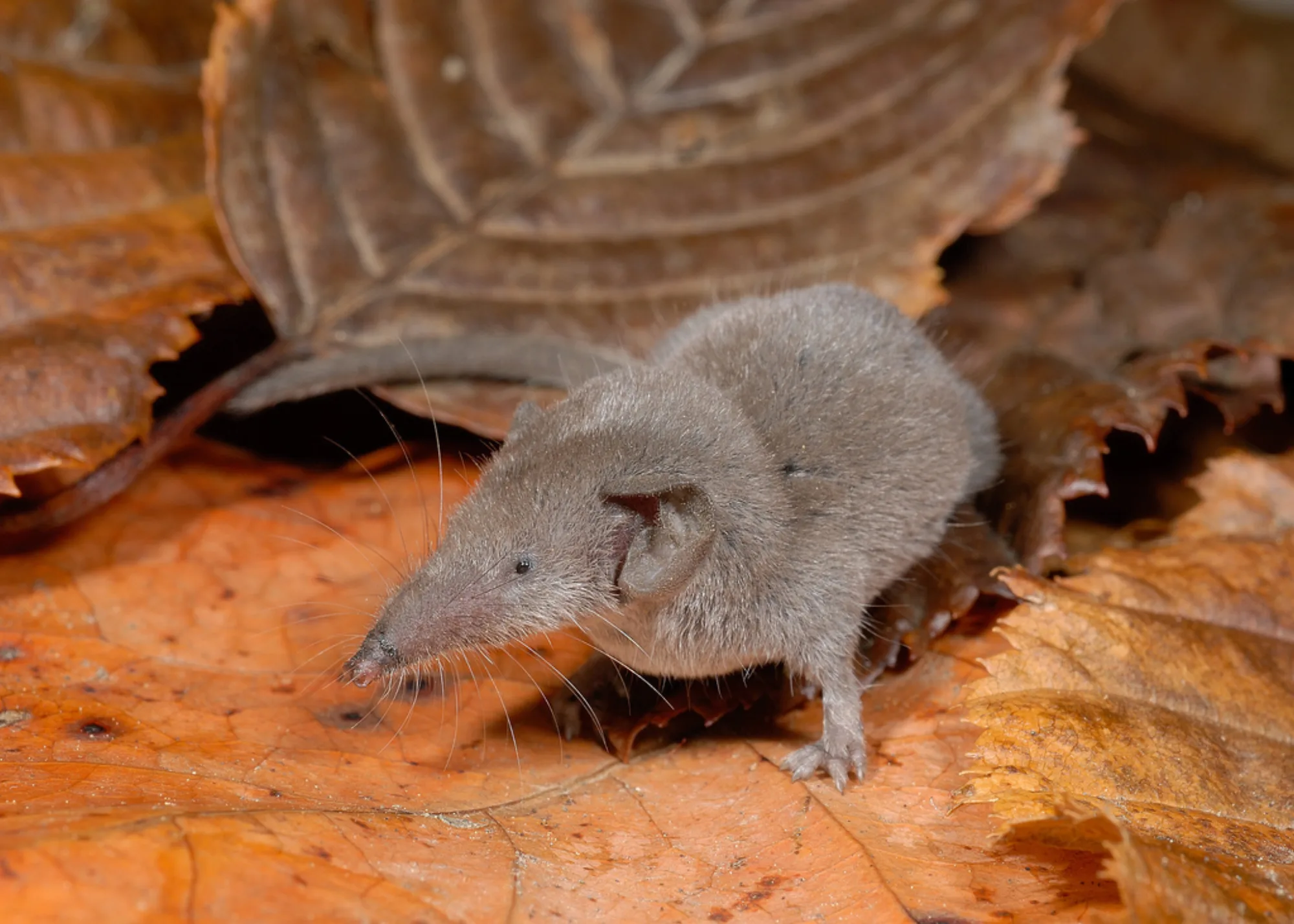
Small enough to weigh about as much as a paperclip, the Etruscan Shrew is the smallest living mammal known by mass, averaging about 1.8 g. Its slender body measures 3 to 5.2 cm, with a tail adding another 2.4 to 3.2 cm. Look for a relatively large head, a long, mobile snout and prominent ears. Its back and sides are pale brown, while its belly is light grey.
The species ranges from southern Europe and North Africa through parts of Asia, including Malaysia, and also occurs on the Maltese islands. It favours warm, damp places with shrubs for cover, including edges where grassland or scrub meets deciduous forest. It also uses thickets beside lakes and rivers, abandoned gardens, orchards, vineyards, olive groves and field edges. Look around rocks, stone walls and ruins, where it darts in and out, although it is generally uncommon. Nests are made in natural shelters, crevices and empty burrows left by other animals.
Etruscan shrews live alone outside the mating season and defend territories with chirps and aggressive signals. They make longer journeys at night, stay near their nest or a hiding place by day, and are most active at dawn. Their fast metabolism demands 1.5 to 2.0 times their body weight in food each day, mostly invertebrates such as insects, larvae and earthworms. They also eat young amphibians, lizards and rodents, and can tackle prey nearly their own size. Litters contain 2 to 6 young, which become independent at three to four weeks old. Farming can destroy nesting sites and habitat, while cold winters, dry periods and birds of prey pose further threats.
Written from the English Wikipedia article Etruscan shrew (CC BY-SA 4.0).
- Records
- 403
- Countries
- 8
No atlas park has a record of the Etruscan Shrew in or around it yet.
These are open occurrence records, so they show where people looked for and recorded the Etruscan Shrew as much as where it lives. Cells are up to 25 km across, and every location is generalised to its cell.
Generalised encounter areas, not exact locations. Each shape is a grid cell coloured by how likely the species is there.
- Very likelyFrance25 km zone · medium confidence · 314 records · updated 80 days ago
- Very likelyThailand25 km zone · medium confidence · 33 records · updated 80 days ago
- Very likelyMadagascar25 km zone · medium confidence · 31 records · updated 80 days ago
- Very likelySwitzerland25 km zone · medium confidence · 15 records · updated 80 days ago
- UncommonSpain25 km zone · medium confidence · 10 records · updated 80 days ago
- UncommonItaly25 km zone · low confidence · 0 records · updated 80 days ago
- RareBulgaria25 km zone · low confidence · 0 records · updated 80 days ago
- RareCroatia25 km zone · low confidence · 0 records · updated 80 days ago
Conservation status not assessed here yet, so every location is generalised to its grid cell.