Masked Booby
Sula dactylatra
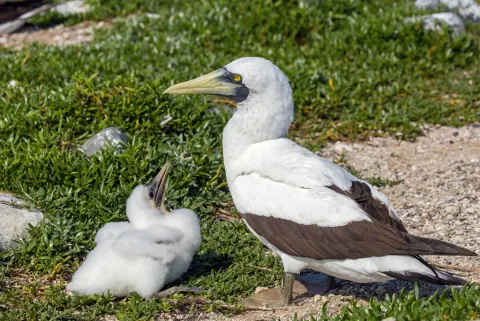
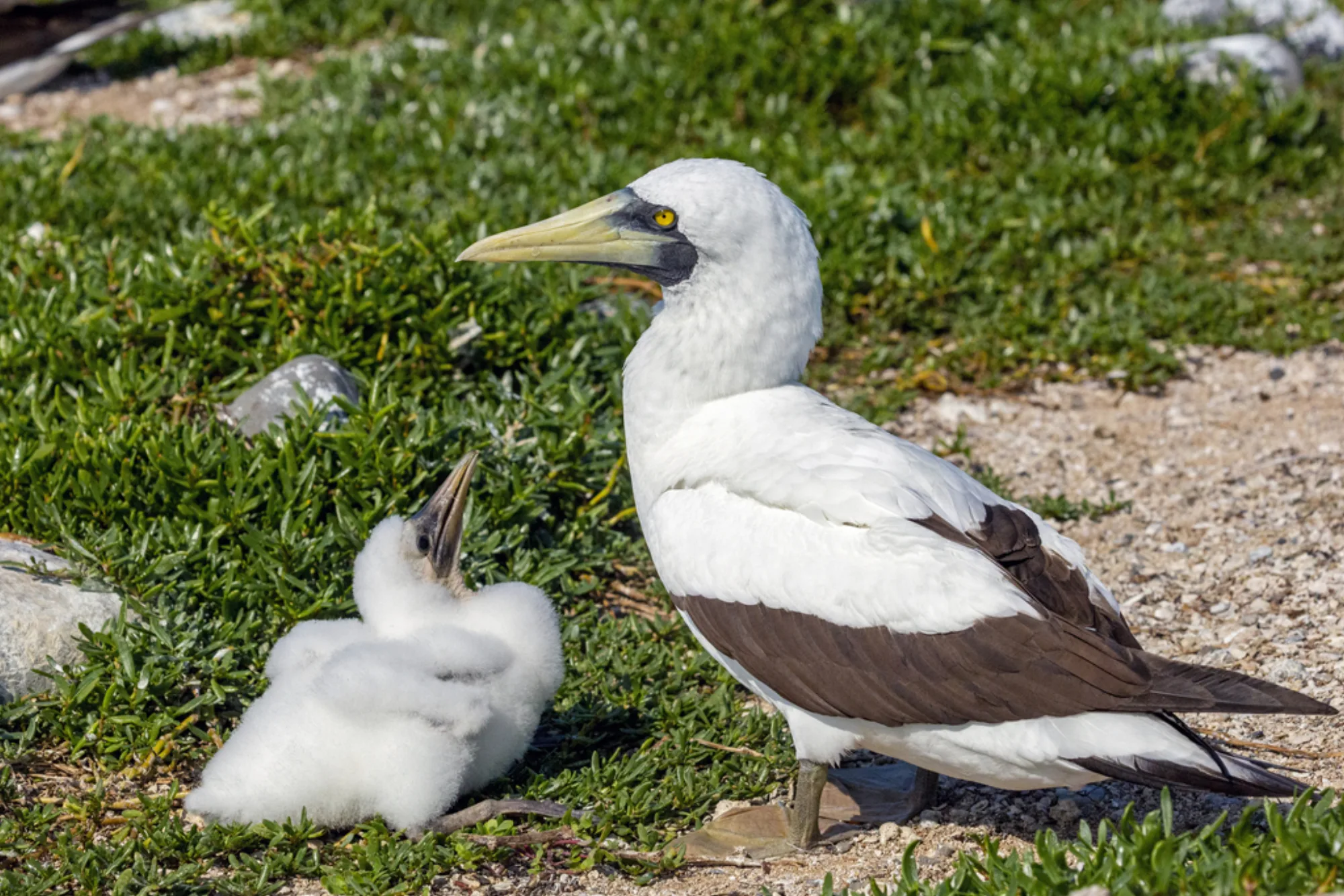
Bright white against tropical seas, the Masked Booby is a large seabird with dark wings and tail, a dark face mask and a long, pointed yellowish bill. Adults measure 75 to 85 cm in length, and males and females look much alike. Young birds have mottled or streaked grey-brown heads and upperparts, dark brown wings and white underparts. At sea, a bird may be seen alone or in a small group returning to its colony, alternating glides with strong wingbeats. Usually quiet over the water, it becomes noisy at nesting colonies, where males whistle and females give a loud honk.
Masked boobies range across tropical oceans, with colonies on remote islands, atolls and cays near deep feeding water. They choose open, generally flat ground above the high-tide line, with access to the ocean. Flying fish and squid are their main food, caught in high-speed dives into the sea. Breeding birds defend their nesting territories, and many pairs stay together across multiple seasons. A shallow scrape holds two chalky white eggs, which both adults incubate. The younger chick almost always dies within a few days, while a surviving youngster depends on its parents for several weeks after leaving the nest.
Gulls and rails take eggs and young, and feral cats have threatened the birds on some islands. Turtles can destroy nests as they cross colonies and dig their own. Rising seas threaten low-lying colonies, while warmer water may reduce food supplies and affect breeding success. The worldwide population is decreasing.
Written from the English Wikipedia article Masked booby (CC BY-SA 4.0).
- Records
- 22,248
- Countries
- 37
- Atlas places
- 4
These are open occurrence records, so they show where people looked for and recorded the Masked Booby as much as where it lives. Cells are up to 25 km across, and every location is generalised to its cell.
Generalised encounter areas, not exact locations. Each shape is a grid cell coloured by how likely the species is there.
- Very likelyUnited States25 km zone · high confidence · 9686 records · updated 80 days ago
- Very likelyAustralia25 km zone · medium confidence · 2695 records · updated 80 days ago
- Very likelyNorfolk Island25 km zone · high confidence · 2684 records · updated 80 days ago
- Very likelyTaiwan25 km zone · medium confidence · 1699 records · updated 80 days ago
- Very likelyOman25 km zone · medium confidence · 843 records · updated 80 days ago
- Very likelyChile25 km zone · high confidence · 670 records · updated 80 days ago
- Very likelyIndia25 km zone · high confidence · 563 records · updated 80 days ago
- Very likelyMexico25 km zone · high confidence · 534 records · updated 80 days ago
- Very likelyU.S. Outlying Islands25 km zone · medium confidence · 512 records · updated 80 days ago
- Very likelySt. Helena25 km zone · medium confidence · 311 records · updated 80 days ago
Conservation status not assessed here yet, so every location is generalised to its grid cell.