Common Starling
Sturnus vulgaris
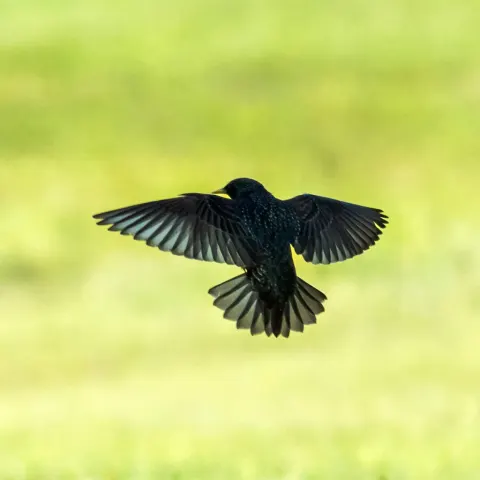
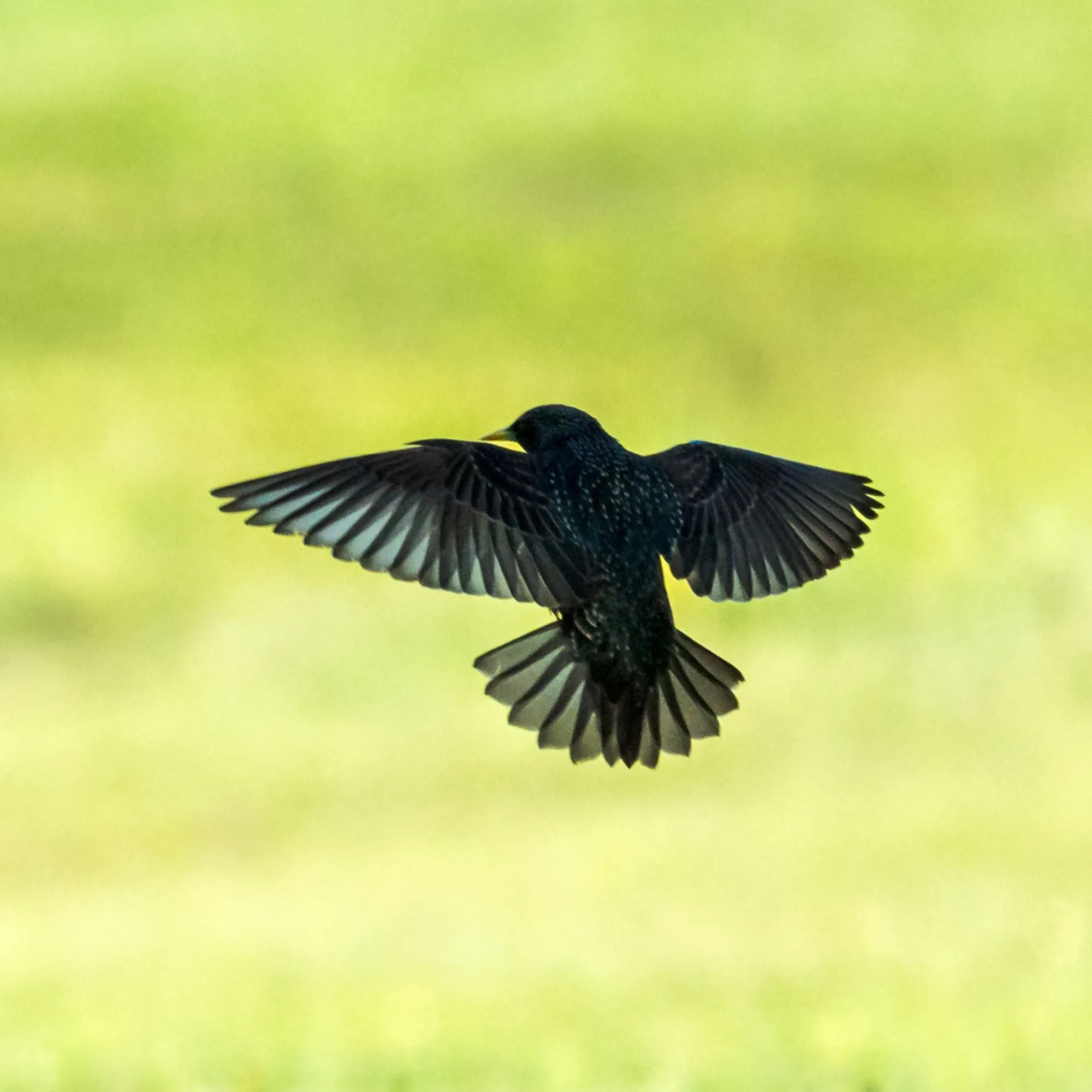
Look for the Common Starling's glossy black feathers, which catch purple or green light and are especially flecked with white in winter. About 20 cm long, it has pink legs and a bill that turns from black in winter to yellow in summer; young birds are browner. On the ground it walks or runs, while in flight its pointed wings and dark colour stand out. Its noisy song can include whistles, clicks and imitations of other birds and human-made sounds.
Native to Eurasia, the starling breeds in open habitats from temperate Europe across the Palearctic to western Mongolia. It has also been introduced to places including Australia, New Zealand, North America and South Africa. Look for it around towns and suburbs, or feeding on short grass in pastures, playing fields and farmland. Some populations stay year-round, while birds from colder regions migrate when winter brings frozen ground and scarce food. In autumn and winter, flocks can gather near roosts and wheel together, changing shape as they fly.
Starlings search for insects on or just below the ground, often among short grass, and also eat seeds and fruit. They nest in cavities, including holes in trees, buildings and nest boxes, usually laying four or five pale blue eggs. Both parents feed the young, which remain in the nest for three weeks. Birds of prey hunt starlings, and introduced populations have been culled. In parts of northern and western Europe, numbers have fallen as intensive farming has reduced pasture and meadow habitat and the grassland invertebrates that chicks need.
Written from the English Wikipedia article Common starling (CC BY-SA 4.0).
- Records
- 7,530,715
- Countries
- 114
- Atlas places
- 7
These are open occurrence records, so they show where people looked for and recorded the Common Starling as much as where it lives. Cells are up to 25 km across, and every location is generalised to its cell.
Generalised encounter areas, not exact locations. Each shape is a grid cell coloured by how likely the species is there.
- Very likelyUnited States25 km zone · high confidence · 5219561 records · updated 86 days ago
- Very likelyCanada25 km zone · high confidence · 1222146 records · updated 86 days ago
- Very likelyAustralia25 km zone · high confidence · 148494 records · updated 86 days ago
- Very likelyUnited Kingdom25 km zone · high confidence · 115090 records · updated 86 days ago
- Very likelyNorway25 km zone · high confidence · 111152 records · updated 86 days ago
- Very likelyBelgium25 km zone · high confidence · 76812 records · updated 86 days ago
- Very likelyNew Zealand25 km zone · high confidence · 56804 records · updated 86 days ago
- Very likelyFrance25 km zone · high confidence · 52071 records · updated today
- Very likelyFinland25 km zone · high confidence · 47089 records · updated today
- Very likelySweden25 km zone · high confidence · 43647 records · updated 86 days ago
Conservation status not assessed here yet, so every location is generalised to its grid cell.