Common Ostrich
Struthio camelus
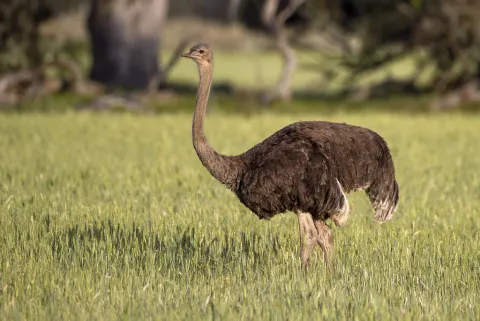
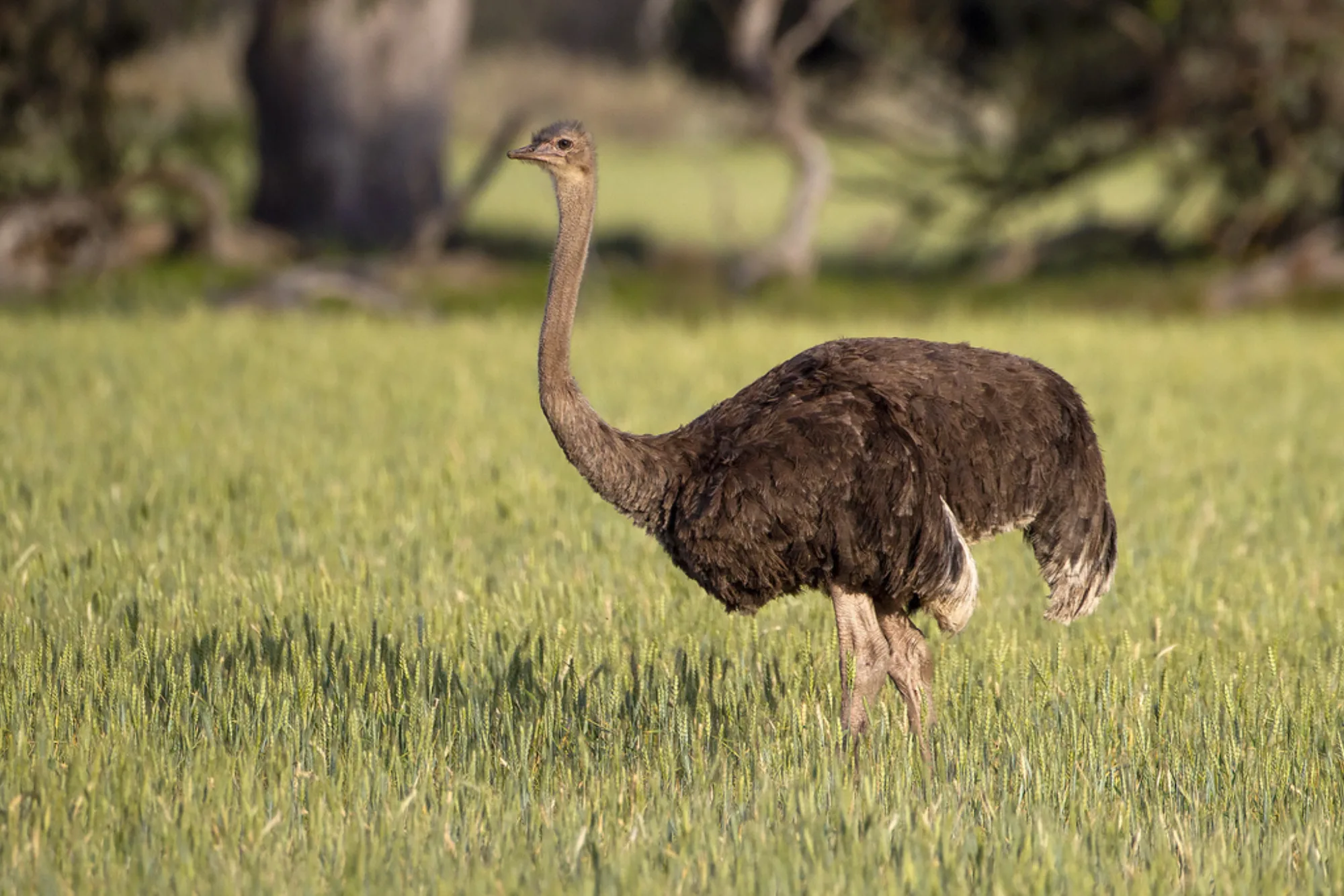
Long legs and a long neck make the Common Ostrich unmistakable on open ground. It is the largest living bird, and although it cannot fly, it can run for long stretches at 55 km/h, with short bursts of about 70 km/h. Adult males are mostly black, with white wing feathers and a white tail; females and young males have white plumage mixed with greyish-brown. Height ranges from 2.1 to 2.75 m in males, while females reach roughly 1.75 to 1.9 m. Native to Africa, these birds favour open ground in the Sahel and savannas, north and south of the equatorial forests. In southwest Africa they also live in semi-desert and desert, while a small feral population lives in the Australian outback.
Ostriches are busiest near the beginning and end of the day, though they may move about on moonlit nights. They usually spend winter alone or in pairs, but gather in roaming groups during the breeding season and sometimes during severe dry spells. These groups often travel with grazing animals such as zebras or antelopes. Their food is mainly seeds, shrubs, grass, fruit and flowers, supplemented at times by insects, small reptiles, rodents and animal remains. They can go for several days without drinking, but bathe frequently where water is available.
Females lay their eggs in a shared nest scraped into the ground by a male. Females incubate by day and males by night; both can help rear the chicks. Lions, leopards and other predators take ostriches, while nests and young are also threatened by jackals, birds of prey and other animals. When danger approaches, an ostrich may run or lie flat to hide, but a cornered bird can strike with a powerful kick. Arabian ostriches disappeared after being hunted, becoming extinct by the mid-20th century.
Written from the English Wikipedia article Common ostrich (CC BY-SA 4.0).
- Records
- 84,054
- Countries
- 22
- Atlas places
- 34
- Kruger National Park· South Africa
- Serengeti National Park· Tanzania
- Kgalagadi Transfrontier Park· South Africa
- Etosha National Park· Namibia
- Ngorongoro Conservation Area· Tanzania
- Namib-Naukluft· Namibia
- Maasai Mara National Reserve· Kenya
- Addo Elephant National Park· South Africa
- Table Mountain National Park· South Africa
- Hwange National Park· Zimbabwe
- Okavango Delta· Botswana
- West Coast National Park· South Africa
- Lake Manyara National Park· Tanzania
- Nairobi National Park· Kenya
- Tarangire National Park· Tanzania
- Tsavo East National Park· Kenya
- Tsavo West National Park· Kenya
- Amboseli National Park· Kenya
- Garden Route National Park· South Africa
- Karoo National Park· South Africa
- Kidepo Valley National Park· Uganda
- Madikwe Game Reserve· South Africa
- Mountain Zebra National Park· South Africa
- Pilanesberg National Park· South Africa
- Aberdare National Park· Kenya
- Bwabwata National Park· Namibia
- Chobe National Park· Botswana
- Golden Gate Highlands National Park· South Africa
- Hell's Gate National Park· Kenya
- iSimangaliso Wetland Park· South Africa
- Kilimanjaro National Park· Tanzania
- Kunene / Kaokoveld· Namibia
- Lake Nakuru National Park· Kenya
- uKhahlamba-Drakensberg Park· South Africa
These are open occurrence records, so they show where people looked for and recorded the Common Ostrich as much as where it lives. Cells are up to 25 km across, and every location is generalised to its cell.
Generalised encounter areas, not exact locations. Each shape is a grid cell coloured by how likely the species is there.
- Very likelySouth Africa25 km zone · high confidence · 55112 records · updated 86 days ago
- Very likelyKenya25 km zone · high confidence · 10386 records · updated 86 days ago
- Very likelyTanzania25 km zone · high confidence · 9478 records · updated 86 days ago
- Very likelyNamibia25 km zone · high confidence · 5627 records · updated 86 days ago
- Very likelyBotswana25 km zone · high confidence · 2228 records · updated 86 days ago
- Very likelyAustralia25 km zone · high confidence · 323 records · updated 86 days ago
- Very likelyZimbabwe25 km zone · high confidence · 299 records · updated today
- Very likelyUganda25 km zone · high confidence · 207 records · updated today
- LikelyEswatini25 km zone · medium confidence · 95 records · updated today
- LikelyMozambique25 km zone · medium confidence · 63 records · updated today
Conservation status not assessed here yet, so every location is generalised to its grid cell.