Barred Owl
Strix varia
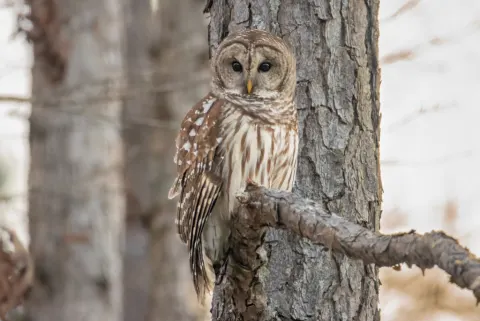
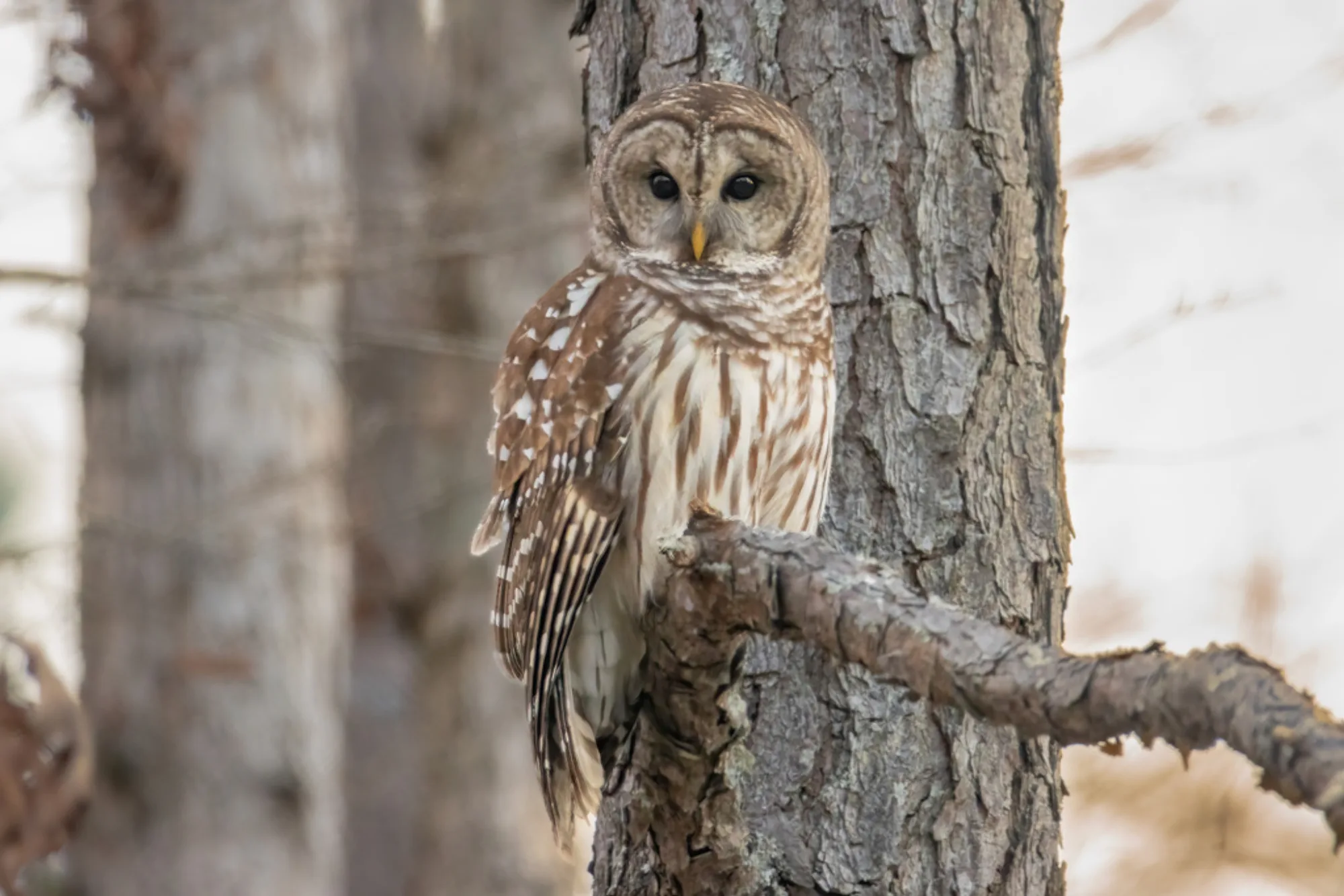
A rounded head without ear tufts and dark eyes that can look black in the field help distinguish the Barred Owl. This large North American owl is greyish-brown, with pale bars across its upper chest and bold vertical streaks on its belly. Adults measure 40 to 63 cm long, and their wings span 96 to 125 cm. Its familiar call has eight accented hoots, ending on a lower note. Calls are most frequent at night, though the owl also calls during the day.
Barred Owls live across much of the eastern United States and southern Canada, and their range has expanded west to the Pacific coast. They favour mature forests, especially old deciduous and mixed woodland, often near water. They also use semi-open woods, large parks with mature trees and some suburban neighbourhoods, though they need large trees for nesting and roosting. By day, an owl may hide in dense foliage or rest close to a broad trunk. It is active mainly at night, but can hunt by day, particularly around early morning or dusk.
Usually hunting from a perch, it glides between positions and drops on small animals, with flight feathers that make its approach nearly silent. Small mammals form the mainstay of its diet, but it also takes birds, amphibians, reptiles, fish and invertebrates. Pairs tend to raise small broods in forested areas, often in a tree hollow or snag. Cars, other collisions and disease can kill Barred Owls, while great horned owls can displace or prey on them. In the west, biologists have recommended culling Barred Owls to reduce their impact on the related spotted owl.
Written from the English Wikipedia article Barred owl (CC BY-SA 4.0).
- Records
- 463,067
- Countries
- 2
- Atlas places
- 4
These are open occurrence records, so they show where people looked for and recorded the Barred Owl as much as where it lives. Cells are up to 25 km across, and every location is generalised to its cell.
Generalised encounter areas, not exact locations. Each shape is a grid cell coloured by how likely the species is there.
- Very likelyUnited States25 km zone · high confidence · 423296 records · updated 80 days ago
- Very likelyCanada25 km zone · high confidence · 39771 records · updated 80 days ago
Conservation status not assessed here yet, so every location is generalised to its grid cell.