Ural Owl
Strix uralensis
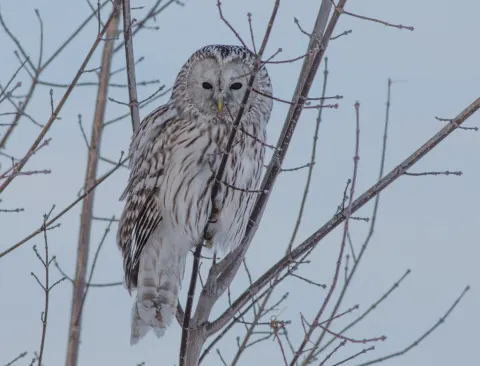
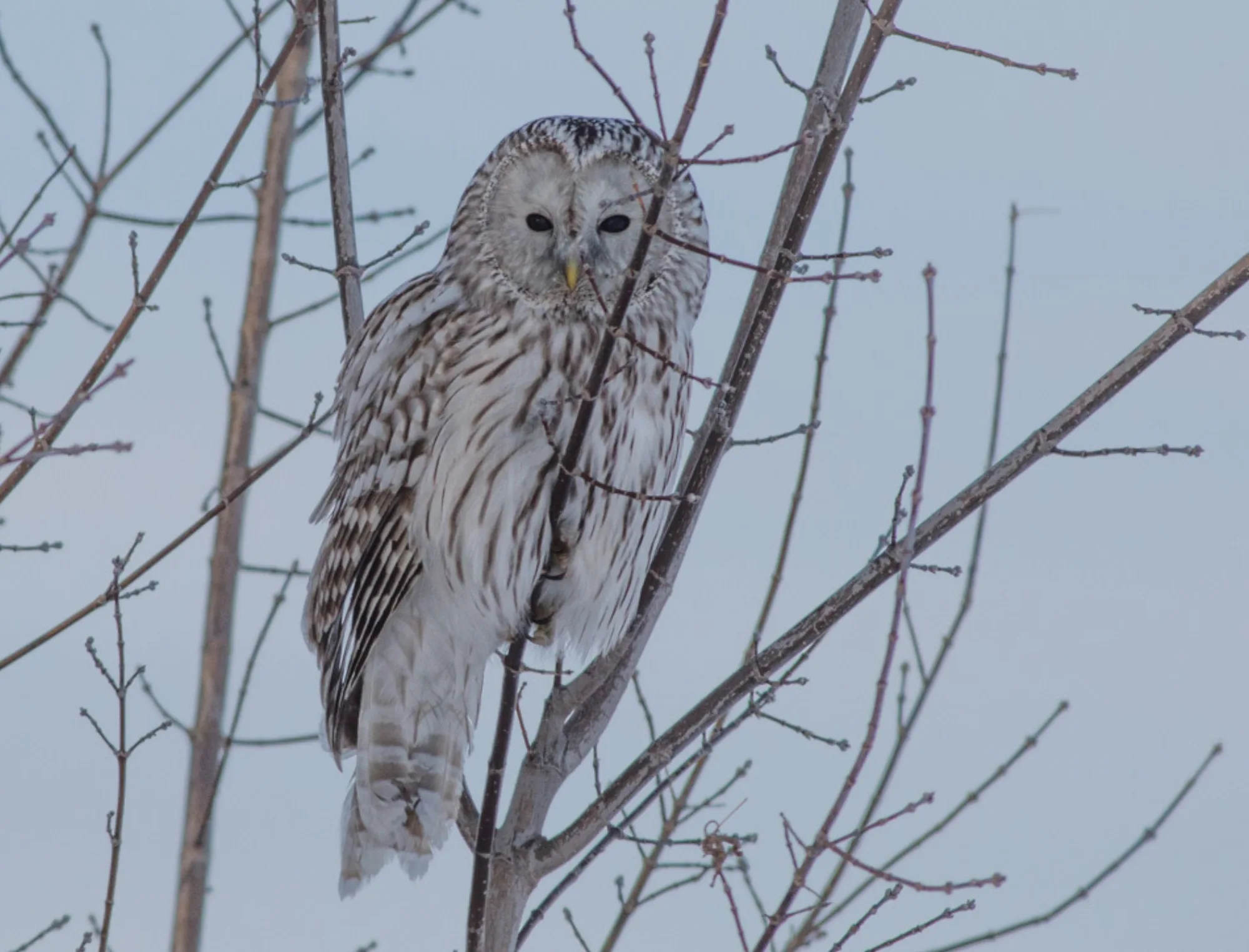
Large and pale, the Ural Owl has a rounded head, dark brown eyes and an unusually long tail with a wedge-shaped tip. Its plumage is usually grey-brown to whitish, with dark streaks on the pale underparts, though colouring varies between individuals. In flight, look for the long, white-tipped tail and the dark bars near the edge and tip of the underwing. Adults measure 50 to 64 cm in length, with a wingspan of 110 to 134 cm.
Its range stretches from Scandinavia and parts of central and eastern Europe across Russia to Sakhalin and Japan. It lives in mature coniferous, mixed and deciduous forests, often favouring places near an opening. In the Carpathians, it favours beech woods with glades and broken trees, while Finnish populations often occupy spruce forest. Although often active around dusk and before dawn, it may also be out in daylight during warmer months while raising young. By day it can rest on a branch near a tree trunk or among dense foliage. The male's deep, rhythmic song may carry up to 2 km, but the species is generally quiet.
Ural owls usually hunt from a perch, dropping onto prey that ventures into open patches of forest. Small mammals, particularly rodents such as voles, are a mainstay, although they also take birds, amphibians and invertebrates. Pairs defend their nesting territory vigorously, using tree cavities, stumps, old nests built by other birds and, in many areas, nest boxes. Breeding success often depends strongly on prey numbers. Forest fragmentation restricts where the owl can live, and some populations have declined or disappeared locally; reintroductions have helped it in central Europe.
Written from the English Wikipedia article Ural owl (CC BY-SA 4.0).
- Records
- 90,033
- Countries
- 2
No atlas park has a record of the Ural Owl in or around it yet.
These are open occurrence records, so they show where people looked for and recorded the Ural Owl as much as where it lives. Cells are up to 25 km across, and every location is generalised to its cell.
Generalised encounter areas, not exact locations. Each shape is a grid cell coloured by how likely the species is there.
- Very likelyFinland25 km zone · high confidence · 89879 records · updated 80 days ago
- LikelyUkraine25 km zone · high confidence · 154 records · updated 80 days ago
Conservation status not assessed here yet, so every location is generalised to its grid cell.