Spotted Owl
Strix occidentalis
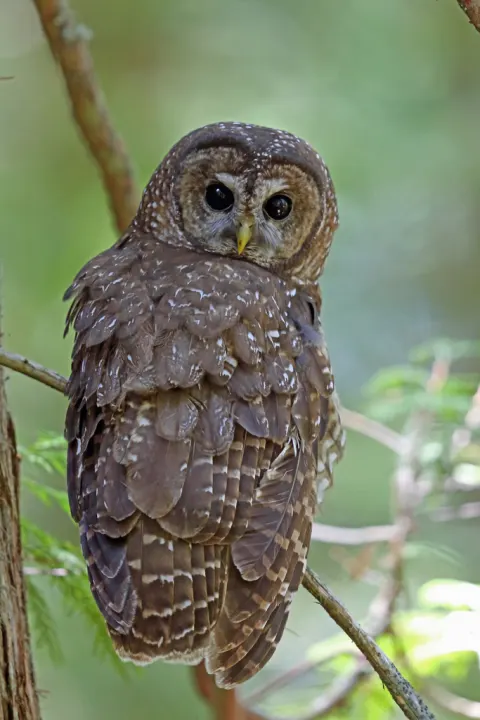
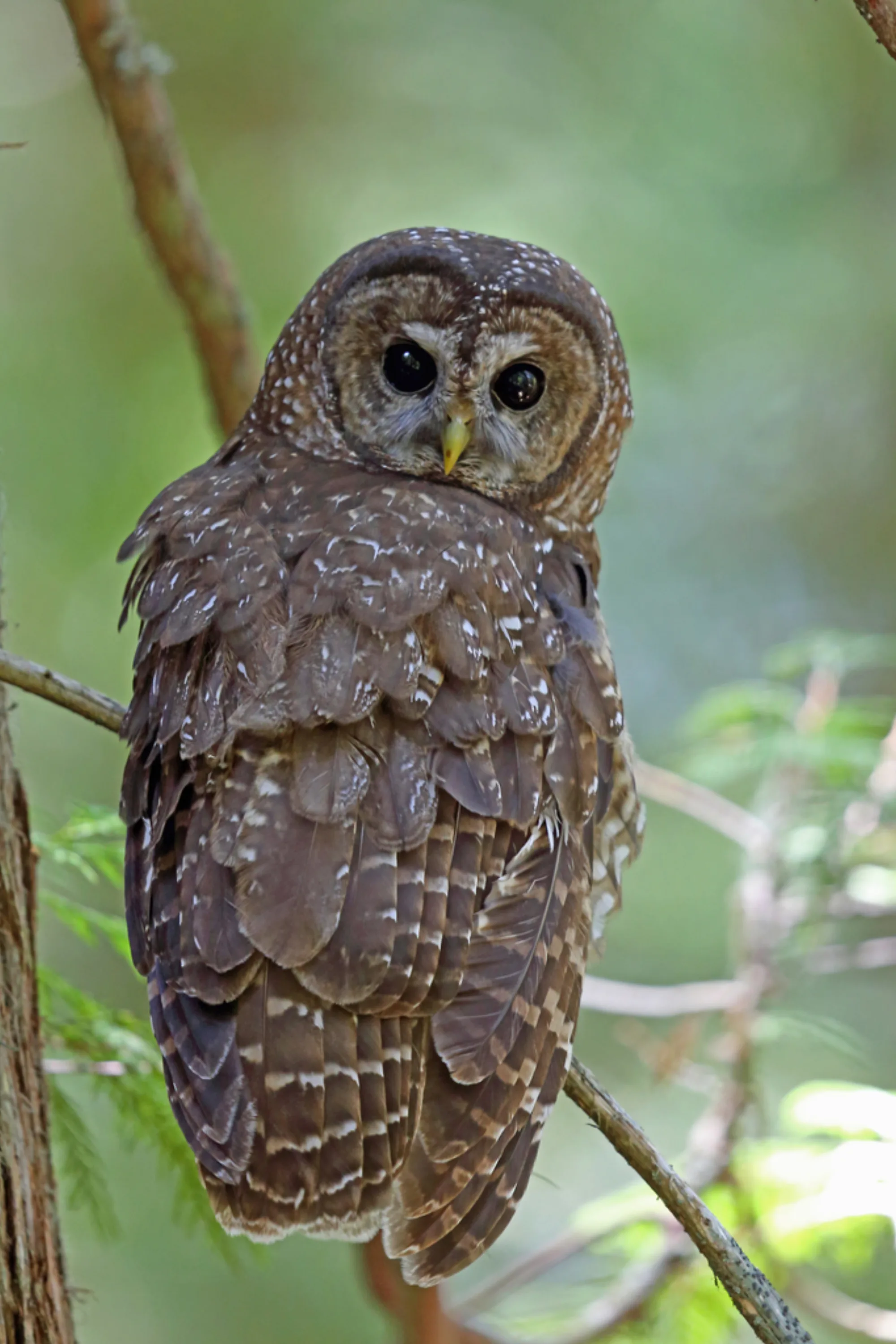
At home in western North America's forests, the Spotted Owl is a nocturnal hunter with cross-shaped markings on its underparts. It averages 43 cm in length, with a wingspan of 114 cm and a weight of 600 g. The similar barred owl is larger and greyer, with bars across its breast and streaks on its belly.
Spotted Owls range from British Columbia to Mexico, occupying hardwood and coniferous forests. They favour old-growth and other mature forests with a closed canopy, and often roost by day in cover like that used for nesting. Large trees are preferred for nesting and roosting, while nearby water and tall shrubs are common features of their habitat. In the southwest, the Mexican subspecies also uses chaparral and pinyon woodlands, sometimes in deep, steep-sided canyons with little canopy cover. California Spotted Owls forage in unlogged forests regenerating after wildfire.
Usually hunting at night, a Spotted Owl waits on a perch before swooping or pouncing, though it sometimes hunts by day. Woodrats are its most common prey overall, and it also takes flying squirrels, other small mammals and birds. Pairs use tree cavities, abandoned nests or rock crevices rather than building nests of their own. A clutch usually holds two eggs, though it can contain four, and the female tends the eggs and young while the male brings food. Young owls become independent three to four months after fledging, then disperse in late summer or autumn. Habitat loss from timber harvesting is the main recognised threat, while competition from barred owls also contributes to declines. Barred owls have displaced northern and California Spotted Owls in parts of their range.
Written from the English Wikipedia article Spotted owl (CC BY-SA 4.0).
- Records
- 255
- Countries
- 2
- Atlas places
- 3
These are open occurrence records, so they show where people looked for and recorded the Spotted Owl as much as where it lives. Cells are up to 25 km across, and every location is generalised to its cell.
Generalised encounter areas, not exact locations. Each shape is a grid cell coloured by how likely the species is there.
- Very likelyUnited States25 km zone · medium confidence · 254 records · updated 80 days ago
- UncommonMexico25 km zone · medium confidence · 1 record · updated 80 days ago
Conservation status not assessed here yet, so every location is generalised to its grid cell.