Great Grey Owl
Strix nebulosa
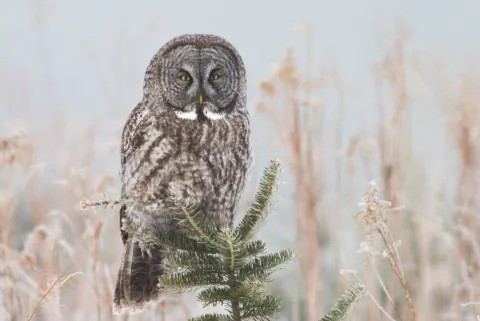
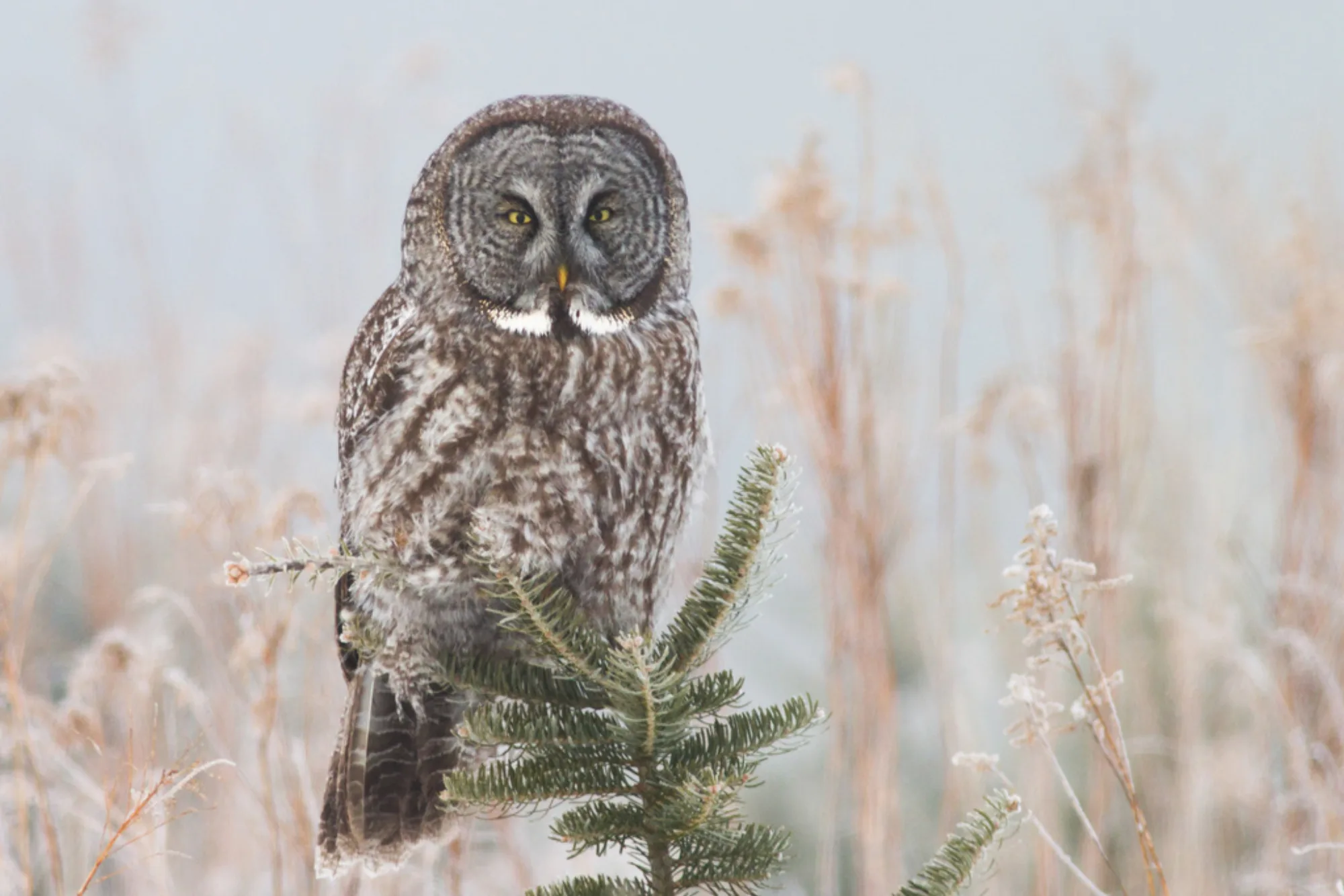
A rounded grey face, yellow eyes ringed with darker feathers and a white bow-tie below the beak give the Great Grey Owl a distinctive look. Its pale underparts are darkly streaked, its grey upperparts barred with pale markings, and its long tail ends in a rounded tip. It has no ear tufts. At 61 to 84 cm long, it is the world's largest owl by length, though its fluffy feathers and large head conceal a relatively light body.
Great Grey Owls live across North America and northern Eurasia. In northern areas, they often breed in dense coniferous taiga near meadows or bogs, while in Oregon and California they have also nested in mixed oak woodland. They can be difficult to spot: an owl may remain still when a person is nearby and often ignores calls played back in its nesting territory. On breeding grounds, it hunts mainly at night and around dawn and dusk, watching and listening from a low perch before swooping. Its hearing can detect prey moving beneath 60 cm of snow. Small rodents make up almost all of its diet, with lemmings, pocket gophers or voles favoured in different areas.
These owls use old nests made by large birds, broken-topped trees or cavities in large trees, and sometimes artificial platforms. Nesting can take place from March to May, but may be skipped when small mammals are scarce or during drought. Timber harvesting threatens nesting trees, cover and hunting perches, while livestock grazing reduces habitat for the owls' preferred prey. Other dangers include rodenticides, vehicle collisions and West Nile virus.
Written from the English Wikipedia article Great grey owl (CC BY-SA 4.0).
- Records
- 5,178
- Countries
- 8
- Atlas places
- 2
These are open occurrence records, so they show where people looked for and recorded the Great Grey Owl as much as where it lives. Cells are up to 25 km across, and every location is generalised to its cell.
Generalised encounter areas, not exact locations. Each shape is a grid cell coloured by how likely the species is there.
- Very likelyFinland25 km zone · high confidence · 4394 records · updated 80 days ago
- Very likelyNorway25 km zone · medium confidence · 436 records · updated 80 days ago
- Very likelyUnited States25 km zone · medium confidence · 110 records · updated 80 days ago
- Very likelyUkraine25 km zone · medium confidence · 81 records · updated 80 days ago
- Very likelyRussia25 km zone · medium confidence · 69 records · updated 80 days ago
- LikelyCanada25 km zone · medium confidence · 75 records · updated 80 days ago
- LikelySweden25 km zone · medium confidence · 7 records · updated 80 days ago
- LikelyEstonia25 km zone · medium confidence · 6 records · updated 80 days ago
Conservation status not assessed here yet, so every location is generalised to its grid cell.