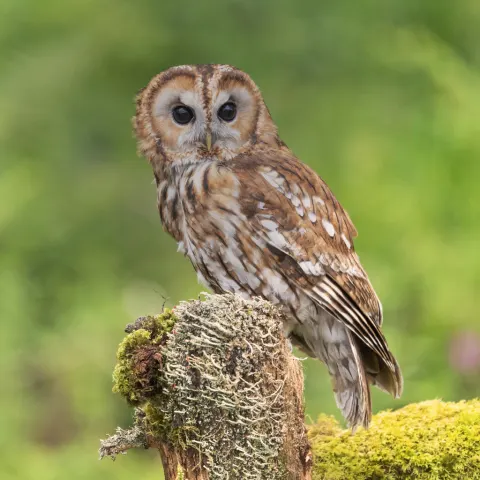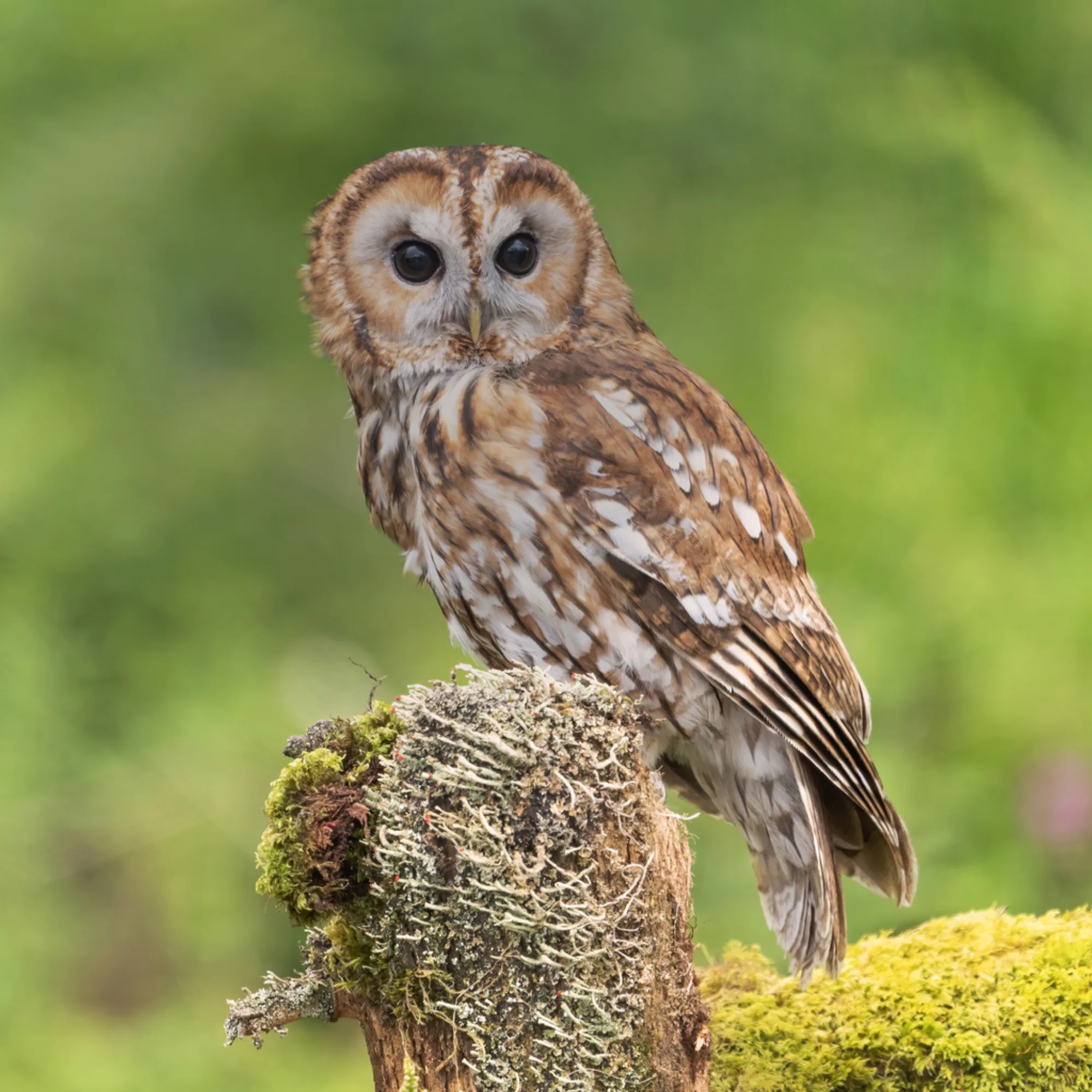
Tawny Owl
Strix aluco
Stocky and round-headed, the Tawny Owl (Strix aluco) has dark brown eyes and no ear tufts. Its upper body can be brown or grey, while its pale underparts are marked with dark streaks. It measures 37 to 46 cm in length, with broad, rounded wings spanning 81 to 105 cm. Its familiar double hoot is a duet: the female calls and the male responds.
This owl lives year-round across a discontinuous range from Great Britain and the Iberian Peninsula east to western Siberia. It favours deciduous and mixed forests, sometimes uses mature conifer plantations, and prefers places with access to water. Gardens, parks and cemeteries have helped it settle in urban areas, including central London, though it is less likely to occur where nights are noisy. During the day, pairs sit sheltered on branches close to tree trunks. At night, the owl keeps watch while perched, then swoops or glides down silently to catch its prey. Woodland rodents are its main food, but it also eats birds, other mammals, earthworms and beetles; birds make up more of its diet in towns and cities.
Pairs defend a territory throughout the year and usually stay together for life. They typically nest in a tree hole, although they also use old magpie nests, squirrel dreys, holes in buildings and nest boxes. A typical clutch contains two or three eggs, and the young leave the nest before they can fly, hiding on nearby branches. Young owls that cannot find a vacant territory often starve. Predators include large birds of prey, while pine martens may raid nests and red foxes can kill newly fledged young. Prolonged wet weather can prevent effective hunting, and the species is increasingly affected by avian malaria.
Written from the English Wikipedia article Tawny owl (CC BY-SA 4.0).
- Records
- 192,457
- Countries
- 11
No atlas park has a record of the Tawny Owl in or around it yet.
These are open occurrence records, so they show where people looked for and recorded the Tawny Owl as much as where it lives. Cells are up to 25 km across, and every location is generalised to its cell.
Generalised encounter areas, not exact locations. Each shape is a grid cell coloured by how likely the species is there.
- Very likelyFinland25 km zone · high confidence · 55464 records · updated 80 days ago
- Very likelyNorway25 km zone · high confidence · 36452 records · updated 80 days ago
- Very likelyBelgium25 km zone · high confidence · 23261 records · updated 80 days ago
- Very likelyFrance25 km zone · high confidence · 20338 records · updated 80 days ago
- Very likelySweden25 km zone · high confidence · 19179 records · updated 80 days ago
- Very likelyUnited Kingdom25 km zone · high confidence · 17971 records · updated 80 days ago
- Very likelyNetherlands25 km zone · high confidence · 13271 records · updated 80 days ago
- Very likelySpain25 km zone · high confidence · 4875 records · updated 80 days ago
- Very likelyPortugal25 km zone · high confidence · 1106 records · updated 80 days ago
- Very likelyGermany25 km zone · high confidence · 540 records · updated 80 days ago
Conservation status not assessed here yet, so every location is generalised to its grid cell.