Kakapo
Strigops habroptila
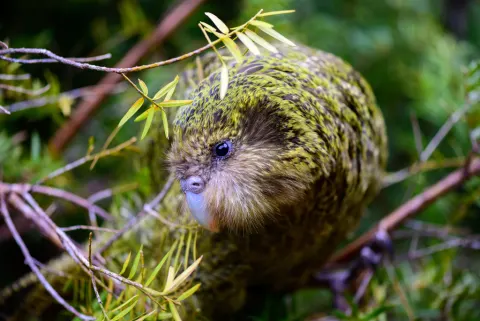
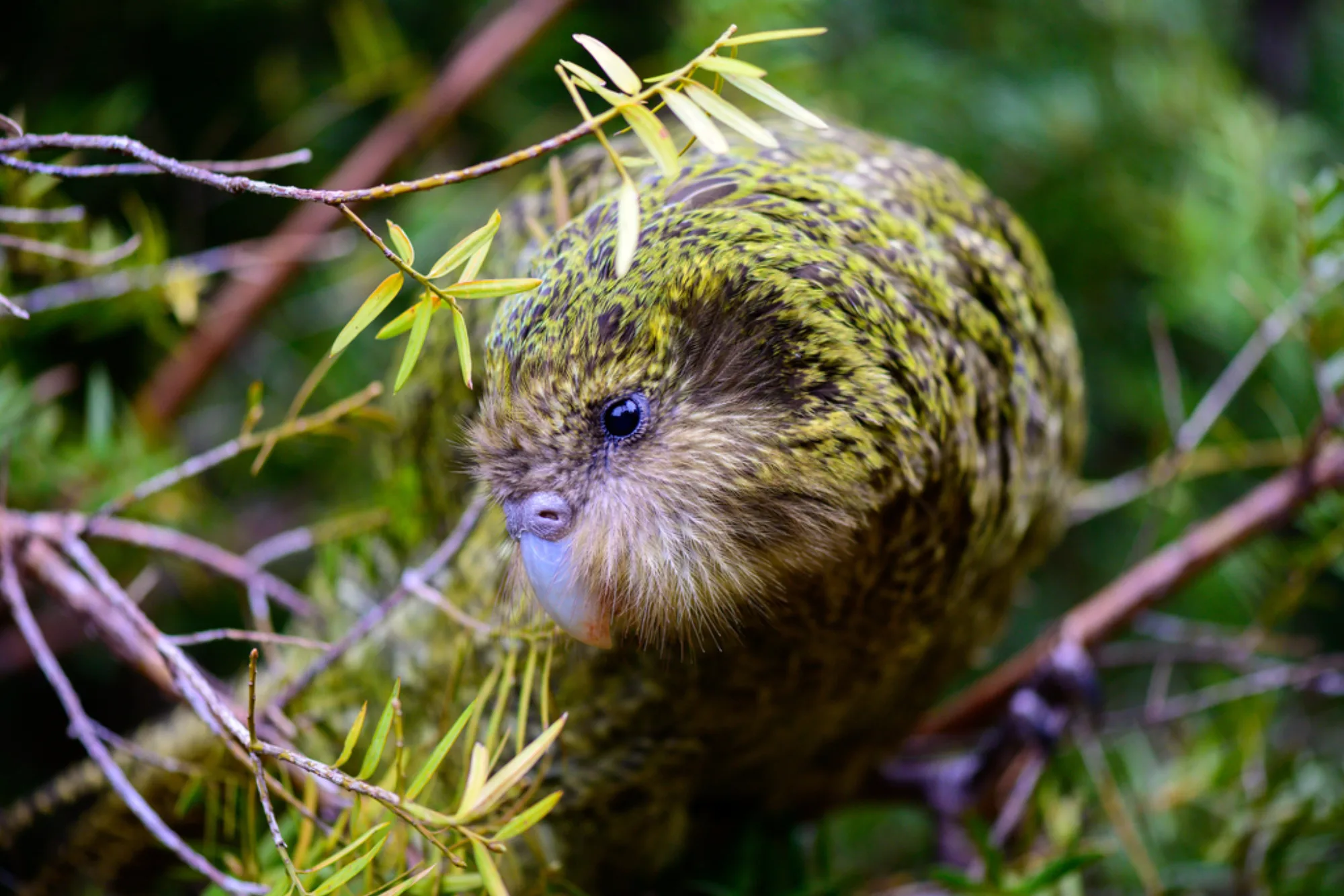
With its round body, owl-like face and soft, mottled plumage, the Kakapo is a parrot unlike any other. It is the world's only flightless parrot and its heaviest, reaching 58 to 64 cm in length. Yellowish moss-green feathers, marked with black or dark brownish grey, help it blend into native vegetation. Its large feet and strong claws are useful for climbing, and it uses its wings for balance as it ascends trees.
This New Zealand bird once lived across a wide range of habitats, from coastal areas and scrubland to forests. It appears to have favoured wet forests with mild winters, including those with broadleaf trees, mountain beech and Hall's tōtara. Known birds now live on four small islands cleared of predators, and a reintroduction to Sanctuary Mountain Maungatautari on the mainland took place in 2023. Mostly active at night, Kakapo shelter under cover by day and move through their territories after dark. They are solitary and eat plant foods including fruit, seeds, leaves and stems. Their feeding can leave distinctive clumps of discarded plant fibre in the vegetation.
Breeding is infrequent and tied to years when trees produce abundant fruit. Males gather on hilltops and ridges, where their low booming calls can carry for kilometres, while females nest on the ground beneath plants or in hollows. Introduced cats, rats, ferrets and stoats nearly wiped out the species, and predators can kill adults and chicks or eat eggs. Past hunting and vegetation clearance also reduced its numbers and habitat. Low genetic diversity brings further problems, including reduced disease resistance and infertility.
Written from the English Wikipedia article Kākāpō (CC BY-SA 4.0).
- Records
- 155
- Countries
- 1
- Atlas places
- 2
These are open occurrence records, so they show where people looked for and recorded the Kakapo as much as where it lives. Cells are up to 25 km across, and every location is generalised to its cell.
Generalised encounter areas, not exact locations. Each shape is a grid cell coloured by how likely the species is there.
- Very likelyNew Zealand25 km zone · high confidence · 155 records · updated 80 days ago
Conservation status not assessed here yet, so every location is generalised to its grid cell.