European Turtle Dove
Streptopelia turtur
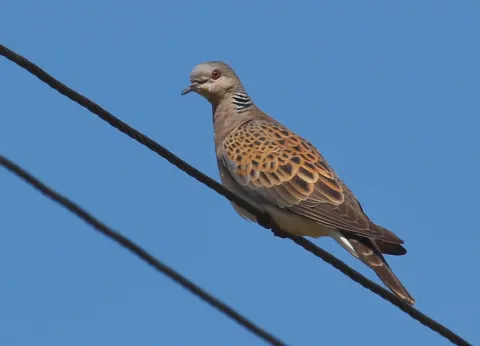
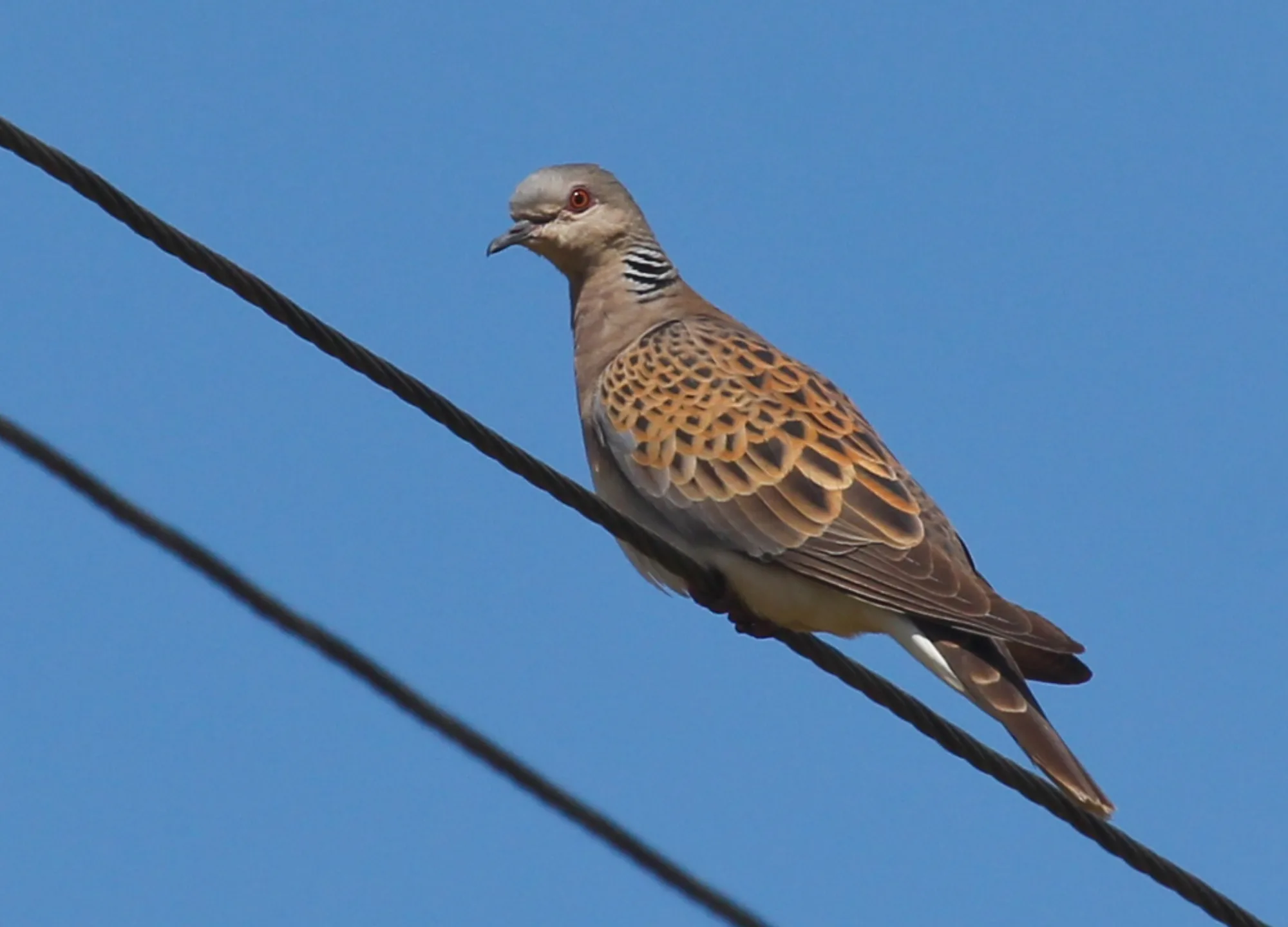
Slimmer than many other doves, the European Turtle Dove has brown colouring and a distinctive black-and-white striped patch on each side of its neck. Adults have blue-grey heads and cinnamon-coloured wings mottled with black, while younger birds are browner and duller and lack the neck patch. Look for the wedge-shaped tail as the bird flies away: it has a dark centre with white edges and tips. In spring, its deep, vibrating coo sounds like “turrr, turrr”.
The species ranges across most of Europe and the Middle East, including Turkey and north Africa, though sightings are uncommon in Russia and northern Scandinavia. It favours open woodland over dense woodland and often feeds on the ground. Usually extremely timid, it occasionally nests in large gardens. A migrant, it spends winter south of the Sahara and rarely reaches northern Europe before the end of April, then heads south again in September. It flies with an arrow-like shape, though without particular speed. Weed seeds and shoots, particularly fumitory, form part of its diet.
Turtle dove numbers have fallen rapidly across Europe, with farming changes reducing the supply of the seeds and shoots they eat. Shooting in Mediterranean countries has also contributed to the decline, while habitat loss, drought, climate change and competition with the collared dove are potential threats. Trichomonosis parasites are another threat. Following a temporary hunting ban in France, Spain and Portugal, breeding numbers in western Europe rose by about 47% between 2021 and 2025. Populations on central and eastern European breeding grounds continued to decline while hunting continued there.
Written from the English Wikipedia article European turtle dove (CC BY-SA 4.0).
- Records
- 139,889
- Countries
- 24
No atlas park has a record of the European Turtle Dove in or around it yet.
These are open occurrence records, so they show where people looked for and recorded the European Turtle Dove as much as where it lives. Cells are up to 25 km across, and every location is generalised to its cell.
Generalised encounter areas, not exact locations. Each shape is a grid cell coloured by how likely the species is there.
- Very likelyFrance25 km zone · high confidence · 47031 records · updated 80 days ago
- Very likelySpain25 km zone · high confidence · 24167 records · updated 80 days ago
- Very likelyIsrael25 km zone · high confidence · 20471 records · updated 80 days ago
- Very likelyBelgium25 km zone · high confidence · 11073 records · updated 80 days ago
- Very likelyPortugal25 km zone · high confidence · 8572 records · updated 80 days ago
- Very likelyUnited Kingdom25 km zone · high confidence · 5756 records · updated 80 days ago
- Very likelyPalestinian Territories25 km zone · high confidence · 5652 records · updated 80 days ago
- Very likelyGreece25 km zone · high confidence · 2177 records · updated 80 days ago
- Very likelyHungary25 km zone · high confidence · 1871 records · updated 80 days ago
- Very likelyUnited Arab Emirates25 km zone · high confidence · 1787 records · updated 80 days ago
Conservation status not assessed here yet, so every location is generalised to its grid cell.