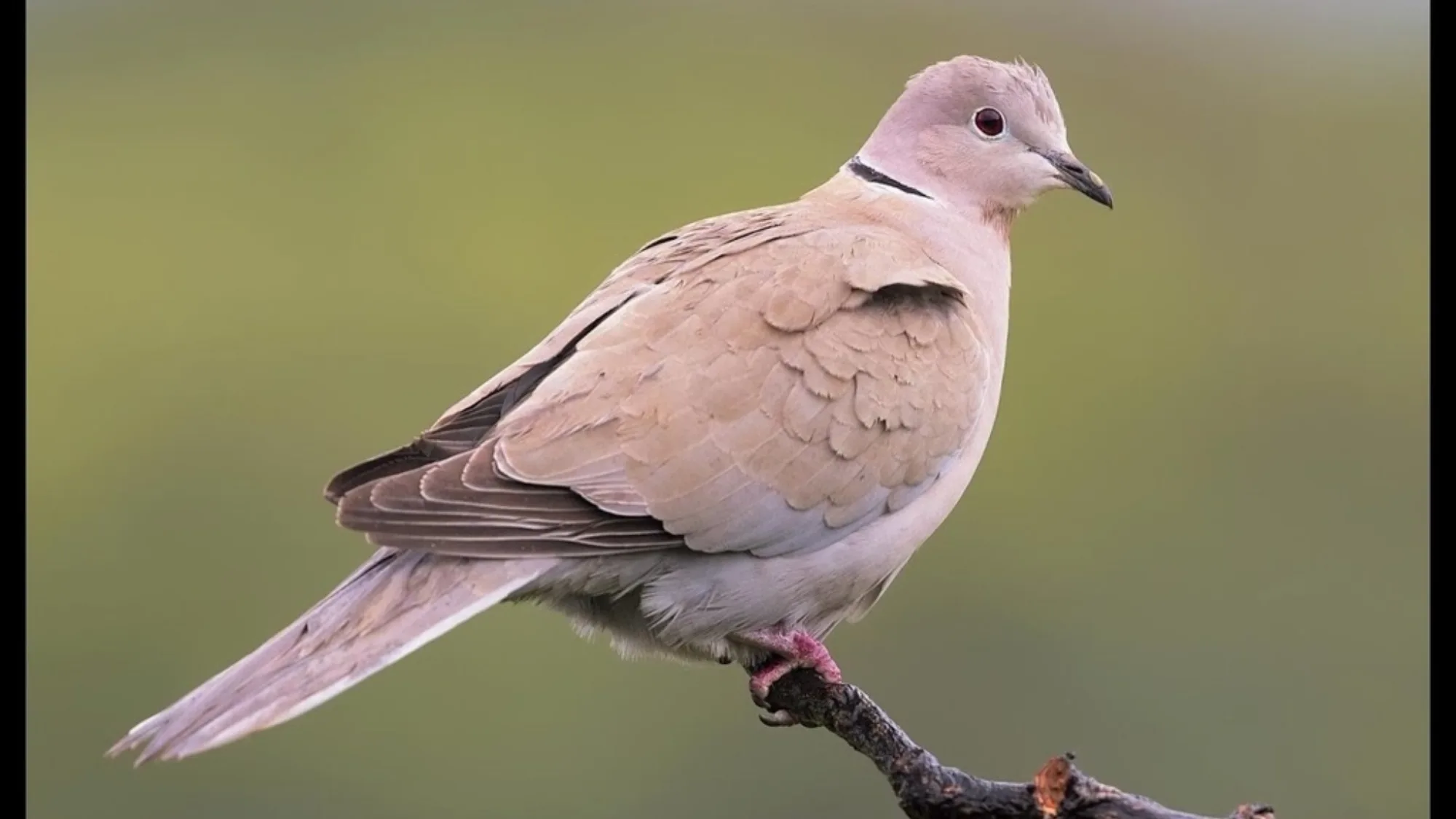
Eurasian Collared Dove
Streptopelia decaocto
A soft three-note coo can draw attention to the Eurasian Collared Dove, a medium-sized bird with grey-buff to pinkish-grey plumage. Look for the black half-collar, edged in white, on the back of its neck. Its upperparts are slightly darker than its underparts, and its short legs are red. In flight, it may give a loud, harsh screech shortly before landing. Young birds have a less developed collar than adults.
Native to Europe, Asia and North Africa, the dove has been introduced elsewhere, including Japan, parts of the Americas and some Caribbean islands. It has spread well beyond its original range and now occurs across much of Europe, nearly every US state and Mexico. Look for it near homes and farms, especially where food is plentiful and trees offer nesting places. Farms can support large populations where grain is spilt around stores or livestock feeding areas. Sociable birds gather around food in winter, eating grain, seeds, shoots and insects. Flocks usually contain 10 to 50 birds, although much larger gatherings have been seen.
Pairs share the work of raising young in a nest made of sticks, where the female lays two white eggs. Incubation takes 14 to 18 days, and the young leave the nest after 15 to 19 days. Where food is abundant, breeding can take place throughout the year, though it is rare in winter in regions with cold winters. In Britain, numbers have fallen since 2005, possibly because of finch trichomonosis; by 2026, the decline had reached 40%.
Written from the English Wikipedia article Eurasian collared dove (CC BY-SA 4.0).
- Records
- 2,454,974
- Countries
- 133
- Atlas places
- 7
These are open occurrence records, so they show where people looked for and recorded the Eurasian Collared Dove as much as where it lives. Cells are up to 25 km across, and every location is generalised to its cell.
Generalised encounter areas, not exact locations. Each shape is a grid cell coloured by how likely the species is there.
- Very likelyUnited States25 km zone · high confidence · 1516502 records · updated 86 days ago
- Very likelyBelgium25 km zone · high confidence · 97038 records · updated 86 days ago
- Very likelyFrance25 km zone · high confidence · 86304 records · updated 86 days ago
- Very likelyPortugal25 km zone · high confidence · 75873 records · updated 86 days ago
- Very likelyUnited Kingdom25 km zone · high confidence · 69605 records · updated 86 days ago
- Very likelySpain25 km zone · high confidence · 68429 records · updated 86 days ago
- Very likelyCanada25 km zone · high confidence · 51761 records · updated 86 days ago
- Very likelyIndia25 km zone · high confidence · 45386 records · updated 86 days ago
- Very likelyIsrael25 km zone · high confidence · 34760 records · updated 86 days ago
- Very likelyPalestinian Territories25 km zone · high confidence · 28928 records · updated 86 days ago
Conservation status not assessed here yet, so every location is generalised to its grid cell.