Leopard Tortoise
Stigmochelys pardalis
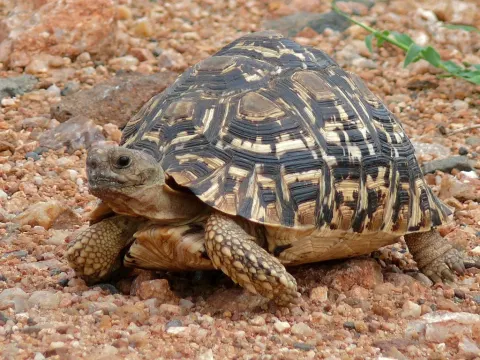
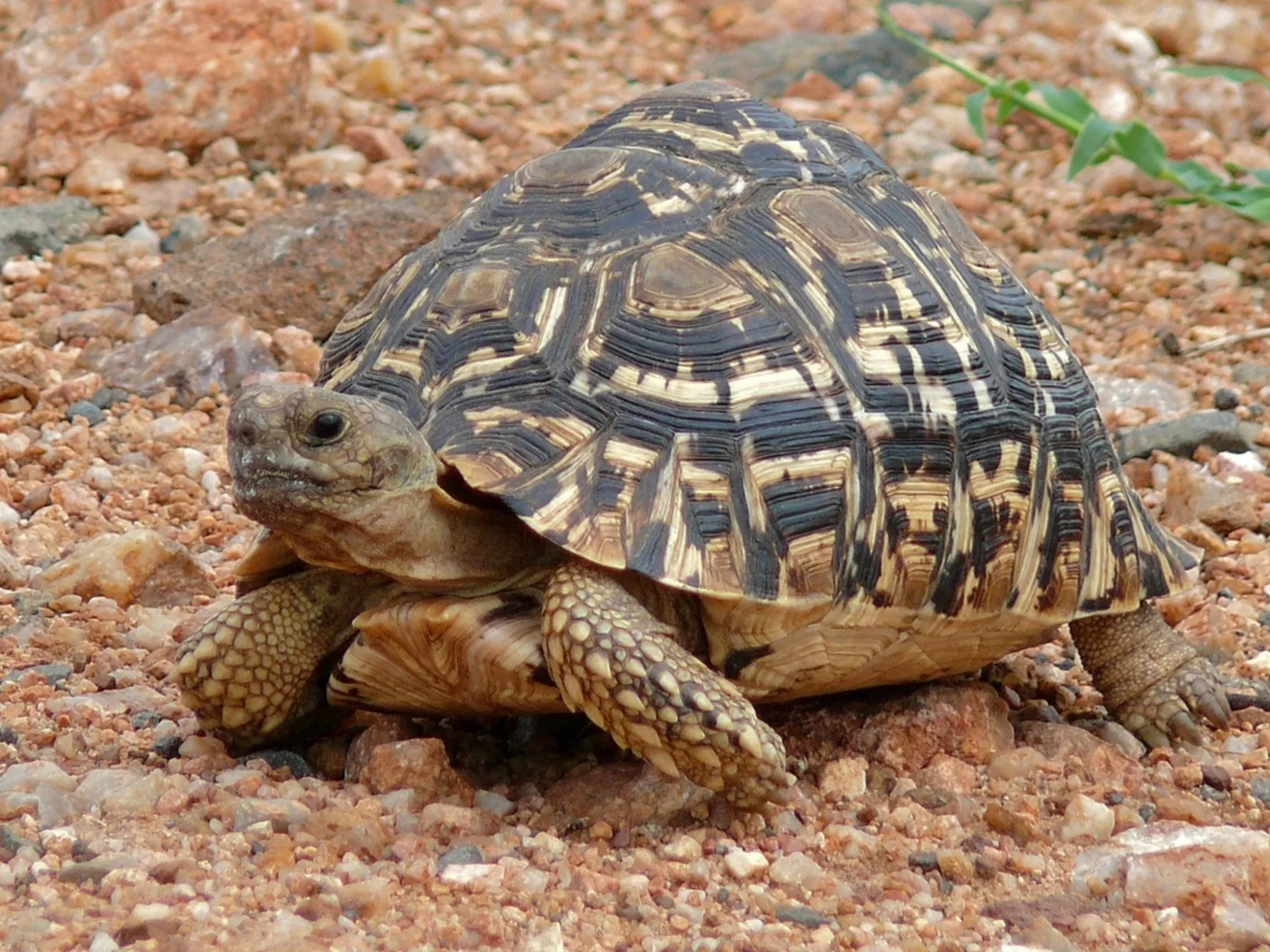
A high, domed shell and a pattern of dark marks on yellow make the Leopard Tortoise a distinctive sight in eastern and southern Africa. Young animals can have black blotches, spots, dashes or stripes, although the pattern tends to fade to brown or grey as they mature. The head and limbs are yellow, tan or brown. Typical adults reach 40 cm and weigh 13 kg, while exceptionally large individuals can reach 70 cm and 40 kg.
Its range extends across East Africa, with South Sudan and Somalia at its northern end and South Africa and Namibia farther south. It lives in grasslands, thorn-scrub, brushland and savannas, from sea level to 2,900 m. Usually active during the day, it slows down in hot weather or the dry season. In very hot or cold conditions, it may shelter in an abandoned fox, jackal or aardvark burrow. It grazes on grasses and also eats thistles, succulents and other plants, along with fruit when available. Some seeds pass through undigested, helping to disperse them.
Males fight over females during the breeding season, ramming and butting their rivals. Between May and October, a female digs a nest and lays five to 30 eggs; she may lay five to seven clutches in a season. Eggs and hatchlings face predators including rock monitors, puff adders, jackals and crows, while lions and hyenas occasionally prey on adults. Agricultural burning, consumption and commercial collection for the pet trade are potential threats, though these have not yet caused significant population declines. Captive breeding for the pet trade is increasing, reducing collection from the wild.
Written from the English Wikipedia article Leopard tortoise (CC BY-SA 4.0).
- Records
- 605
- Countries
- 9
- Atlas places
- 37
- Kruger National Park· South Africa
- Addo Elephant National Park· South Africa
- Garden Route National Park· South Africa
- Serengeti National Park· Tanzania
- Etosha National Park· Namibia
- Ngorongoro Conservation Area· Tanzania
- Table Mountain National Park· South Africa
- Tarangire National Park· Tanzania
- Tsavo East National Park· Kenya
- Tsavo West National Park· Kenya
- Chobe National Park· Botswana
- Hluhluwe-iMfolozi Park· South Africa
- iSimangaliso Wetland Park· South Africa
- Maasai Mara National Reserve· Kenya
- Nairobi National Park· Kenya
- Okavango Delta· Botswana
- Central Kalahari Game Reserve· Botswana
- Hwange National Park· Zimbabwe
- Karoo National Park· South Africa
- Kgalagadi Transfrontier Park· South Africa
- Lake Nakuru National Park· Kenya
- Pilanesberg National Park· South Africa
- Arusha National Park· Tanzania
- Augrabies Falls National Park· South Africa
- Bwabwata National Park· Namibia
- Gonarezhou National Park· Zimbabwe
- Lake Manyara National Park· Tanzania
- Lower Zambezi National Park· Zambia
- Makgadikgadi Pans National Park· Botswana
- Mana Pools National Park· Zimbabwe
- Matobo National Park· Zimbabwe
- Namib-Naukluft· Namibia
- Nkasa Rupara National Park· Namibia
- Ruaha National Park· Tanzania
- Samburu National Reserve· Kenya
- West Coast National Park· South Africa
- Zambezi National Park· Zimbabwe
These are open occurrence records, so they show where people looked for and recorded the Leopard Tortoise as much as where it lives. Cells are up to 25 km across, and every location is generalised to its cell.
Generalised encounter areas, not exact locations. Each shape is a grid cell coloured by how likely the species is there.
- Very likelySouth Africa25 km zone · medium confidence · 478 records · updated 80 days ago
- Very likelyKenya25 km zone · medium confidence · 43 records · updated 80 days ago
- Very likelyTanzania25 km zone · medium confidence · 29 records · updated 80 days ago
- Very likelyNamibia25 km zone · medium confidence · 25 records · updated 80 days ago
- Very likelyBotswana25 km zone · medium confidence · 15 records · updated 80 days ago
- LikelyZimbabwe25 km zone · medium confidence · 9 records · updated 80 days ago
- LikelyEswatini25 km zone · medium confidence · 3 records · updated 80 days ago
- PossibleEthiopia25 km zone · medium confidence · 2 records · updated 80 days ago
- PossibleZambia25 km zone · medium confidence · 1 record · updated 80 days ago
Conservation status not assessed here yet, so every location is generalised to its grid cell.