Great Skua
Stercorarius skua
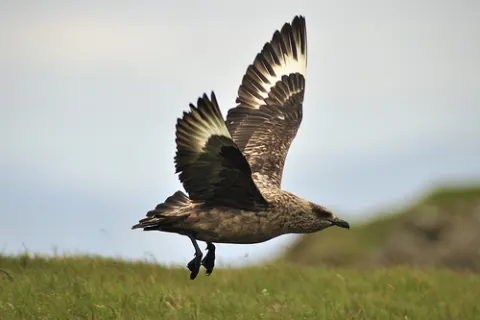
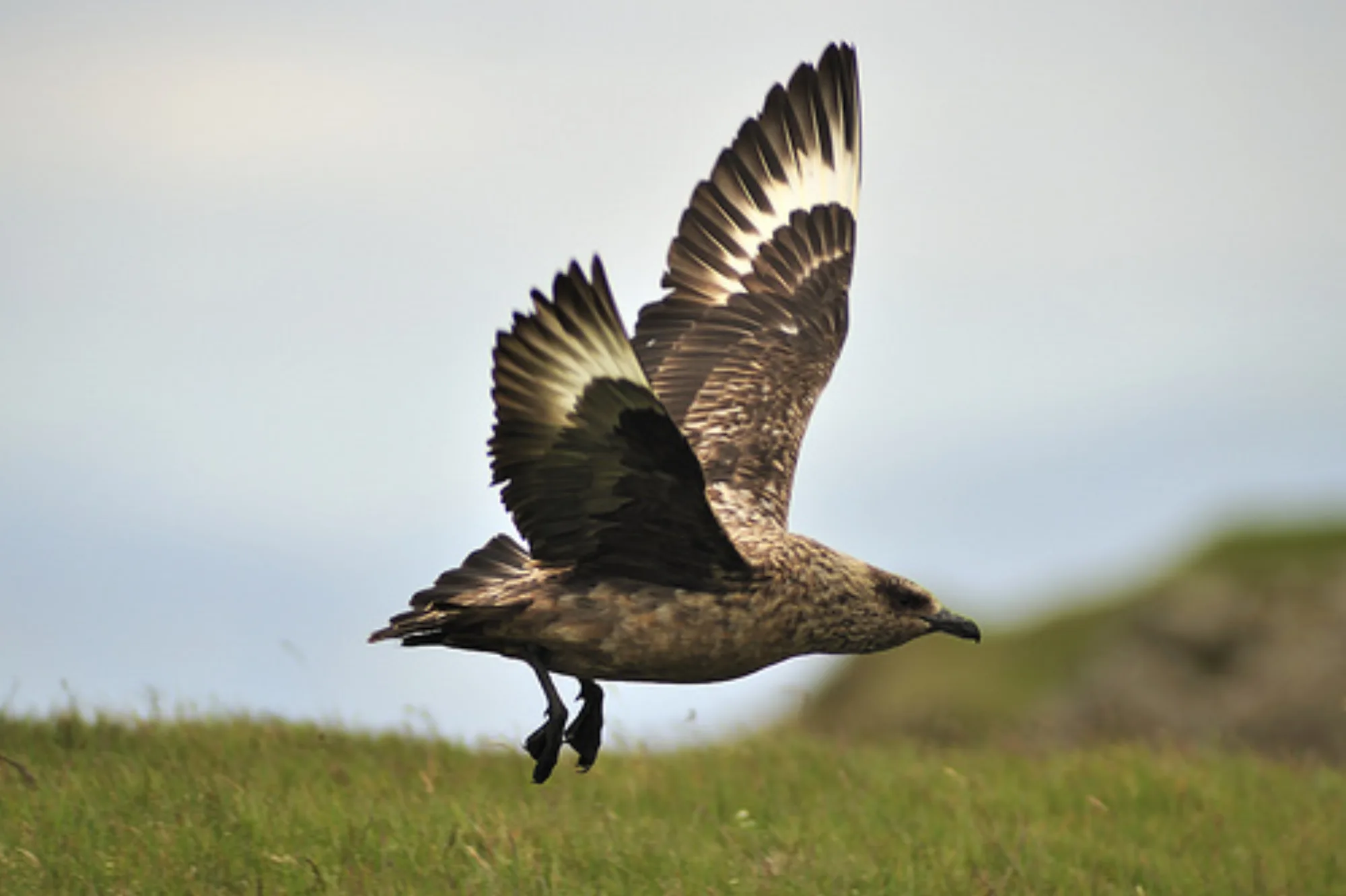
Broad-chested and roughly the size of a herring gull, the Great Skua is a powerful seabird with conspicuous white flashes on its wings. Adults are streaked greyish brown with black caps, while young birds are warmer brown and lack streaks underneath. Its short, blunt tail and strong flight add to its distinctive outline, and its calls include a harsh, repeated hah as well as quacks and croaks. In Britain, it is also known as the bonxie, a Shetland name with Norse roots.
Look for Great Skuas on coastal moorland and rocky islands where they breed, including in Iceland, Norway, the Faroe Islands and the Scottish islands. Some also breed on mainland Scotland and in northwest Ireland. The birds migrate to spend winter at sea in the Atlantic, regularly reaching North American waters and occasionally wandering to Mediterranean countries. Their grass-lined nests usually hold two spotted, olive-brown eggs. Adults defend the nest vigorously, repeatedly diving at people who come close.
Fish make up much of their diet, alongside seabirds and their eggs, carrion, and occasional berries and small mammals. Fishing vessels may provide their most abundant food in the form of discarded by-catch. Great Skuas also pursue gulls, terns and gannets to steal their catches, and can kill seabirds as large as herring gulls. On St Kilda, researchers using night vision equipment observed skuas hunting Leach's storm petrels after dark. Young birds that have fledged can be taken by rats, cats or Arctic foxes, while healthy adults face threats from large eagles and, more rarely at sea, orcas.
Written from the English Wikipedia article Great skua (CC BY-SA 4.0).
- Records
- 68,494
- Countries
- 18
No atlas park has a record of the Great Skua in or around it yet.
These are open occurrence records, so they show where people looked for and recorded the Great Skua as much as where it lives. Cells are up to 25 km across, and every location is generalised to its cell.
Generalised encounter areas, not exact locations. Each shape is a grid cell coloured by how likely the species is there.
- Very likelyUnited Kingdom25 km zone · high confidence · 23114 records · updated 80 days ago
- Very likelyNorway25 km zone · high confidence · 11841 records · updated 80 days ago
- Very likelySpain25 km zone · high confidence · 8664 records · updated 80 days ago
- Very likelyPortugal25 km zone · high confidence · 8376 records · updated 80 days ago
- Very likelyIceland25 km zone · high confidence · 5555 records · updated 80 days ago
- Very likelyBelgium25 km zone · high confidence · 2103 records · updated 80 days ago
- Very likelySvalbard & Jan Mayen25 km zone · high confidence · 2099 records · updated 80 days ago
- Very likelyFrance25 km zone · high confidence · 1727 records · updated 80 days ago
- Very likelyMorocco25 km zone · high confidence · 1406 records · updated 80 days ago
- Very likelyIreland25 km zone · high confidence · 1000 records · updated 80 days ago
Conservation status not assessed here yet, so every location is generalised to its grid cell.