Angel Shark
Squatina squatina
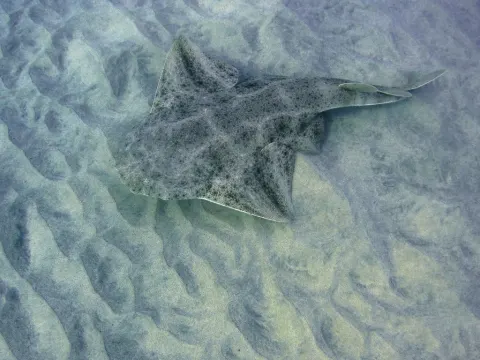
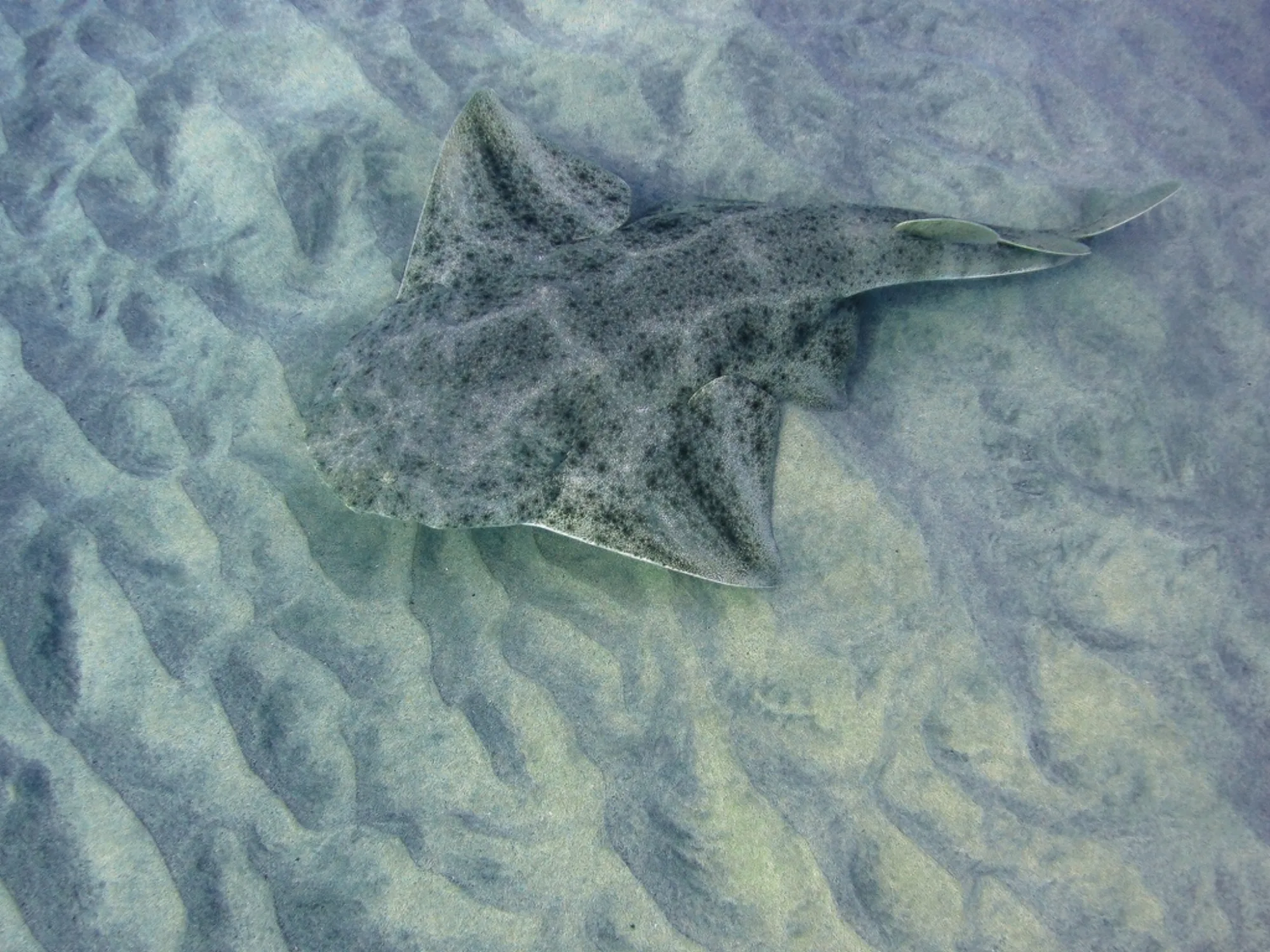
Flattened against the seabed, the Angel Shark can look much like a ray, with a broad, stocky body and wide, wing-like fins. Its upper surface ranges from grey to reddish or greenish brown, scattered with small black and white spots. Young sharks have more elaborate markings, including pale lines and darker blotches. Females can reach 2.4 m in length, while males can reach 1.8 m.
This shark lives in temperate waters of the northeastern Atlantic and the Mediterranean, including around the Canary Islands, Ireland and western Britain. It favours sandy or muddy ground on the continental shelf, from near the coast down to 150 m, and sometimes enters brackish water. By day it usually lies still beneath sediment, with only its eyes visible. After dark, it moves around more and is sometimes seen swimming above the bottom. In summer, gatherings of as many as a hundred sharks have been seen near Gran Canaria. When approached underwater, an Angel Shark usually stays still or swims away, but it can inflict a severe bite if disturbed.
An ambush hunter, it feeds mainly on bottom-dwelling bony fish, especially flatfish, as well as skates and invertebrates. A shark may stay at a successful hunting spot for several days. Females give birth to seven to 25 pups, with a reproductive cycle estimated at 2 years. Commercial fishing has caused steep declines: sharks of all ages can be caught accidentally in bottom trawls, trammel nets and bottom longlines. Slow reproduction limits their ability to recover from losses, while coastal development for commerce and tourism has also caused habitat loss.
Written from the English Wikipedia article Squatina squatina (CC BY-SA 4.0).
- Records
- 96
- Countries
- 3
No atlas park has a record of the Angel Shark in or around it yet.
These are open occurrence records, so they show where people looked for and recorded the Angel Shark as much as where it lives. Cells are up to 25 km across, and every location is generalised to its cell.
Generalised encounter areas, not exact locations. Each shape is a grid cell coloured by how likely the species is there.
- Very likelySpain25 km zone · medium confidence · 86 records · updated 80 days ago
- LikelyFrance25 km zone · medium confidence · 6 records · updated 80 days ago
- LikelyIreland25 km zone · medium confidence · 4 records · updated 80 days ago
Conservation status not assessed here yet, so every location is generalised to its grid cell.