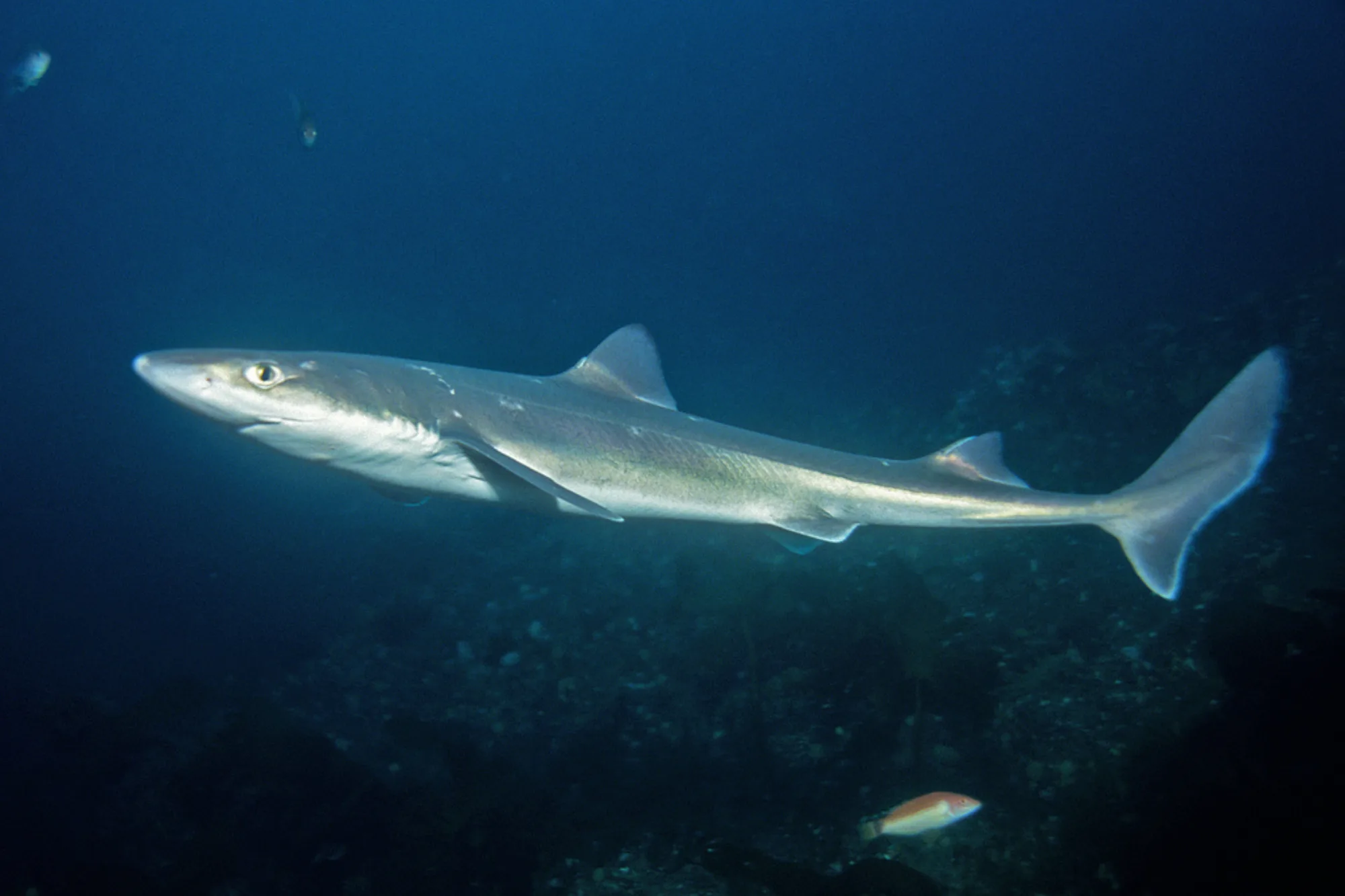
Spurdog
Squalus acanthias
Greyish brown with white spots along its back, the Spurdog is a shark with a spine in front of each of its two dorsal fins. It has no anal fin, and its tail has uneven lobes. The spines serve as a defence: when caught, the shark can arch its back and pierce its captor, injecting a mild venom.
Spurdogs live in shallow water and farther offshore across much of the world, especially in temperate seas. They are bottom dwellers, commonly found at depths of around 50 to 149 m, although they have been recorded deeper than 700 m. They hunt in packs that can number in the thousands. Their varied diet includes squid, fish, crabs, jellyfish, sea cucumbers, shrimp and other invertebrates. Breeding takes place offshore in winter, and females give birth to live young after a gestation of around 18 to 24 months. Litters usually contain about 5 to 6 pups, which are normally born in warmer, deeper offshore waters. Males reach maturity at around 10 years, while females take around 16 years.
Fishing has driven a significant decline in Spurdog populations, with overfishing linked to demand for its meat in northern Europe. Stocks around Europe have fallen by at least 95%, although populations in EU and UK waters were considered sufficiently recovered for commercial fishing in 2023. Bottom trawls and sink gillnets are the main fishing methods, and Spurdogs are also caught alongside larger fish and discarded. Their late maturity means populations take time to rebuild.
Written from the English Wikipedia article Spiny dogfish (CC BY-SA 4.0).
- Records
- 191,888
- Countries
- 5
- Atlas places
- 2
These are open occurrence records, so they show where people looked for and recorded the Spurdog as much as where it lives. Cells are up to 25 km across, and every location is generalised to its cell.
Generalised encounter areas, not exact locations. Each shape is a grid cell coloured by how likely the species is there.
- Very likelyUnited States25 km zone · high confidence · 81488 records · updated 80 days ago
- Very likelyCanada25 km zone · high confidence · 52285 records · updated 80 days ago
- Very likelyUnited Kingdom25 km zone · high confidence · 50603 records · updated 80 days ago
- Very likelyAustralia25 km zone · high confidence · 6853 records · updated 80 days ago
- Very likelyNorway25 km zone · high confidence · 659 records · updated 80 days ago
Conservation status not assessed here yet, so every location is generalised to its grid cell.