Sprat
Sprattus sprattus
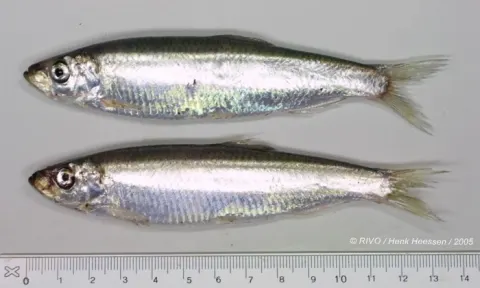
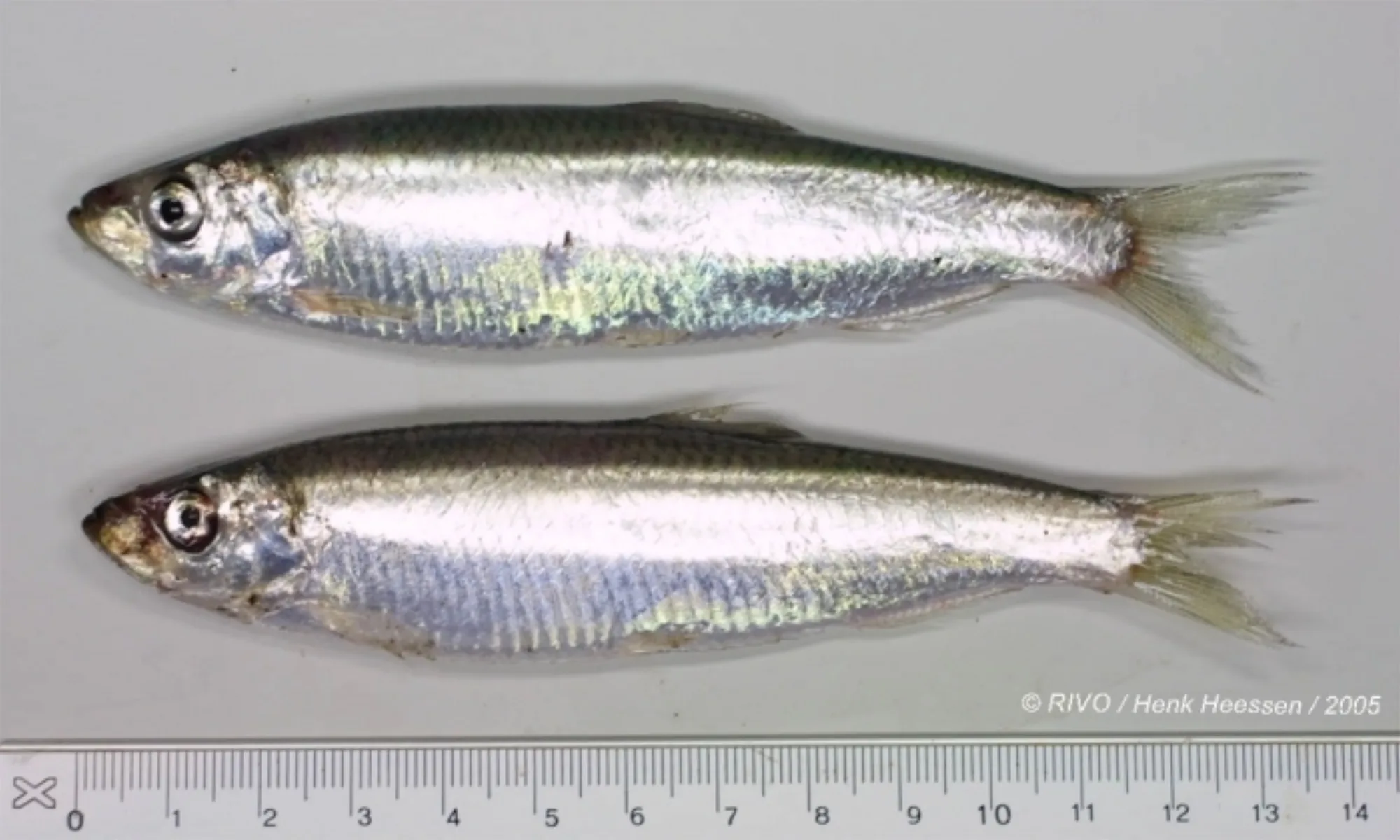
Silvery flanks and a bluish or greenish back give the Sprat its colouring, with no dark spots to break it up. This small member of the herring family has an elongated, flattened shape and a slightly projecting lower jaw. Most measure 8 to 12 cm, although they can grow to 16 cm. Its belly has a ridge of sharp scales, a useful feature alongside its colour and shape.
Sprats live in the northeastern Atlantic and waters around Europe, West Asia and North Africa. Their range reaches from southern Norway and Sweden and the British Isles to Morocco, and includes the Baltic, North, Mediterranean, Adriatic and Black Seas. They occur in open water far from shore as well as in bays and estuaries, and can tolerate water with salinity as low as 4 parts per thousand. These fish travel in schools and move between winter feeding areas and summer breeding grounds. At night they rise towards the surface to feed. Adults eat small crustaceans called copepods, while young sprats feed on copepod eggs and larvae, as well as diatoms.
Breeding can happen throughout the year, with a peak from December to April in the Mediterranean and from April to August in the Baltic and northeastern Atlantic. Sprats may spawn close to shore or as far as 100 km out. They support substantial fisheries across parts of their range and are mostly caught by trawling. A parasitic copepod can damage their eyesight or cause blindness, and heavy infestations can kill them. Population sizes fluctuate considerably, especially in the Mediterranean and Black Seas, possibly in part because of the increasing dominance of a comb jelly.
Written from the English Wikipedia article European sprat (CC BY-SA 4.0).
- Records
- 15,330
- Countries
- 13
No atlas park has a record of the Sprat in or around it yet.
These are open occurrence records, so they show where people looked for and recorded the Sprat as much as where it lives. Cells are up to 25 km across, and every location is generalised to its cell.
Generalised encounter areas, not exact locations. Each shape is a grid cell coloured by how likely the species is there.
- Very likelyNetherlands25 km zone · high confidence · 5663 records · updated 80 days ago
- Very likelyLatvia25 km zone · medium confidence · 3029 records · updated 80 days ago
- Very likelySweden25 km zone · high confidence · 2317 records · updated 80 days ago
- Very likelyNorway25 km zone · high confidence · 1672 records · updated 80 days ago
- Very likelyBelgium25 km zone · high confidence · 1085 records · updated 80 days ago
- Very likelyDenmark25 km zone · medium confidence · 466 records · updated 80 days ago
- Very likelyPoland25 km zone · high confidence · 306 records · updated 80 days ago
- Very likelyUnited Kingdom25 km zone · medium confidence · 284 records · updated 80 days ago
- Very likelyGermany25 km zone · high confidence · 260 records · updated 80 days ago
- Very likelyFrance25 km zone · high confidence · 159 records · updated 80 days ago
Conservation status not assessed here yet, so every location is generalised to its grid cell.