Chipping Sparrow
Spizella passerina
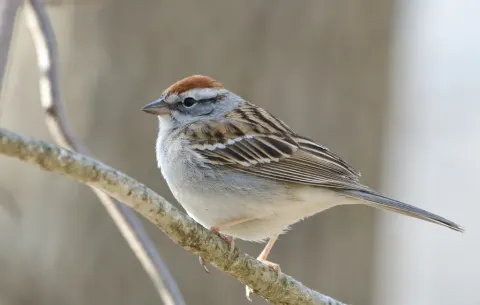
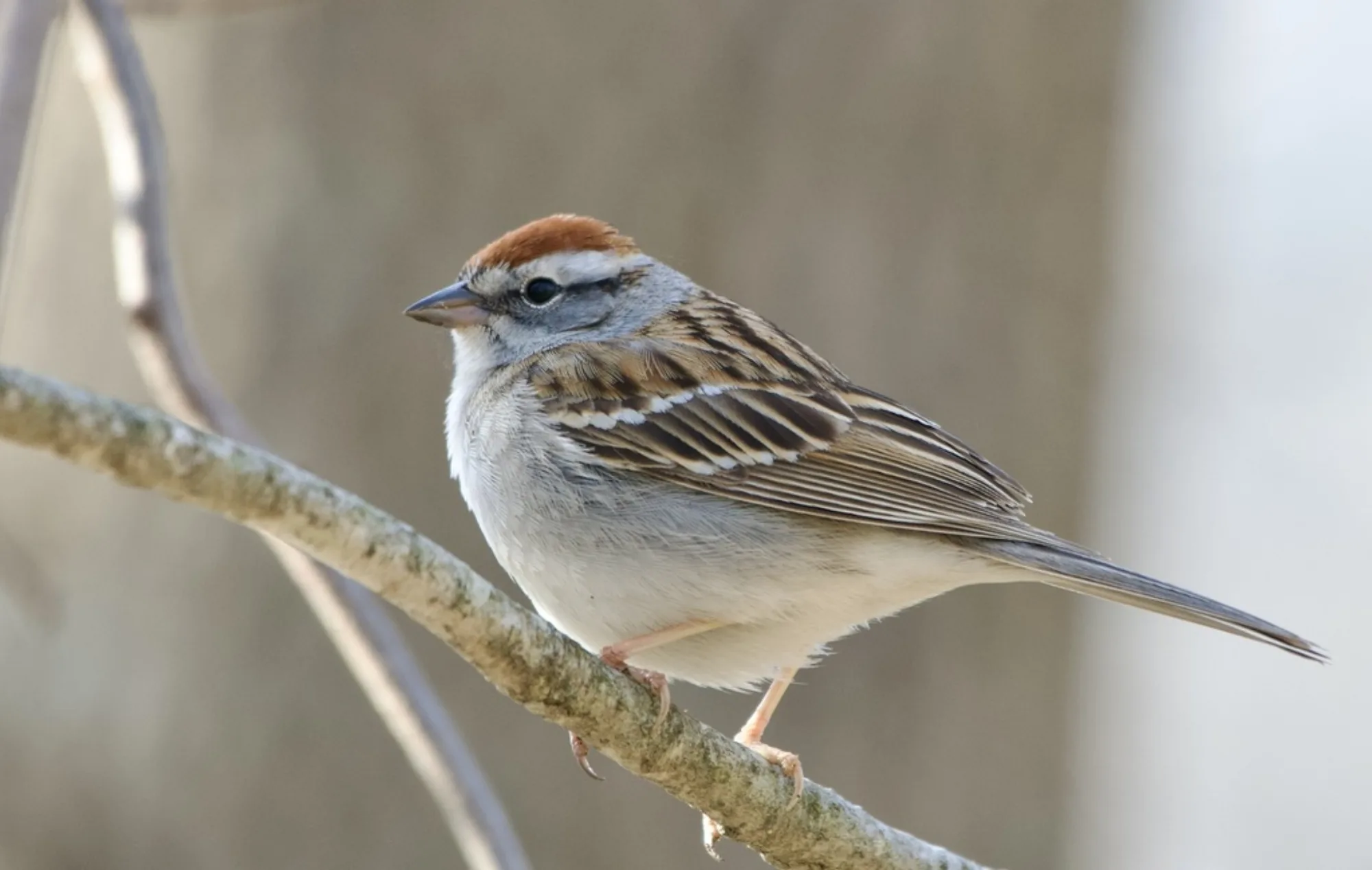
Across much of its North American range, the Chipping Sparrow is common and fairly tame. This small New World sparrow measures 12 to 15 cm long, with grey underparts and orangish-rust upperparts throughout the year. In the breeding season, look for its reddish cap, nearly white eyebrow and black line through the eye. Outside the breeding season, its cap turns brown and its facial markings become less distinct. Young birds have conspicuous streaks below and a dark line through the eye. Listen for a trilling song and a piercing flight call, which can be heard during night migration.
Some populations migrate, with birds from northern areas travelling south in autumn to spend the winter in Mexico and the southern United States, then returning north in spring. In winter they gather in flocks, sometimes alongside other bird species. They often search for food on the ground under cover, near field edges, but also climb among plants and trees. Seeds are eaten year-round, while insects make up most of the diet during breeding; they also take buds, small arthropods and sometimes spiders.
Breeding begins in late April and May, in open woodland clearings and shrubby grass fields. In the west, these sparrows breed mainly in coniferous forests; farther east, they use woodland, farmland, parks and gardens. The female builds a loose nest of grass and rootlets, lined with plant fibre and animal hair, usually in a tree or bush. She lays between two and seven eggs, which range from pale blue to white and have dark markings. Brown-headed cowbirds often lay their eggs in Chipping Sparrow nests, usually causing the sparrows to abandon them.
Written from the English Wikipedia article Chipping sparrow (CC BY-SA 4.0).
- Records
- 2,493,488
- Countries
- 2
- Atlas places
- 2
These are open occurrence records, so they show where people looked for and recorded the Chipping Sparrow as much as where it lives. Cells are up to 25 km across, and every location is generalised to its cell.
Generalised encounter areas, not exact locations. Each shape is a grid cell coloured by how likely the species is there.
- Very likelyUnited States25 km zone · high confidence · 2092564 records · updated 80 days ago
- Very likelyCanada25 km zone · high confidence · 400924 records · updated 80 days ago
Conservation status not assessed here yet, so every location is generalised to its grid cell.