Dickcissel
Spiza americana
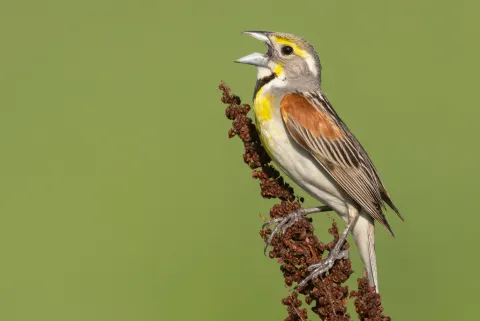
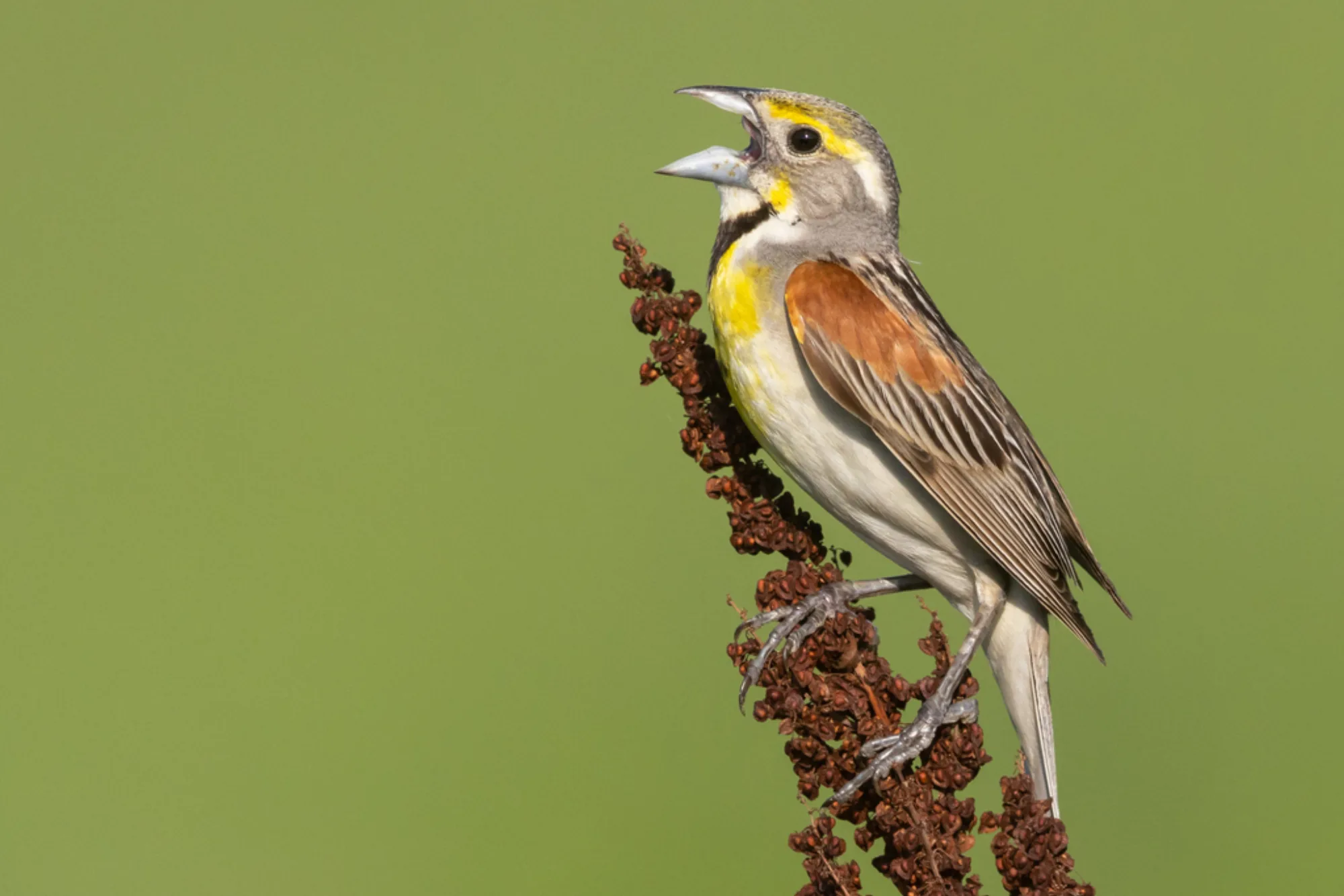
A Dickcissel may sing from a conspicuous field perch, giving a sharp dick dick followed by a buzzing cissel. This small migratory bird has a large, pale bill, a yellow line above each eye and brownish upperparts, with black streaks on its back. Its dark wings carry a rust-coloured shoulder patch, while the underparts are light. Adult males have a black throat patch, yellow breast and grey cheeks and crown, with particularly bright head and breast markings in breeding plumage. Females and young birds have brownish cheeks and crowns, streaked flanks and a passing resemblance to house sparrows. In flight, listen for a low, electric-sounding buzz.
Dickcissels breed in fields and prairie grasslands across the Midwestern United States. After breeding, large flocks migrate south, reaching southern Mexico as well as Central America and northern parts of South America; wintering areas include northern Colombia and northern Venezuela. Birds arrive on the breeding grounds relatively late, with the first appearing in May and most arriving in early June. They build nests close to the ground in dense grass or small shrubs, and also nest in bushes and trees. Pairs remain together to raise one brood, then separate when they leave for their winter quarters around early August. Dickcissels forage on the ground or in fields, eating mainly insects and seeds, and usually feed in flocks outside the nesting season. Their numbers and range can fluctuate considerably. Changes in land use probably contributed to the earlier expansion and subsequent disappearance of eastern populations, while a decline was recorded across the Midwestern United States and the northern breeding range from 1966 to 2015.
Written from the English Wikipedia article Dickcissel (CC BY-SA 4.0).
- Records
- 260,965
- Countries
- 4
No atlas park has a record of the Dickcissel in or around it yet.
These are open occurrence records, so they show where people looked for and recorded the Dickcissel as much as where it lives. Cells are up to 25 km across, and every location is generalised to its cell.
Generalised encounter areas, not exact locations. Each shape is a grid cell coloured by how likely the species is there.
- Very likelyUnited States25 km zone · high confidence · 254084 records · updated 80 days ago
- Very likelyMexico25 km zone · high confidence · 5366 records · updated 80 days ago
- Very likelyCanada25 km zone · high confidence · 893 records · updated 80 days ago
- Very likelyHonduras25 km zone · high confidence · 622 records · updated 80 days ago
Conservation status not assessed here yet, so every location is generalised to its grid cell.