American Goldfinch
Spinus tristis
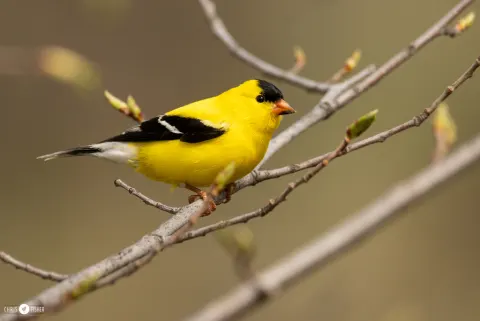
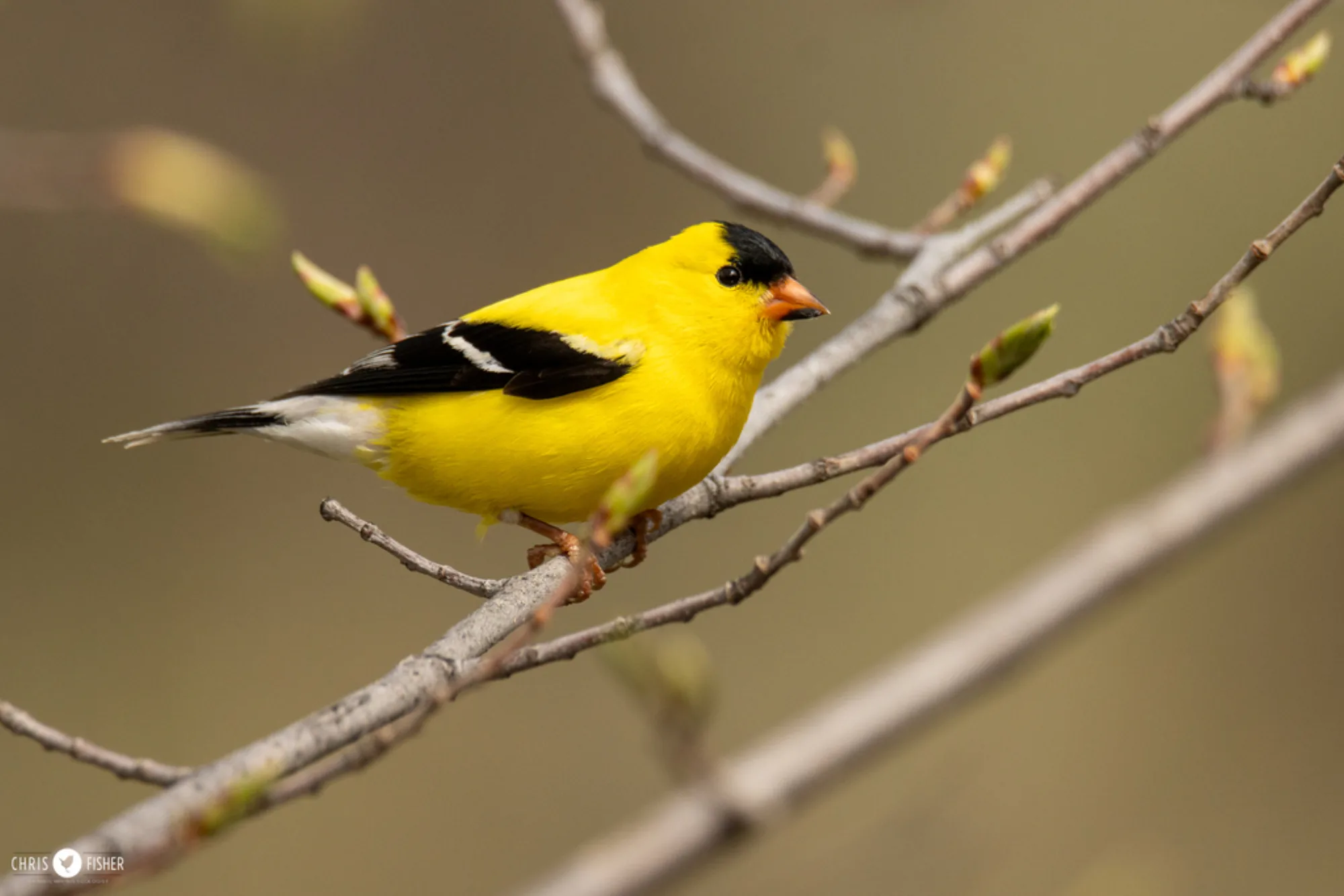
Look for a small finch with a bouncing, wave-shaped flight and a musical series of warbles and twitters. In summer, the male American Goldfinch has a lemon-yellow body, black cap and white rump, while the female is mostly brown with a yellow bib. By autumn, both sexes wear duller plumage, olive-brown above and buff below, while the face and bib turn pale yellow. The bird has a small, conical beak, pink for most of the year and bright orange after the spring moult.
Its breeding range stretches across North America, from Saskatchewan south to North Carolina in the east and northern California in the west. As colder weather and reduced food supplies arrive, it moves south in compact flocks, spending winter from southern Canada across the United States and into parts of Mexico. Look for it in open, weedy places such as fields, meadows, flood plains and roadsides, as well as orchards and gardens. It also visits feeders, especially in winter, and often gathers with other finches outside the breeding season.
Seeds make up most of its diet, and it often hangs from seedheads to reach them. It also takes buds, berries and maple sap, and occasionally insects. Breeding begins in late July, when seeds are abundant, and the female builds a nest in a deciduous shrub or tree. Most pairs raise one brood a year, with the female feeding the chicks seeds and insects. Snakes, weasels, squirrels and blue jays may destroy eggs or kill young, while hawks and cats threaten both young and adults. Nestlings can also drown after rainstorms if their tightly woven nest fills with water and the parents do not cover it.
Written from the English Wikipedia article American goldfinch (CC BY-SA 4.0).
- Records
- 6,771,352
- Countries
- 5
- Atlas places
- 3
These are open occurrence records, so they show where people looked for and recorded the American Goldfinch as much as where it lives. Cells are up to 25 km across, and every location is generalised to its cell.
Generalised encounter areas, not exact locations. Each shape is a grid cell coloured by how likely the species is there.
- Very likelyUnited States25 km zone · high confidence · 5401809 records · updated 86 days ago
- Very likelyCanada25 km zone · high confidence · 1363759 records · updated 86 days ago
- Very likelyMexico25 km zone · high confidence · 4639 records · updated today
- LikelySt. Pierre & Miquelon25 km zone · high confidence · 1145 records · updated today
- RareUnited Kingdom25 km zone · low confidence · 0 records · updated today
Conservation status not assessed here yet, so every location is generalised to its grid cell.