Eurasian Siskin
Spinus spinus
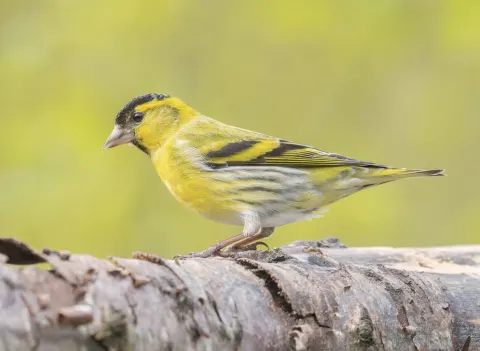
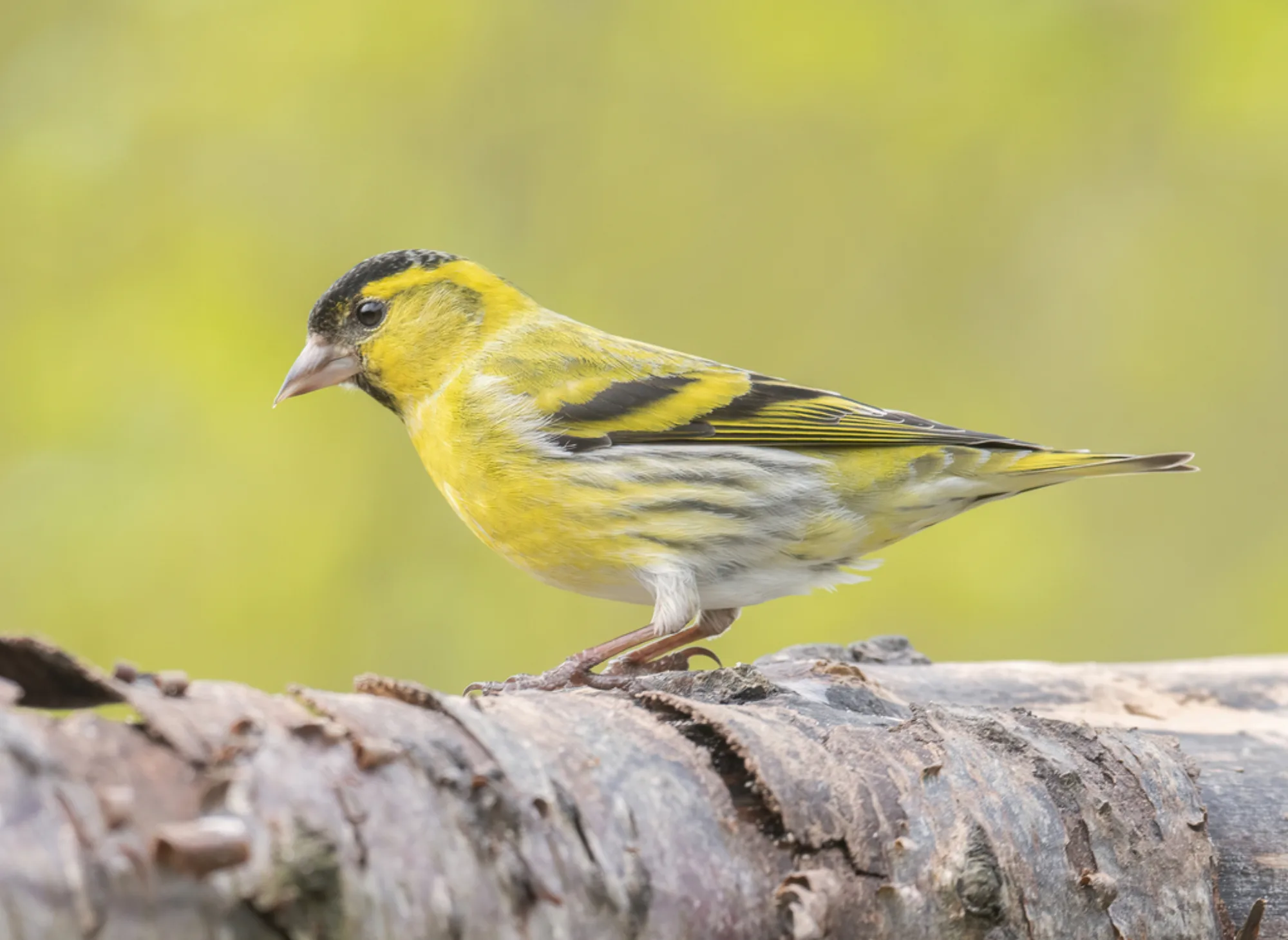
Look for the Eurasian Siskin among the branches, a small, short-tailed finch with greyish-green upperparts and streaked white underparts. Black wings carry a yellow bar, while the black tail has yellow sides. The male has a yellow face and breast and a neat black cap; females and young have greyish-green heads without the cap. Its flight is rapid and bounding, and its song mixes tweets and trills.
Siskins range across much of Eurosiberia and northern Africa, living in coniferous and mixed woodland. They occur year-round in Central Europe and some southern European mountain ranges, and spend winter around the Mediterranean and Black Sea. Every few years, larger numbers move south, although the reasons are uncertain and may involve climate and food supplies. Outside the breeding season, they gather in flocks, sometimes with redpolls, and can be approachable at close range. During breeding they become more solitary and harder to watch.
These active birds feed mostly in trees, often hanging upside down to reach food, and also visit garden feeders. Seeds are their main food, especially those of alder and conifers, though they also take seeds from plants such as thistles and dandelions. When feeding chicks, they eat more insects, particularly beetles. Breeding birds favour spruce woods and hide their small, bowl-shaped nests high in conifers, sometimes nesting in small colonies. Females lay 2 to 6 eggs, and the chicks leave the nest after 15 days; a second brood usually follows. The account gives no specific threat to wild siskins, although it suggests that a shortage of alder or birch seeds may prompt greater southward movement.
Written from the English Wikipedia article Eurasian siskin (CC BY-SA 4.0).
- Records
- 779,472
- Countries
- 81
- Atlas places
- 1
These are open occurrence records, so they show where people looked for and recorded the Eurasian Siskin as much as where it lives. Cells are up to 25 km across, and every location is generalised to its cell.
Generalised encounter areas, not exact locations. Each shape is a grid cell coloured by how likely the species is there.
- Very likelyNorway25 km zone · high confidence · 202061 records · updated 86 days ago
- Very likelySweden25 km zone · high confidence · 192014 records · updated 86 days ago
- Very likelyFinland25 km zone · high confidence · 184933 records · updated 86 days ago
- Very likelyUnited Kingdom25 km zone · high confidence · 44727 records · updated 86 days ago
- Very likelyBelgium25 km zone · high confidence · 39650 records · updated 86 days ago
- Very likelyFrance25 km zone · high confidence · 13554 records · updated 86 days ago
- Very likelyNetherlands25 km zone · high confidence · 9641 records · updated 86 days ago
- Very likelySpain25 km zone · high confidence · 8822 records · updated 86 days ago
- Very likelyÅland Islands25 km zone · high confidence · 8590 records · updated 86 days ago
- Very likelyPortugal25 km zone · high confidence · 6678 records · updated 86 days ago
Conservation status not assessed here yet, so every location is generalised to its grid cell.