Spotted Dove
Spilopelia chinensis
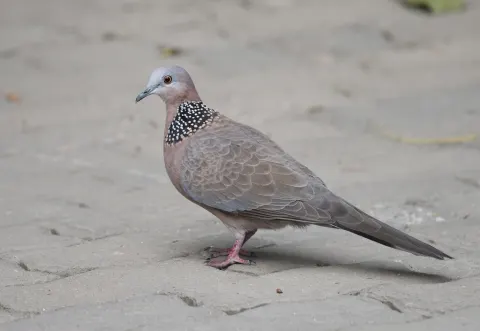
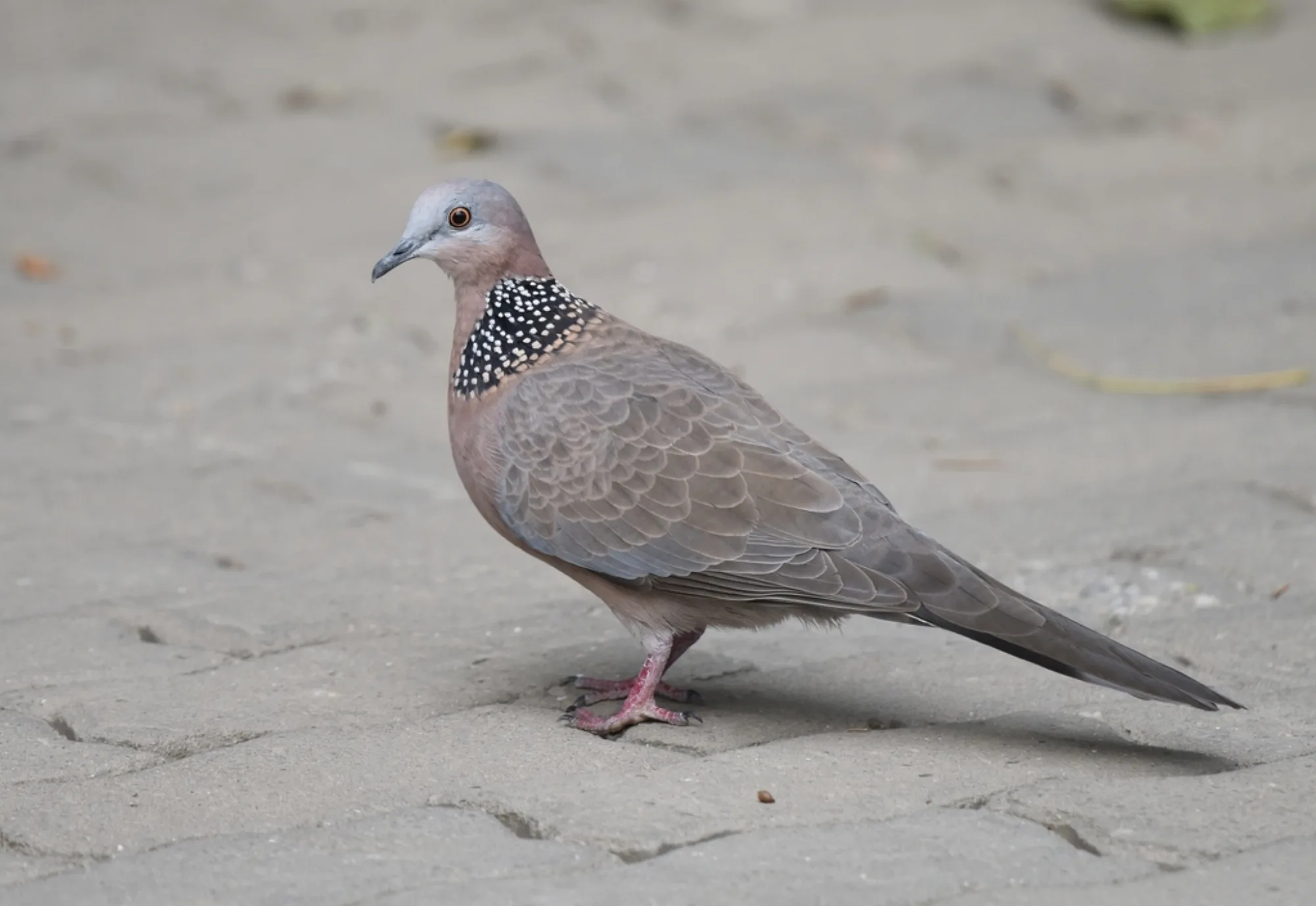
A small, slim pigeon with a long tail, the Spotted Dove measures 28 to 32 centimetres in length. Its plumage is buff brown, with rosy buff below and grey on the head and belly. A black patch flecked with white wraps around the back and sides of its neck, and white tips show on the outer tail feathers when it takes off. Males and females look alike, while young birds are duller and lack neck spots until mature. Plumage varies across the bird's wide range.
Native to the Indian subcontinent and East and Southeast Asia, it lives in woodland, scrub, farmland and around human habitation. It also occurs in light forests, gardens and urban areas. Beyond its native range, introduced populations have settled in Australia, New Zealand, Hawaii, Mauritius and southern California. Across eastern Australia and around cities and major towns in the south, it is common in places ranging from gardens and parks to farmland and tropical shrubland. Birds often forage on the ground in pairs or small groups, eating grass seeds, grains, fallen fruit and other plant seeds. They sometimes take insects, including winged termites. When taking flight from the ground, they can rise with an explosive flutter, then sometimes glide down to a perch.
Breeding timing varies with location: in Hawaii it continues throughout the year, while in southern Australia it mostly runs from September to January. Both parents build a loose cup of twigs, usually in low vegetation, and share incubation and feeding duties. The usual clutch is two whitish eggs, and more than one brood may be raised. When disturbed on airfields, these doves sometimes collide with aircraft; the available account describes no other threats to them.
Written from the English Wikipedia article Spotted dove (CC BY-SA 4.0).
- Records
- 1,493,692
- Countries
- 28
- Atlas places
- 16
- Bandipur National Park· India
- Kanha National Park· India
- Blue Mountains National Park· Australia
- Nagarhole National Park· India
- Annapurna Conservation Area· Nepal
- Chitwan National Park· Nepal
- Eravikulam National Park· India
- Jim Corbett National Park· India
- Kaziranga National Park· India
- Koshi Tappu Wildlife Reserve· Nepal
- Langtang National Park· Nepal
- Periyar National Park· India
- Sundarbans National Park· India
- Tadoba Andhari Tiger Reserve· India
- West Bali National Park· Indonesia
- Yala National Park· Sri Lanka
These are open occurrence records, so they show where people looked for and recorded the Spotted Dove as much as where it lives. Cells are up to 25 km across, and every location is generalised to its cell.
Generalised encounter areas, not exact locations. Each shape is a grid cell coloured by how likely the species is there.
- Very likelyIndia25 km zone · high confidence · 387883 records · updated 86 days ago
- Very likelyAustralia25 km zone · high confidence · 367127 records · updated 86 days ago
- Very likelyTaiwan25 km zone · high confidence · 358212 records · updated 86 days ago
- Very likelyUnited States25 km zone · high confidence · 90007 records · updated 86 days ago
- Very likelyChina25 km zone · high confidence · 81553 records · updated 86 days ago
- Very likelyThailand25 km zone · high confidence · 38998 records · updated 86 days ago
- Very likelySingapore25 km zone · high confidence · 37141 records · updated 86 days ago
- Very likelyHong Kong SAR China25 km zone · high confidence · 26915 records · updated 86 days ago
- Very likelySri Lanka25 km zone · high confidence · 25371 records · updated 86 days ago
- Very likelyNew Zealand25 km zone · high confidence · 15670 records · updated 86 days ago
Conservation status not assessed here yet, so every location is generalised to its grid cell.