Eastern Spotted Skunk
Spilogale putorius
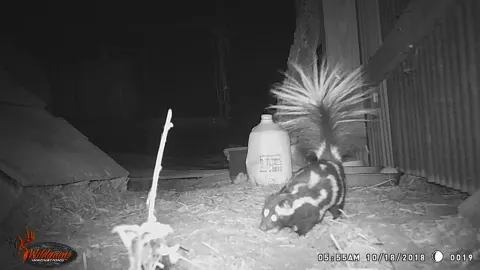
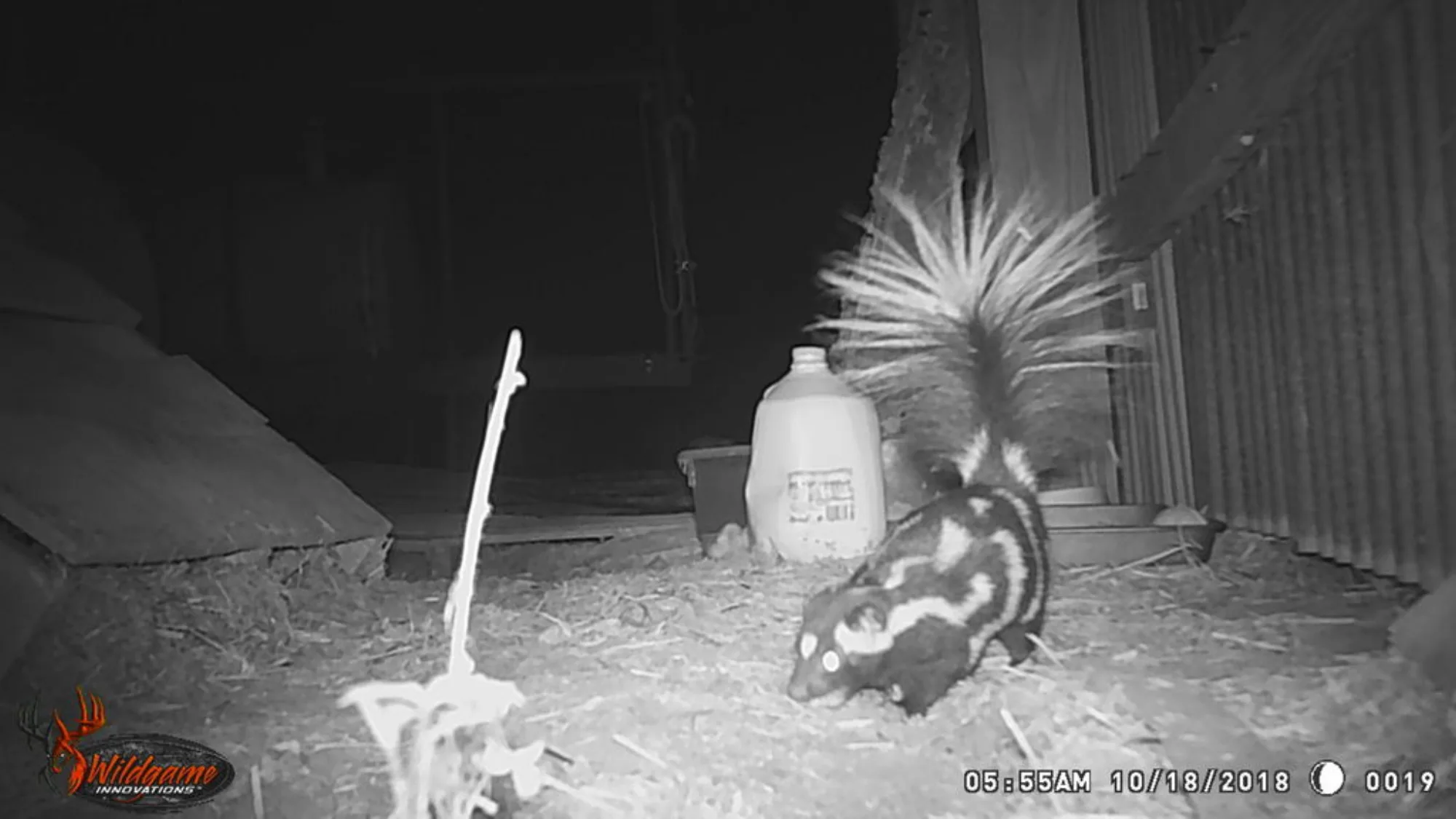
Small enough to be mistaken for a good-sized tree squirrel at a glance, the Eastern Spotted Skunk has a slender, weasel-like body. Its dense black fur carries broken white stripes, with white marks on the forehead and cheeks and at the tip of the tail. The stripes give it a spotted appearance, and its markings are thought to warn predators.
It lives across parts of the central and southeastern United States, with smaller areas of its range in Canada and Mexico. Forest edges and upland prairie grasslands appear to be favoured, particularly where rocks and clumps of shrubs offer cover. In western counties, it also relies on streamside corridors with woody shrubs and woodland edges. Fencerows and abandoned farm buildings provide habitat too, while trees offer places to climb and shelter.
Secretive and nocturnal, this skunk is rarely seen by people and tends to be more active on cool, dry nights. It reduces its activity during very hot summers and very cold winters, but does not hibernate. In winter, as many as eight may share an underground den. When threatened, it may stamp its feet or perform a handstand before spraying a predator. Its food includes eggs and mice, the latter sometimes caught around farms where stored grain attracts them. Breeding usually takes place in March or April, with an average of 4 to 5 kits born in late May or early June. Populations have fallen sharply in several states, particularly in the Midwest, although the precise cause remains uncertain. Pesticides, changes in farming, over-trapping and the consolidation of barns and other structures are thought to have contributed to the decline. Owls are a major predator across much of its range, while a canine distemper outbreak killed skunks in North Carolina.
Written from the English Wikipedia article Eastern spotted skunk (CC BY-SA 4.0).
- Records
- 30
- Countries
- 4
- Atlas places
- 1
These are open occurrence records, so they show where people looked for and recorded the Eastern Spotted Skunk as much as where it lives. Cells are up to 25 km across, and every location is generalised to its cell.
Generalised encounter areas, not exact locations. Each shape is a grid cell coloured by how likely the species is there.
- Very likelyAustria25 km zone · medium confidence · 22 records · updated 80 days ago
- Very likelyUnited States25 km zone · medium confidence · 5 records · updated 80 days ago
- Very likelyMexico25 km zone · medium confidence · 3 records · updated 80 days ago
- RareCosta Rica25 km zone · low confidence · 0 records · updated 80 days ago
Conservation status not assessed here yet, so every location is generalised to its grid cell.