Black-spotted Cuscus
Spilocuscus rufoniger
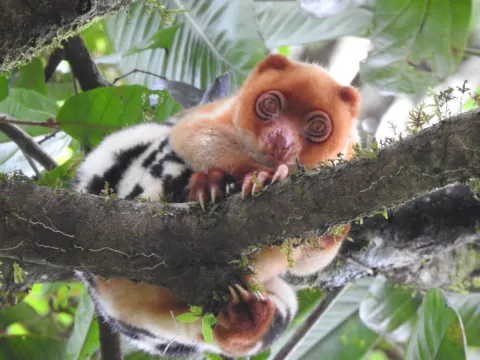
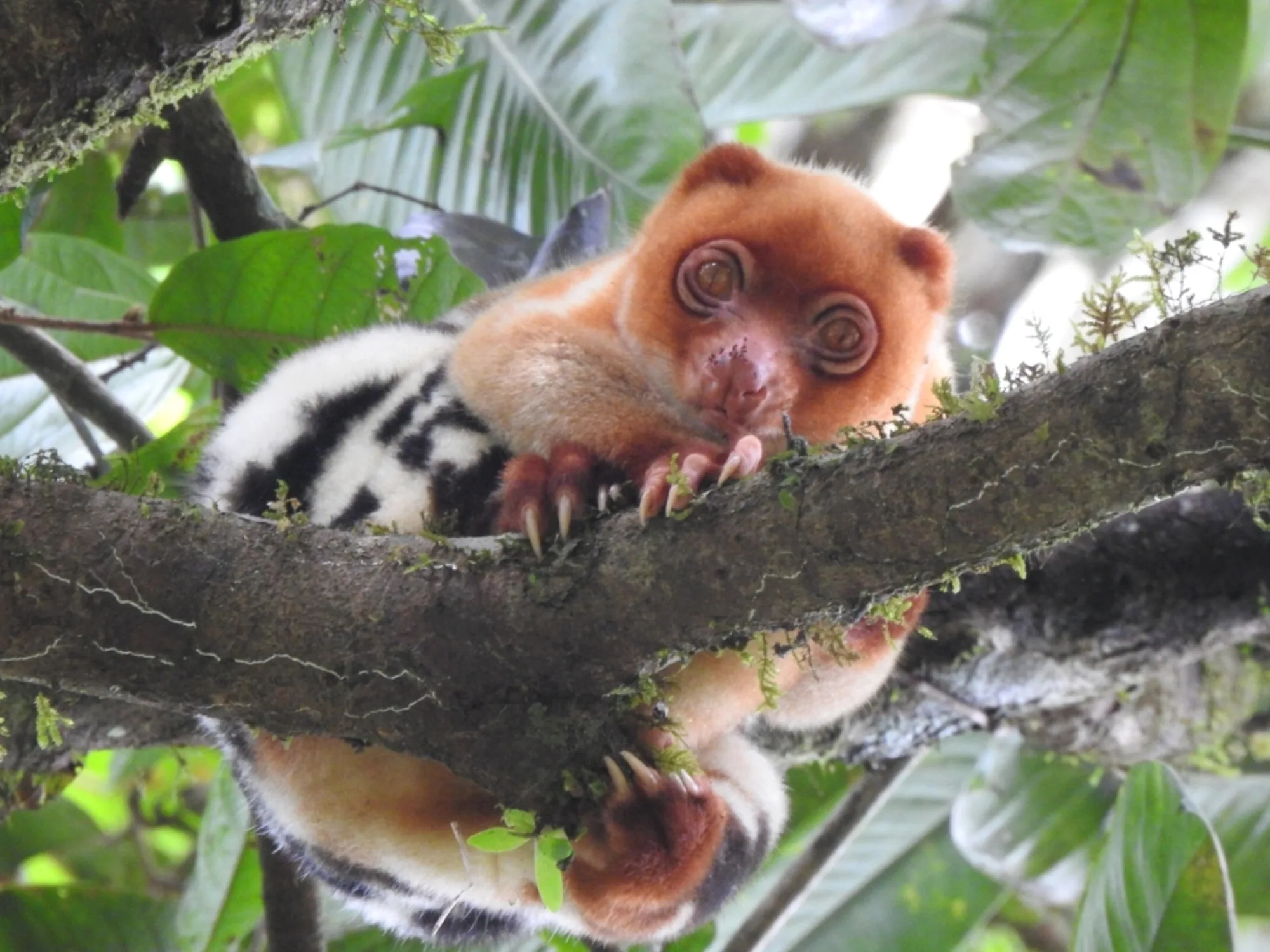
Found across northern New Guinea, the Black-spotted Cuscus is a heavy-set marsupial and one of the largest members of its family. Adults usually weigh between 6 and 7 kg, with a total length of 120 cm from their rounded heads to the tips of their grasping tails. These animals are easy to identify by their thick, woolly fur, which features a mix of black and red. While both sexes share these colors, females are larger with a solid dark patch on their backs, whereas males have a spotted appearance. Their large eyes have vertical pupils, an adaptation for their life in the dark.
These solitary creatures spend most of their time high in the canopy of primary tropical forests and lowland brushwood. They are primarily arboreal and notably sluggish, spending the daylight hours curled up on branches. At night, they move through the trees to find food, using sharp front claws and opposable digits to climb. Their diet is poorly understood but is thought to include fruits, nuts, and leaves, alongside small animals. Although they mostly stay in the trees, they do descend to the forest floor periodically.
Human activity is the primary cause of the rapid decline of this species. Large areas of their native forest are being cleared for logging, oil palm operations, and agricultural cultivation. Because they are bigger than most other marsupials, they are also targeted by hunters for their meat. Their colorful, dense pelts are frequently used to create traditional headwear and capes. Because they live in a restricted environment and lack protection from national parks in Papua New Guinea, they remain highly vulnerable to these pressures.
Written from the English Wikipedia article Black-spotted cuscus (CC BY-SA 4.0).
- Atlas places
- 0
These are open occurrence records, so they show where people looked for and recorded the Black-spotted Cuscus as much as where it lives. Cells are up to 25 km across, and every location is generalised to its cell.
No encounter zones yet
Where and when you can expect to see Black-spotted Cuscus is calculated from observation density. No zones have been computed for this species yet.