Smooth Hammerhead
Sphyrna zygaena
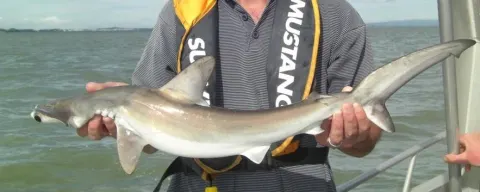
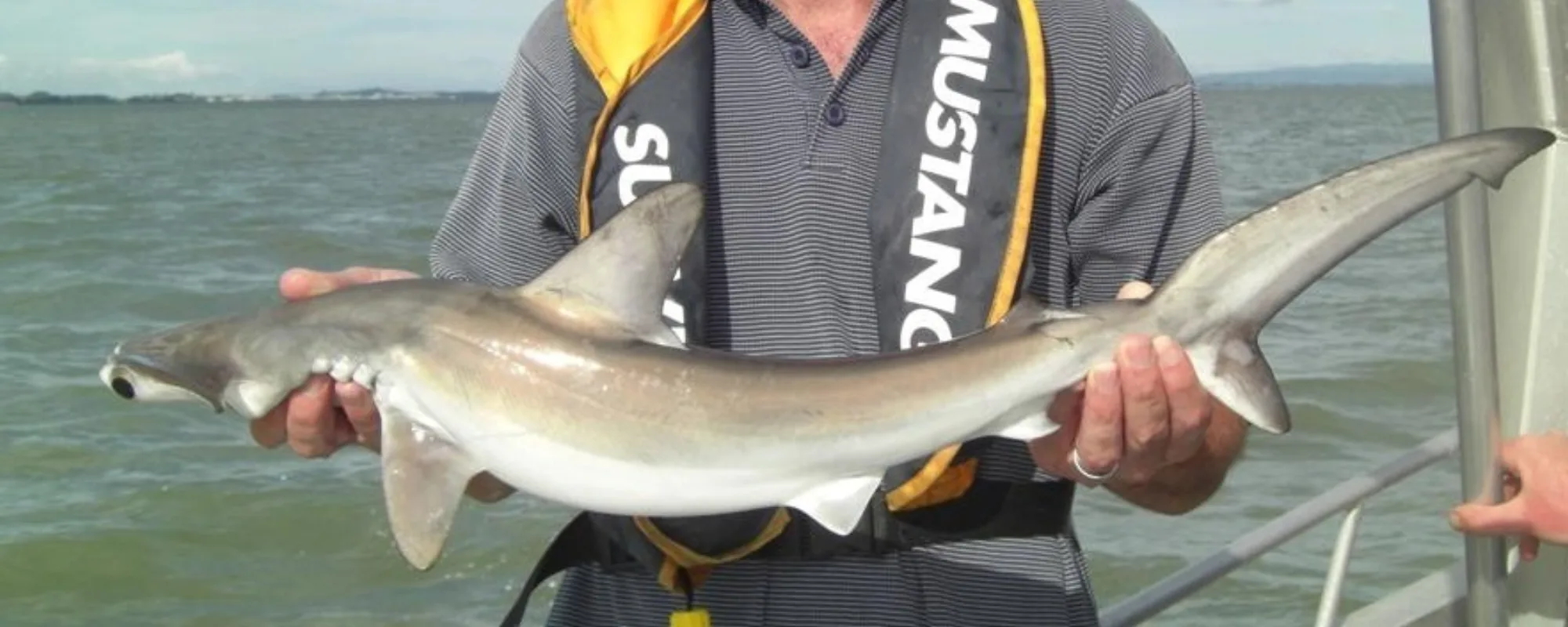
A broad, curved head gives the Smooth Hammerhead its distinctive outline, with no notch at the centre of its front edge. This streamlined shark usually measures 2.5 to 3.5 m, though it can reach 5 m. Its back ranges from dark brownish grey to olive, fading to lighter sides above a white belly.
Smooth hammerheads occur worldwide, favouring subtropical and warm temperate waters, with records from the Atlantic, Indian and Pacific oceans. They favour bays and estuaries near shore, but also venture into open water above the continental shelf or near oceanic islands. They generally stay in water less than 20 m deep, although they have been recorded at 200 m. In summer they travel towards the poles in search of cooler water, returning towards the equator in winter. Adults travel alone or in small groups, but migrating sharks can gather in much larger schools. During hot summer weather, their dorsal fins may be visible as they swim just beneath the surface.
Active hunters, they eat bony fish, rays, sharks and cephalopods, as well as smaller amounts of crustaceans. They also scavenge from fishing lines, and in some places stingrays make up much of their diet. Females give birth to live young in shallow coastal nurseries after a pregnancy of 10 to 11 months, with litters of 20 to 50 pups. Commercial fisheries catch smooth hammerheads across the world, both deliberately and as bycatch, while their valuable fins can lead to sharks being finned at sea. They are also caught by recreational anglers and killed when entangled in shark nets set to protect beaches.
Written from the English Wikipedia article Smooth hammerhead (CC BY-SA 4.0).
- Records
- 452
- Countries
- 14
- Atlas places
- 1
These are open occurrence records, so they show where people looked for and recorded the Smooth Hammerhead as much as where it lives. Cells are up to 25 km across, and every location is generalised to its cell.
Generalised encounter areas, not exact locations. Each shape is a grid cell coloured by how likely the species is there.
- Very likelyMozambique25 km zone · medium confidence · 187 records · updated 80 days ago
- Very likelyNew Zealand25 km zone · medium confidence · 88 records · updated 80 days ago
- Very likelyAustralia25 km zone · medium confidence · 71 records · updated 80 days ago
- Very likelyFaroe Islands25 km zone · medium confidence · 35 records · updated 80 days ago
- Very likelyMexico25 km zone · medium confidence · 30 records · updated 80 days ago
- Very likelyJapan25 km zone · medium confidence · 12 records · updated 80 days ago
- LikelyUnited States25 km zone · medium confidence · 13 records · updated 80 days ago
- LikelyEquatorial Guinea25 km zone · medium confidence · 6 records · updated 80 days ago
- PossibleSouth Africa25 km zone · medium confidence · 4 records · updated 80 days ago
- PossibleEcuador25 km zone · medium confidence · 3 records · updated 80 days ago
Conservation status not assessed here yet, so every location is generalised to its grid cell.