Great Hammerhead
Sphyrna mokarran
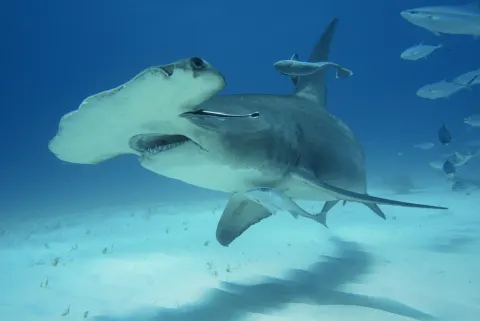
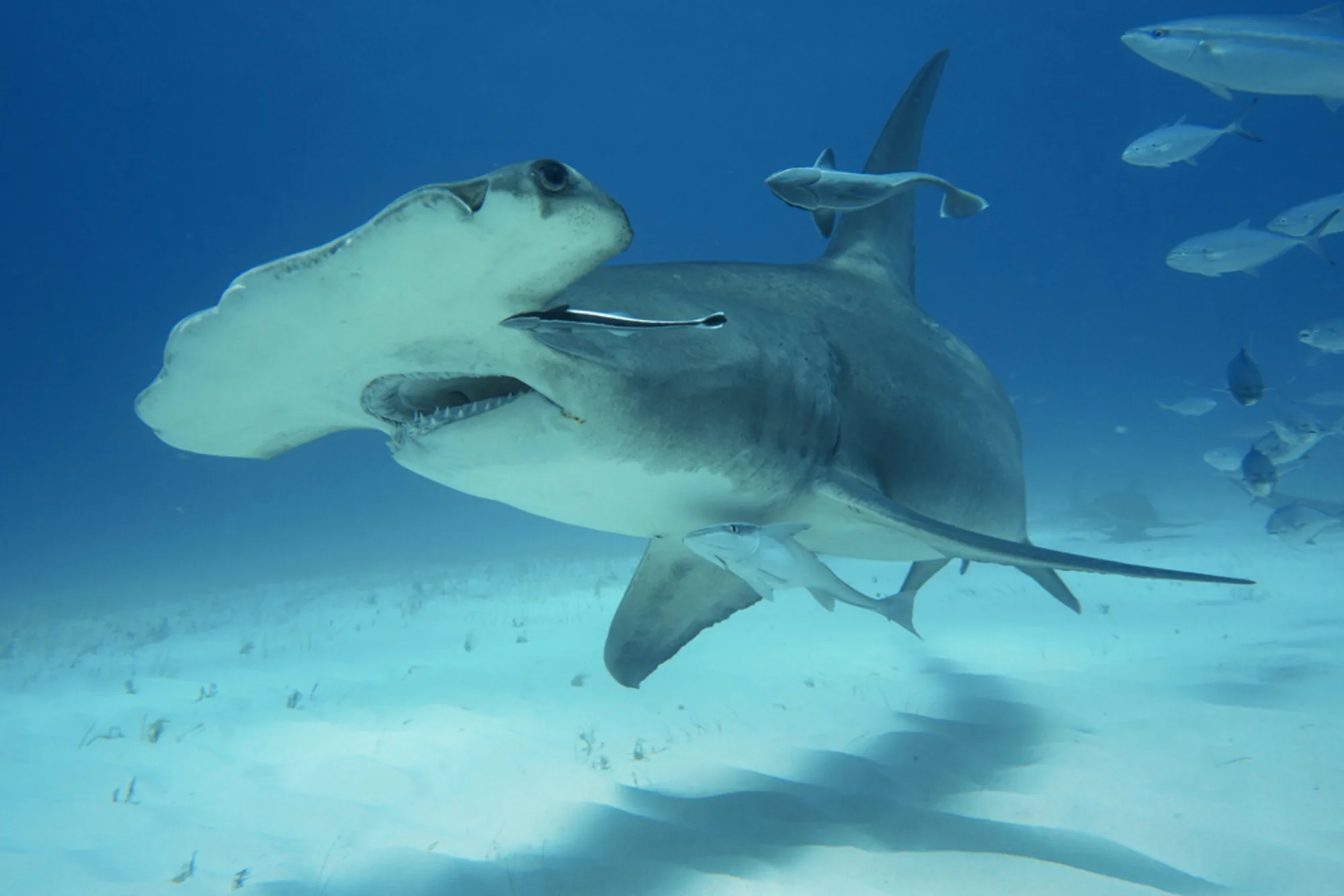
With its broad, almost straight-edged head and tall, sickle-shaped dorsal fin, the Great Hammerhead is distinctive even among hammerhead sharks. The largest of its kind, it averages 4.6 m in length and can reach 6.2 m. Its upper body ranges from dark brown through grey to olive, fading to white underneath.
This shark lives in warm tropical seas around the world, from the Caribbean and Mediterranean to the Indian and Pacific oceans. It favours coral reefs but also visits lagoons, continental shelves, island terraces and deep water close to land. It can be found in water less than 1 m deep or as far down as 80 m offshore. Some populations migrate towards the poles in summer. Usually solitary and nomadic, it may be shy or indifferent towards divers, although some have approached people closely. Pilot fish sometimes travel alongside it.
Great hammerheads hunt mainly at dawn and dusk, sweeping their heads over the seabed to detect stingrays hidden in sand. Their varied diet also includes crabs, squid, fish and smaller sharks. A shark has been observed pinning a stingray to the bottom with its head before biting it. Females give birth to live young every two years, with litters typically numbering 20 to 40 pups. Fishing is a major threat: the sharks are caught commercially and recreationally, and their fins are valuable for shark fin soup. They are also caught accidentally as bycatch, while entanglement in shark nets around beaches causes further deaths. Their low abundance and long generation time make them especially susceptible to overfishing, and populations are declining worldwide.
Written from the English Wikipedia article Great hammerhead (CC BY-SA 4.0).
- Records
- 7,473
- Countries
- 10
- Atlas places
- 3
These are open occurrence records, so they show where people looked for and recorded the Great Hammerhead as much as where it lives. Cells are up to 25 km across, and every location is generalised to its cell.
Generalised encounter areas, not exact locations. Each shape is a grid cell coloured by how likely the species is there.
- Very likelyAustralia25 km zone · medium confidence · 7404 records · updated 80 days ago
- Very likelyMozambique25 km zone · medium confidence · 35 records · updated 80 days ago
- Very likelySouth Africa25 km zone · medium confidence · 11 records · updated 80 days ago
- LikelyBahamas25 km zone · medium confidence · 8 records · updated 80 days ago
- LikelyCayman Islands25 km zone · medium confidence · 4 records · updated 80 days ago
- LikelyUnited Kingdom25 km zone · medium confidence · 4 records · updated 80 days ago
- LikelyMexico25 km zone · medium confidence · 3 records · updated 80 days ago
- LikelyUnnamed area25 km zone · medium confidence · 3 records · updated 80 days ago
- LikelyFrench Polynesia25 km zone · medium confidence · 1 record · updated 80 days ago
- LikelyUnited States25 km zone · low confidence · 0 records · updated 80 days ago
Conservation status not assessed here yet, so every location is generalised to its grid cell.