Scalloped Hammerhead
Sphyrna lewini
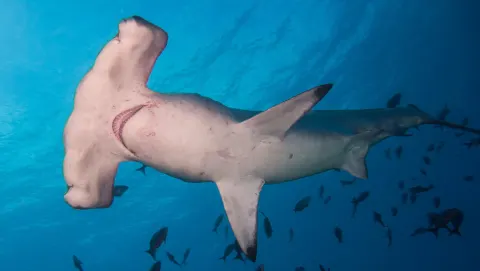
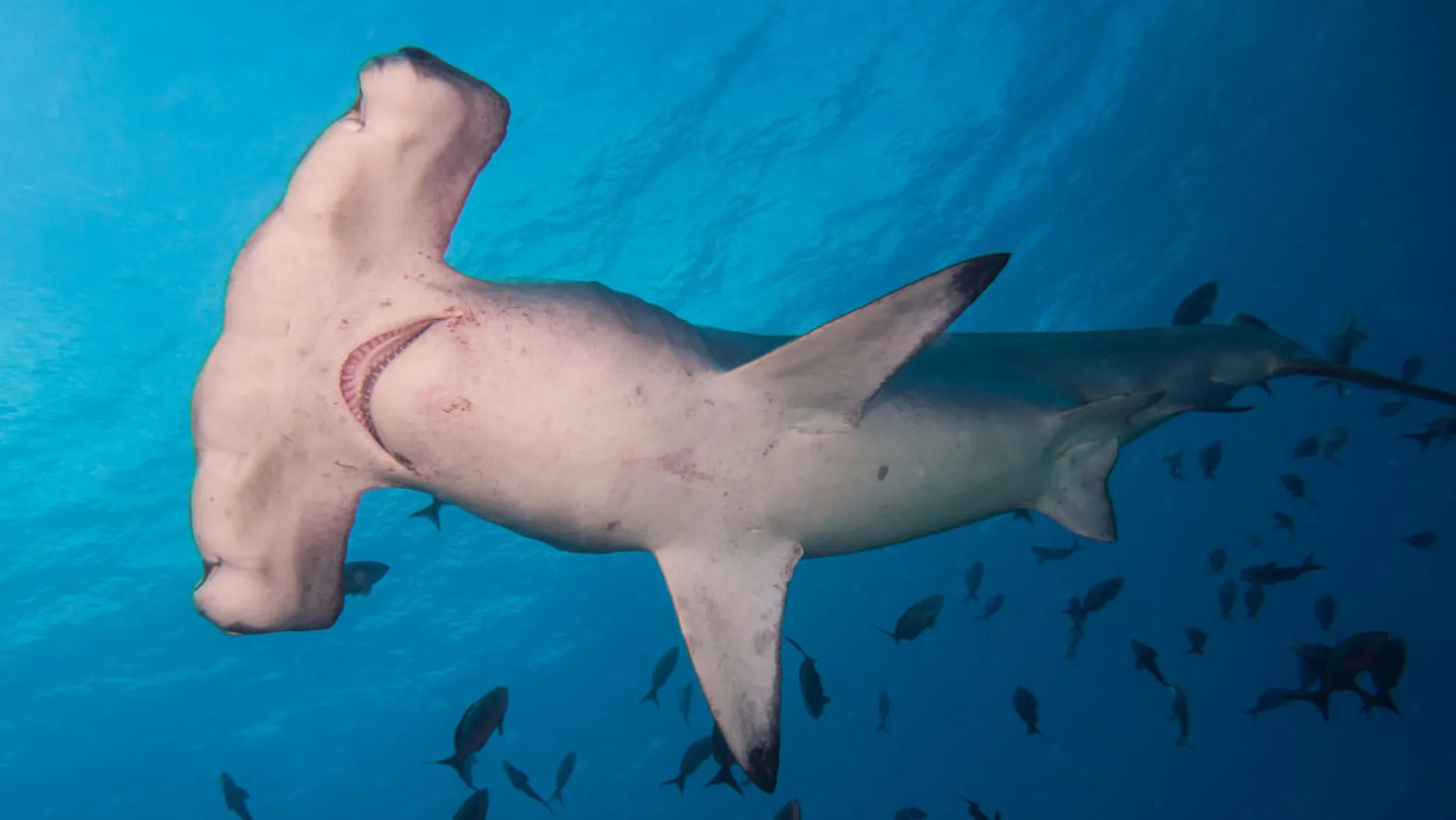
A wide, hammer-shaped head gives the Scalloped Hammerhead its distinctive profile. A notch in the centre of the front edge, with two more on each side, creates its scalloped outline. Its upper body is usually grey, greyish brown, bronze or olive, contrasting with a white underside. It is a fairly large shark, with a maximum reported length of 4.3 m.
This shark lives in warm temperate and tropical seas around the world, over continental and island shelves and in deeper water nearby. It can descend beyond 500 m, although it is most often found above 25 m. By day it tends to stay closer to shore, moving farther offshore to hunt at night. Young sharks gather in larger groups, whereas adults may be solitary, paired or in small schools. Schools can sometimes number in the hundreds, and younger sharks tend to stay closer to the surface than adults. Its diet consists mainly of fish such as sardines, mackerel and herring, with squid, octopus and crustaceans also on the menu.
Females give birth to live young after a pregnancy of around 12 months, and litters contain 12 to 41 pups. Shallow bays and mangroves shelter young sharks, which need plenty of food to survive. In Costa Rica, juveniles remain among the mangrove roots of Golfo Dulce for around three years before migrating to waters around Cocos Island to feed. Overfishing and demand for fins threaten the species, while sharks are also caught unintentionally on longlines and in nets. Their habit of gathering in large groups can make it easier for fisheries to catch many at once.
Written from the English Wikipedia article Scalloped hammerhead (CC BY-SA 4.0).
- Records
- 955
- Countries
- 30
- Atlas places
- 3
These are open occurrence records, so they show where people looked for and recorded the Scalloped Hammerhead as much as where it lives. Cells are up to 25 km across, and every location is generalised to its cell.
Generalised encounter areas, not exact locations. Each shape is a grid cell coloured by how likely the species is there.
- Very likelyMexico25 km zone · medium confidence · 314 records · updated 80 days ago
- Very likelyIndonesia25 km zone · medium confidence · 109 records · updated 80 days ago
- Very likelyMozambique25 km zone · medium confidence · 108 records · updated 80 days ago
- Very likelyCosta Rica25 km zone · high confidence · 94 records · updated 80 days ago
- Very likelyUnited States25 km zone · medium confidence · 82 records · updated 80 days ago
- Very likelyAustralia25 km zone · medium confidence · 43 records · updated 80 days ago
- Very likelyEcuador25 km zone · medium confidence · 43 records · updated 80 days ago
- Very likelyPapua New Guinea25 km zone · medium confidence · 34 records · updated 80 days ago
- Very likelyU.S. Outlying Islands25 km zone · medium confidence · 16 records · updated 80 days ago
- Very likelyGuam25 km zone · medium confidence · 14 records · updated 80 days ago
Conservation status not assessed here yet, so every location is generalised to its grid cell.