Yellow-bellied Sapsucker
Sphyrapicus varius
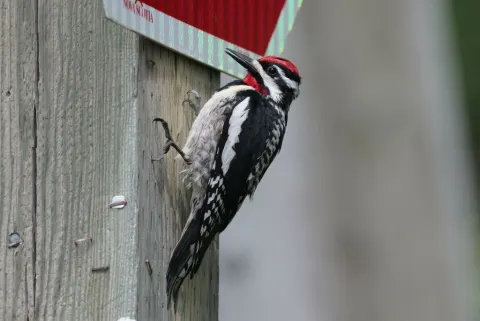
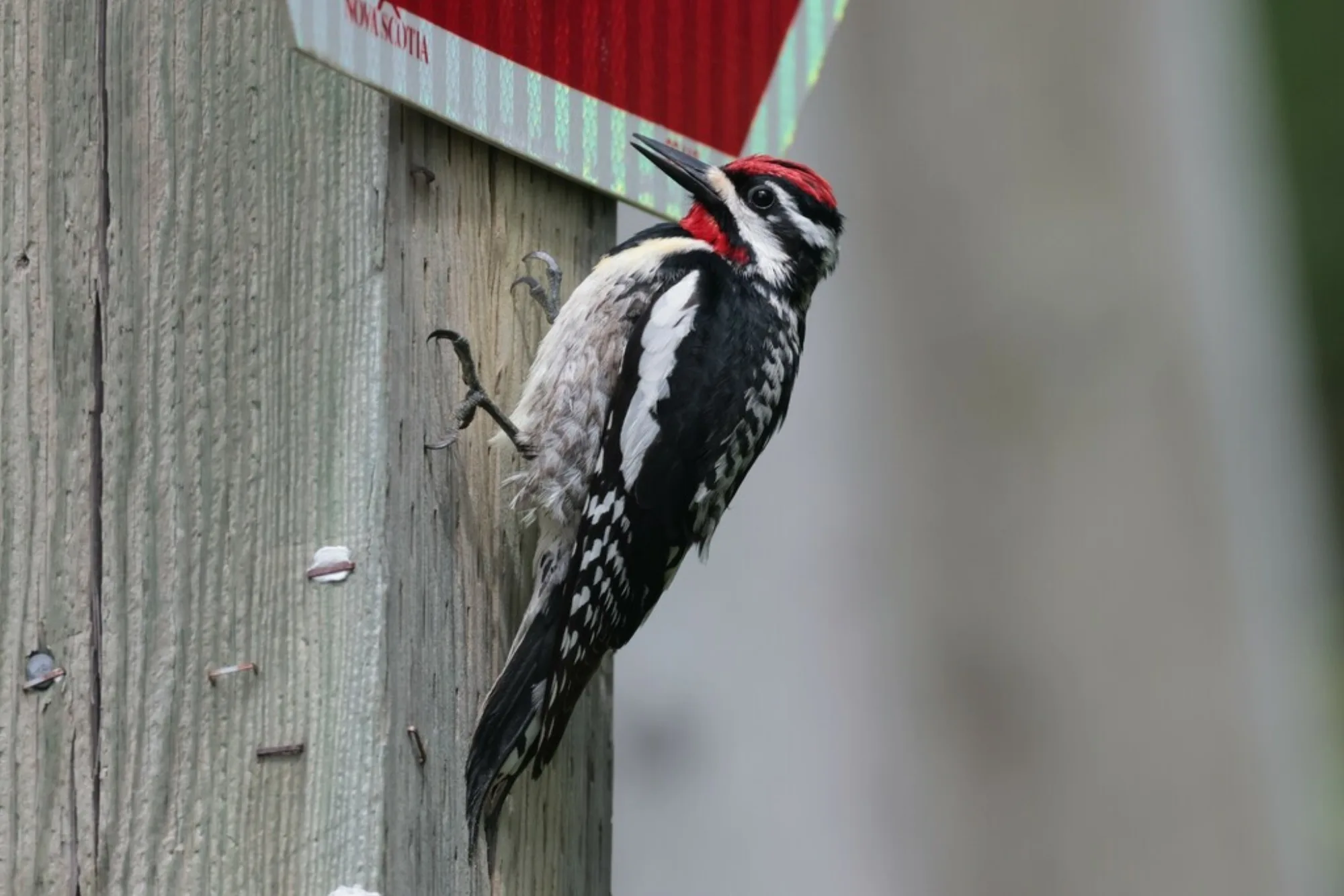
Look for the Yellow-bellied Sapsucker in forests from eastern Alaska across Canada to the northeastern United States. This medium-sized woodpecker measures around 19 to 21 centimetres long, with a black-and-white patterned back, a white wing panel and yellow-tinged underparts. Its crown is usually red and bordered in black; males have a red throat, while females have a white one. Listen, too, for drumming on dead trees: the bursts begin rapidly, then become more drawn out.
The bird breeds in deciduous and mixed coniferous forests, at elevations up to 2,000 metres. It spends winter in Central America, the West Indies and the eastern United States, where it uses forests and their edges, open woodland, and tall trees in suburban areas, clearings and pastures. Usually feeding alone, it drills rows of holes in trees for sap and also eats insects, fruit and nuts. Sap becomes its main food in late summer and autumn, while insects make up about half the adults' diet during nesting. Pairs excavate a cavity in a living deciduous tree, often one with rotten heartwood, and may reuse a suitable tree. Both parents incubate the four to seven eggs and feed the chicks, chiefly on insects. Young birds leave the nest after 25 to 29 days and become independent about two weeks later.
Although common within its range, the sapsucker can be difficult to see outside the breeding season, and its population is decreasing. Raccoons can kill adults and nestlings, particularly when a nest is too low or too shallow; snakes also prey on nests.
Written from the English Wikipedia article Yellow-bellied sapsucker (CC BY-SA 4.0).
- Records
- 897,713
- Countries
- 3
- Atlas places
- 3
These are open occurrence records, so they show where people looked for and recorded the Yellow-bellied Sapsucker as much as where it lives. Cells are up to 25 km across, and every location is generalised to its cell.
Generalised encounter areas, not exact locations. Each shape is a grid cell coloured by how likely the species is there.
- Very likelyUnited States25 km zone · high confidence · 739874 records · updated 80 days ago
- Very likelyCanada25 km zone · high confidence · 157839 records · updated 80 days ago
Conservation status not assessed here yet, so every location is generalised to its grid cell.