Great Barracuda
Sphyraena barracuda
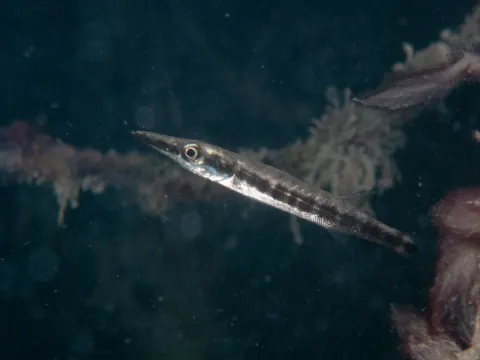
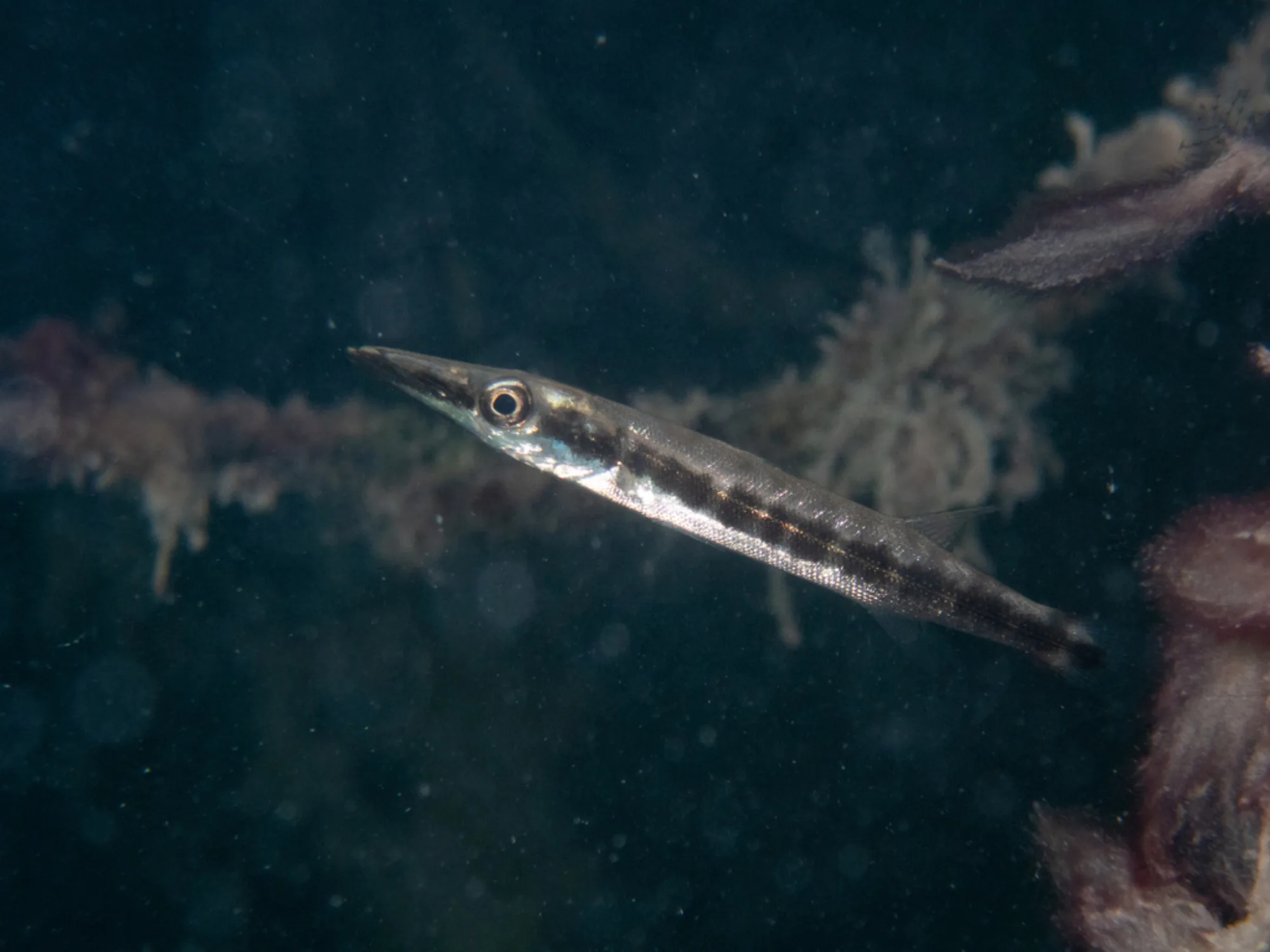
Long, pointed and silvery, the Great Barracuda has a large head and powerful jaws lined with fang-like teeth. Its lower jaw projects beyond the upper one, and its blue-grey back fades to silvery white underneath. Dark stripes sometimes mark the upper sides, while black blotches may appear lower down. Mature fish usually measure 60 to 100 cm and weigh 2.5 to 9.0 kg, though exceptionally large individuals can exceed 1.5 m and 23 kg.
Great barracudas live in tropical to warm temperate waters of the Indian, Pacific and Atlantic oceans, often near the equator. They shelter among mangroves, seagrass beds and deep reefs, reaching depths of up to 110 m. Young fish and small adults generally stay near shore, while larger adults tend to use reefs, rocks and artificial structures farther out. Barracudas are generally solitary, although young and half-grown fish often gather in schools. They hunt by ambush, using surprise and brief bursts of speed to catch prey, and eat mainly fish, along with cephalopods and occasionally shrimp. Large individuals may herd prey fish into shallow water and guard them until they are ready to hunt again. They also scavenge and may follow snorkellers in the hope of finding food left by larger predators.
Spawning takes place from April to October, with the highest rate in July, August and September. A female may release approximately 5,000 to 30,000 eggs. Great barracudas are popular with recreational anglers and are reportedly declining in Florida. Fishing-related stress can reduce their ability to reach shelter, leaving them more exposed to predators.
Written from the English Wikipedia article Great barracuda (CC BY-SA 4.0).
- Records
- 7,920
- Countries
- 45
- Atlas places
- 3
These are open occurrence records, so they show where people looked for and recorded the Great Barracuda as much as where it lives. Cells are up to 25 km across, and every location is generalised to its cell.
Generalised encounter areas, not exact locations. Each shape is a grid cell coloured by how likely the species is there.
- Very likelyUnited States25 km zone · high confidence · 4977 records · updated 80 days ago
- Very likelyMozambique25 km zone · high confidence · 714 records · updated 80 days ago
- Very likelyPuerto Rico25 km zone · high confidence · 388 records · updated 80 days ago
- Very likelyGuadeloupe25 km zone · medium confidence · 282 records · updated 80 days ago
- Very likelyU.S. Virgin Islands25 km zone · medium confidence · 150 records · updated 80 days ago
- Very likelyBrazil25 km zone · medium confidence · 149 records · updated 80 days ago
- Very likelyMexico25 km zone · medium confidence · 145 records · updated 80 days ago
- Very likelyBelize25 km zone · high confidence · 143 records · updated 80 days ago
- Very likelyU.S. Outlying Islands25 km zone · medium confidence · 96 records · updated 80 days ago
- Very likelySeychelles25 km zone · medium confidence · 91 records · updated 80 days ago
Conservation status not assessed here yet, so every location is generalised to its grid cell.