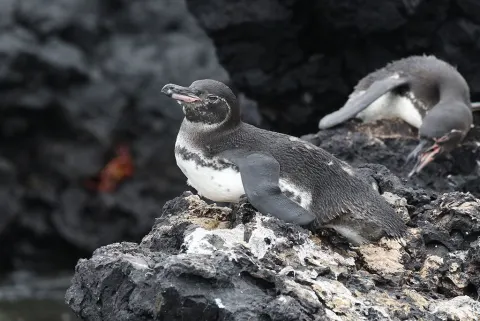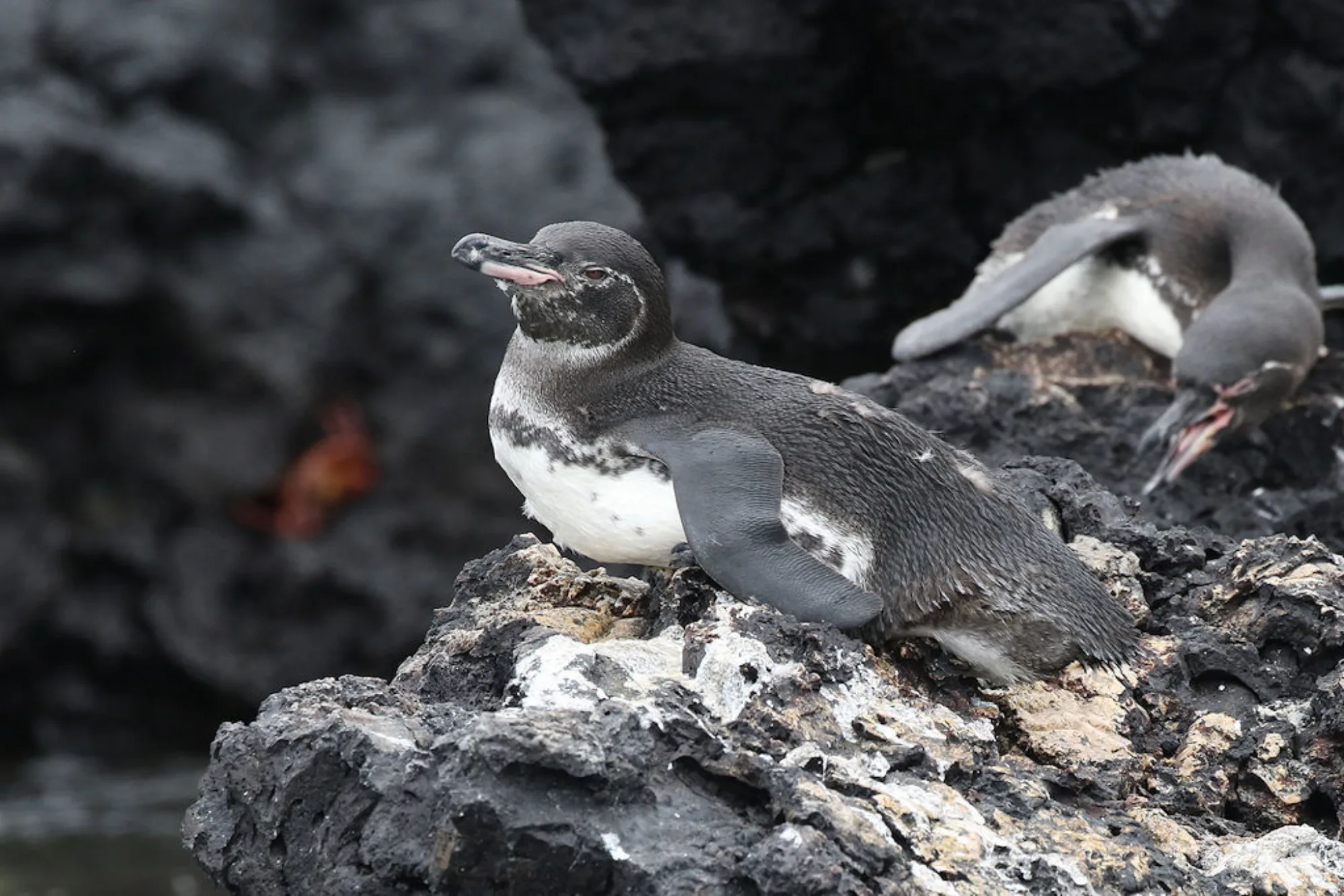
Galapagos Penguin
Spheniscus mendiculus
Found only in Ecuador's Galápagos Islands, the Galapagos Penguin is the only penguin that lives north of the equator. Most live on Fernandina and the west coast of Isabela, where rocky shores offer nesting places and cool currents support their food supply. Adults have black backs, heads and flippers, white bellies and a white stripe that curves around the head to the throat. Two black bands cross the breast, while young birds have dark heads and lack a breast band. At 48 to 50 centimetres tall and around 2 to 4 kilograms, adults are among the smallest penguins.
During the day they forage in cool water, returning to land at night and usually staying within a few kilometres of their breeding sites. They eat small schooling fish, including mullet, sardines, pilchards and anchovies, as well as occasional crustaceans. On land, they pant or hold their flippers out and lean forward to shade their feet. Pairs stay together for life and can breed throughout the year, with nesting most common from May to July. They lay one or two eggs in caves or rock crevices, where the young are sheltered from the sun and predators. Both parents take turns incubating, and one remains at the nest to guard the eggs or chicks when the other goes off to feed.
El Niño can reduce the food available, causing starvation and poor breeding success; during such periods the birds may postpone breeding. Other pressures include fishing nets, habitat loss, pollution and introduced cats, dogs and rats that attack penguins and destroy nests. Poorly managed tourism can also disrupt breeding, collapse burrows and kill birds.
Written from the English Wikipedia article Galapagos penguin (CC BY-SA 4.0).
- Records
- 8,652
- Countries
- 1
- Atlas places
- 1
These are open occurrence records, so they show where people looked for and recorded the Galapagos Penguin as much as where it lives. Cells are up to 25 km across, and every location is generalised to its cell.
Generalised encounter areas, not exact locations. Each shape is a grid cell coloured by how likely the species is there.
- Very likelyEcuador25 km zone · high confidence · 8652 records · updated 80 days ago
Conservation status not assessed here yet, so every location is generalised to its grid cell.