Humboldt Penguin
Spheniscus humboldti
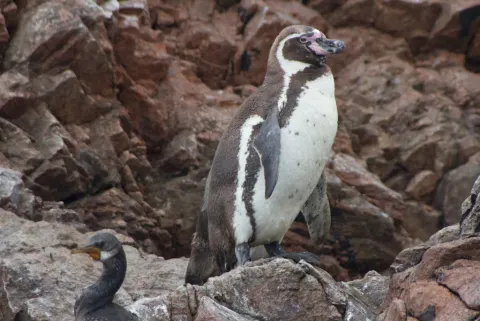
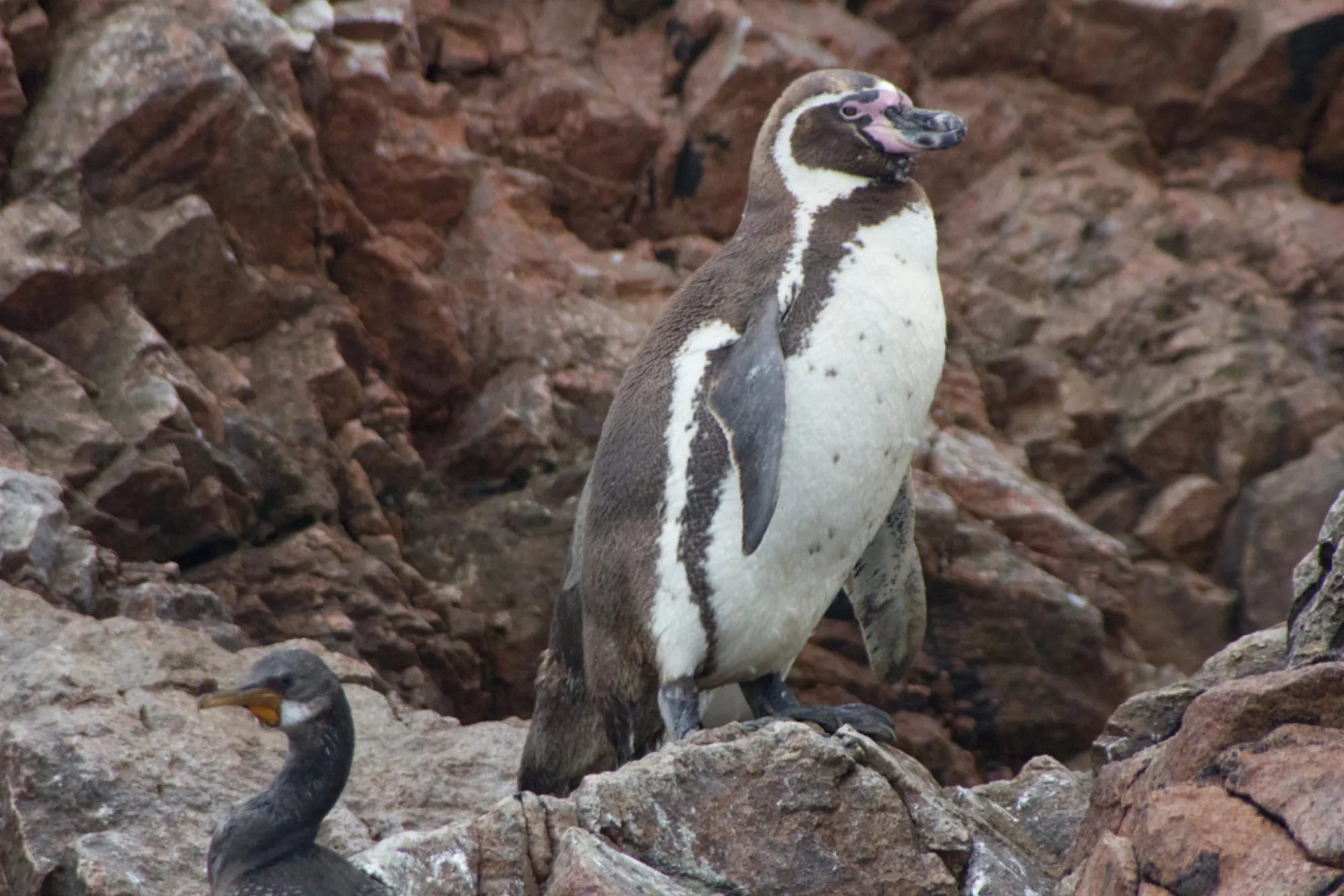
The Humboldt Penguin travels between the rocky shores and offshore islands of Peru and Chile, swimming in the cold Humboldt Current. This medium-sized penguin grows to between 56 and 70 cm long and weighs between 2.9 and 6 kg. Adults have dark upperparts, pale underparts and a black band across the breast that continues down the sides. A white border curves around the black head to the throat, and the base of the bill is pink; juveniles lack the breast band.
Its breeding range stretches from southern Chile, past the dry Atacama Desert coast, to Isla Foca in northern Peru. Penguins nest in loose colonies, digging into guano or using caves, hollows, beaches and other sheltered places. Most pairs lay two eggs, and parents take turns incubating them and searching for food. One parent guards the chicks while the other forages, until the young are old enough to be left at the nest. At sea, these visual hunters catch schooling fish, mostly by seizing them from below on short, shallow dives. Their diet varies with location and season, and can also include squid and crustaceans.
Food shortages and changing conditions can send Humboldt Penguins over long distances, including southwards during El Niño as they follow anchovy stocks. El Niño can also bring mass deaths, abandoned nests and breeding failure. Overfishing reduces the availability of prey, while fishing nets can entangle the birds. Human visits can disturb nesting penguins, and repeated disturbance can lead them to desert their nests. Introduced rats eat eggs, while feral cats and dogs take chicks and adults; oil spills and industrial development also threaten some colonies.
Written from the English Wikipedia article Humboldt penguin (CC BY-SA 4.0).
- Records
- 12,102
- Countries
- 4
- Atlas places
- 1
These are open occurrence records, so they show where people looked for and recorded the Humboldt Penguin as much as where it lives. Cells are up to 25 km across, and every location is generalised to its cell.
Generalised encounter areas, not exact locations. Each shape is a grid cell coloured by how likely the species is there.
- Very likelyChile25 km zone · high confidence · 7641 records · updated 80 days ago
- Very likelyPeru25 km zone · high confidence · 4442 records · updated 80 days ago
- PossibleEcuador25 km zone · medium confidence · 11 records · updated 80 days ago
- PossibleUnited States25 km zone · medium confidence · 8 records · updated 80 days ago
Conservation status not assessed here yet, so every location is generalised to its grid cell.