African Penguin
Spheniscus demersus
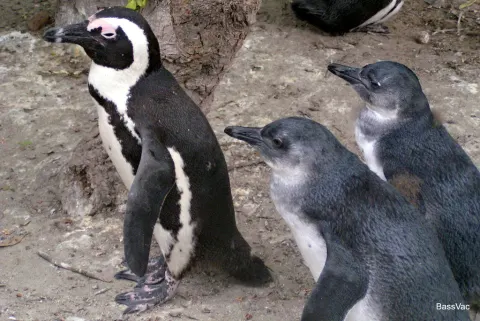
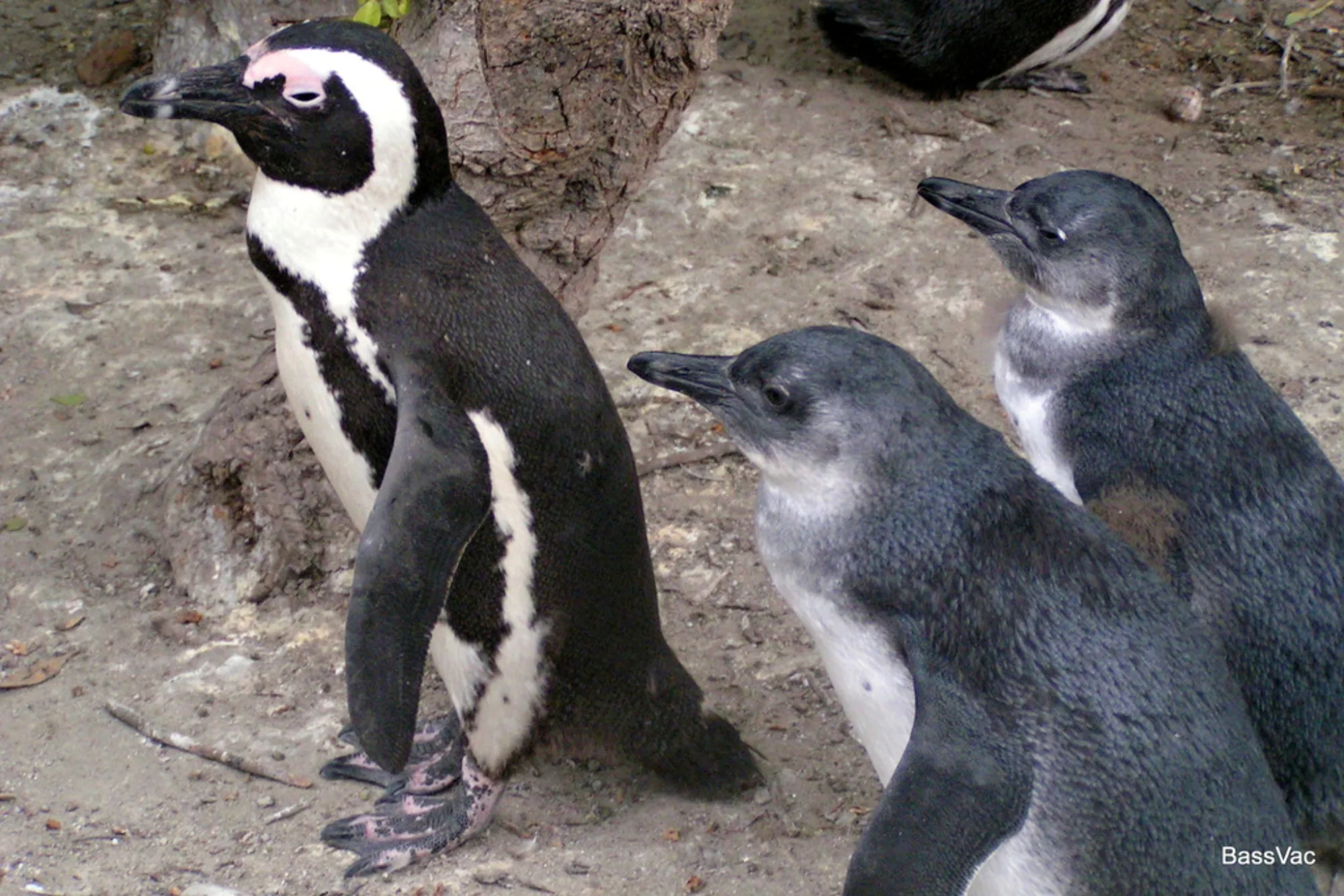
A black mask and pink skin patches over its eyes give the African Penguin a distinctive face. Adults have black backs and white underparts, with a black band and spots whose pattern is unique to each bird. Young birds lack these bold markings, with greyish-blue to brown upperparts and pale, unspotted underparts. Flightless on land, the penguin uses its flattened wings as flippers in the water, and its loud braying call has earned it the name jackass penguin.
Along the coasts of Namibia and South Africa, African penguins live in colonies on offshore islands and at a few mainland sites. Boulders Beach, near Simon's Town, attracts visitors with its beach and penguins, which can allow people to approach closely. At sea, the birds dive in pursuit of fish and squid, normally swimming within 20 km of shore. They eat sardines and anchovies among other prey, but a decline in sardines has shifted their diet towards anchovies to some extent. Pairs return to the same breeding site each year, nesting in guano burrows or in sand beneath rocks or bushes. Both parents share incubation, and after about a month of parental guarding, chicks gather with others while their parents forage.
Food shortages are a serious threat: commercial fishing has forced penguins to look farther offshore and switch to less nutritious prey. The removal of guano for fertiliser has also deprived many colonies of material for sheltered burrows, leaving birds more exposed to heat and predators. Oil pollution from spills, shipwrecks and tankers adds to the pressures they face at sea.
Written from the English Wikipedia article African penguin (CC BY-SA 4.0).
- Records
- 10,240
- Countries
- 4
- Atlas places
- 9
- Addo Elephant National Park· South Africa
- Table Mountain National Park· South Africa
- Garden Route National Park· South Africa
- Namib-Naukluft· Namibia
- West Coast National Park· South Africa
- Tsau ǁKhaeb (Sperrgebiet) National Park· Namibia
- Dorob National Park· Namibia
- Walvis Bay· Namibia
- Ai-Ais/Richtersveld Transfrontier Park· Namibia
These are open occurrence records, so they show where people looked for and recorded the African Penguin as much as where it lives. Cells are up to 25 km across, and every location is generalised to its cell.
Generalised encounter areas, not exact locations. Each shape is a grid cell coloured by how likely the species is there.
- Very likelySouth Africa25 km zone · high confidence · 9972 records · updated 80 days ago
- Very likelyNamibia25 km zone · high confidence · 260 records · updated 80 days ago
- PossibleCanada25 km zone · medium confidence · 4 records · updated 80 days ago
- PossibleUnited States25 km zone · medium confidence · 4 records · updated 80 days ago
Conservation status not assessed here yet, so every location is generalised to its grid cell.