Blue-winged Teal
Spatula discors
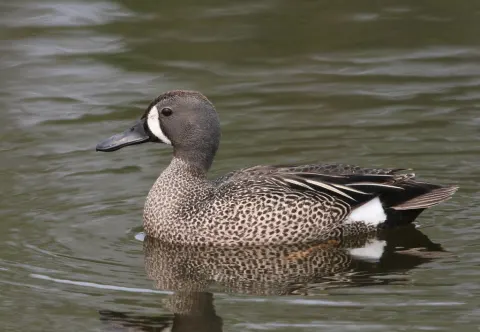
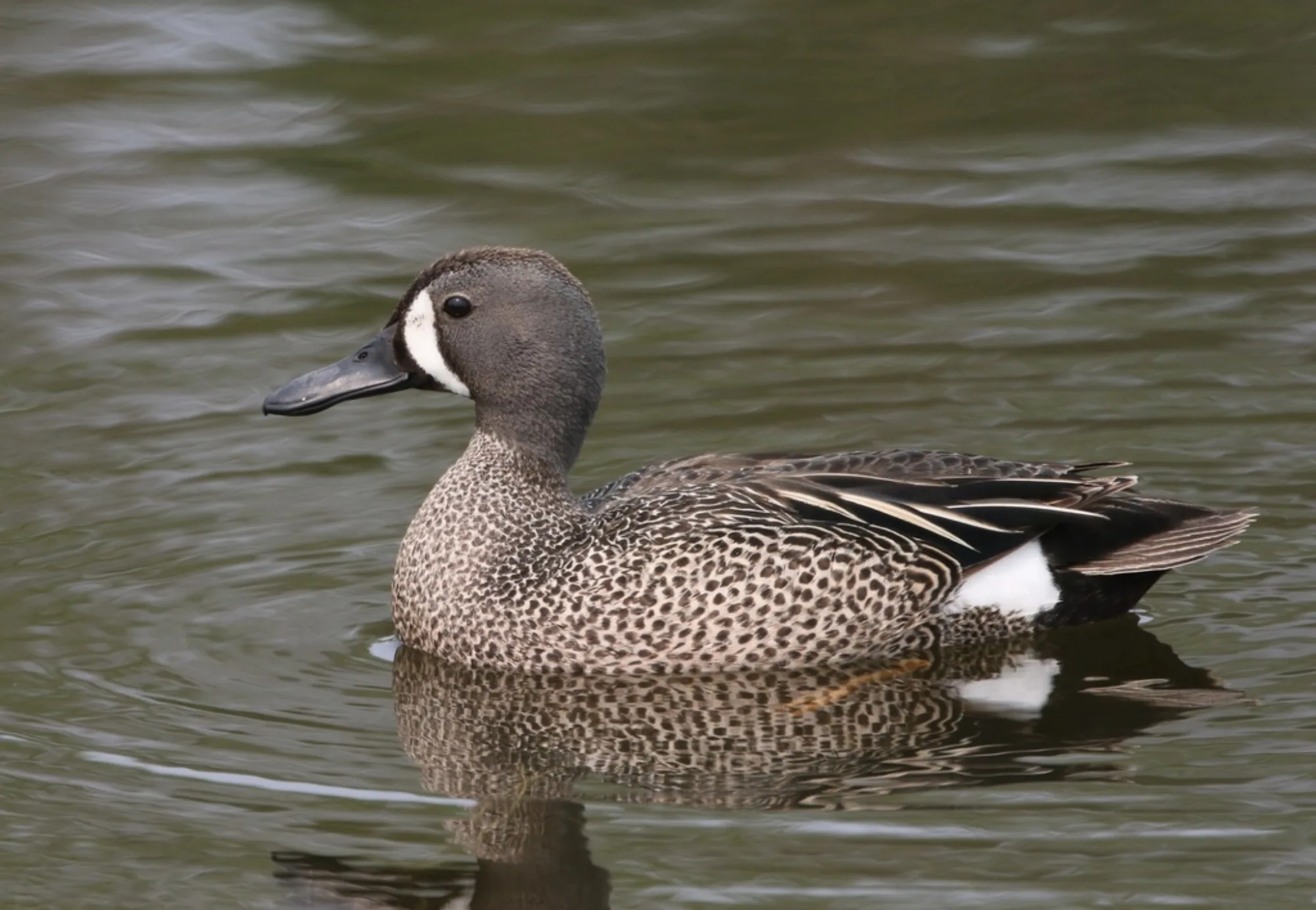
Small and compact, the Blue-winged Teal is a North American dabbling duck measuring 40 cm in length, with a 58 cm wingspan. A white crescent marks the adult male's greyish blue head; he has a light brown body and a black tail. The female is mottled brown with a whitish patch at the base of her bill; both sexes have yellow legs and sky-blue wing patches. Listen for the male's short whistle or the female's soft quack.
The species breeds across a broad stretch of North America, reaching Nova Scotia in the east, southern Alaska in the west and northern Texas in the south. It nests around marshes and ponds, favouring shorelines, calm water and wetlands with dense vegetation. In coastal breeding areas, look for it in salt-marsh meadows beside ponds or creeks. Birds migrate south in flocks, sometimes crossing long distances over open ocean, and often spend the winter in places as distant as Brazil and central Chile. Winter habitat includes shallow freshwater marshes inland, as well as brackish and saltwater marshes.
At the water's edge, these ducks dabble in the shallows, eating mainly plants along with molluscs and aquatic insects. They also rest on exposed rocks, fallen trees, bare shorelines and mud flats, and shelter among bulrushes and cattails. Nests are shallow hollows on dry ground, lined with grass and down, where females generally lay 10 to 12 eggs. Within 12 hours of hatching, ducklings can make their way on foot to water, though they do not fly until 6 to 7 weeks. Predators include foxes, raccoons, skunks, crows and magpies; in one study, mammals caused about half of all nest failures.
Written from the English Wikipedia article Blue-winged teal (CC BY-SA 4.0).
- Records
- 1,154,348
- Countries
- 10
- Atlas places
- 1
These are open occurrence records, so they show where people looked for and recorded the Blue-winged Teal as much as where it lives. Cells are up to 25 km across, and every location is generalised to its cell.
Generalised encounter areas, not exact locations. Each shape is a grid cell coloured by how likely the species is there.
- Very likelyUnited States25 km zone · high confidence · 994886 records · updated 80 days ago
- Very likelyCanada25 km zone · high confidence · 97528 records · updated 80 days ago
- Very likelyMexico25 km zone · high confidence · 40421 records · updated 80 days ago
- Very likelyCosta Rica25 km zone · high confidence · 3840 records · updated 80 days ago
- Very likelyBelize25 km zone · high confidence · 3496 records · updated 80 days ago
- Very likelyBermuda25 km zone · high confidence · 3214 records · updated 80 days ago
- Very likelyColombia25 km zone · high confidence · 3041 records · updated 80 days ago
- Very likelyPuerto Rico25 km zone · high confidence · 2710 records · updated 80 days ago
- Very likelyCuraçao25 km zone · high confidence · 2673 records · updated 80 days ago
- Very likelyCayman Islands25 km zone · high confidence · 2539 records · updated 80 days ago
Conservation status not assessed here yet, so every location is generalised to its grid cell.