Northern Shoveler
Spatula clypeata
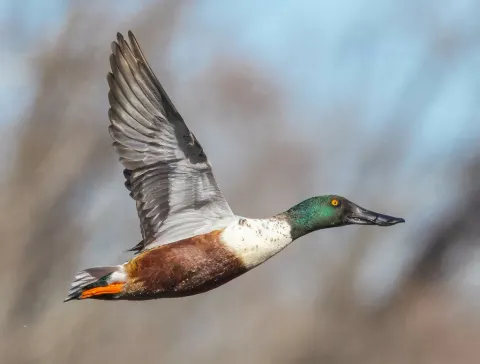
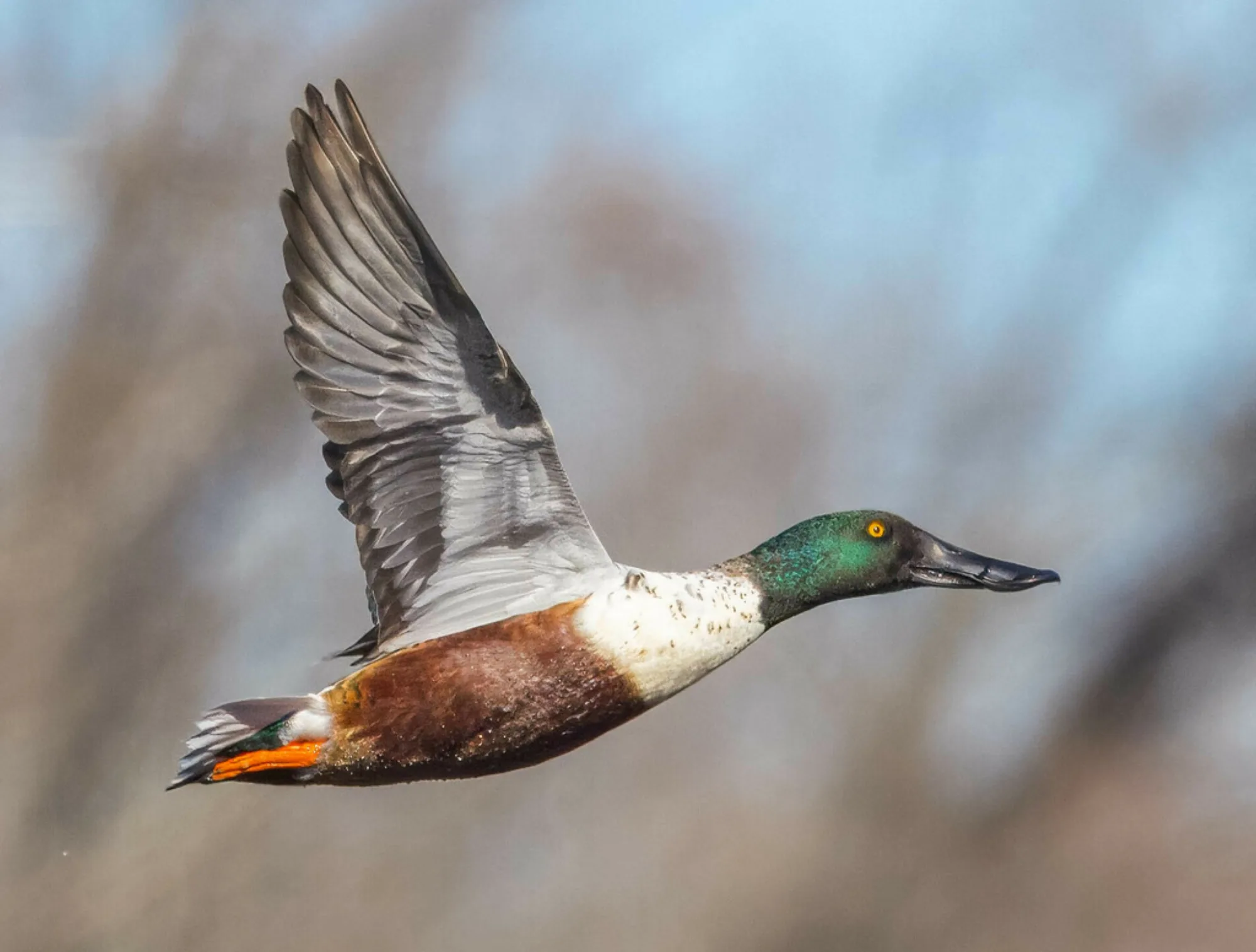
A broad, spoon-shaped bill makes the Northern Shoveler easy to pick out among Northern Hemisphere ducks. In breeding plumage, the male has a dark green head, white breast and chestnut belly and sides, with a black or very dark grey bill. His head can look black from a distance or in poor light. The female is mottled brown, with a long, broad bill and a grey forewing. Both sexes have bright orange-red legs, and the birds measure 44 to 52 cm in length.
Look for shovelers in open wetlands, including wet grasslands and marshes with vegetation rising above the water. They favour mud-bottomed marshes rich in aquatic invertebrates. The species breeds across large parts of Eurasia and western North America, as well as in the Great Lakes region. It migrates strongly, generally spending winter south of its breeding range, including in southern Europe, the Indian subcontinent, the Caribbean and northern South America. In Great Britain, the bird is more familiar in winter and occurs most often in southern and eastern England, with the North Kent Marshes, the Humber and the Ouse Washes among its haunts.
On the water, a shoveler may sweep its bill from side to side, straining plant food and small aquatic animals from the surface. Outside the breeding season, it tends to gather in small flocks. Females nest in grassy places away from open water, lining a shallow ground hollow with vegetation and down and typically laying about nine eggs. During breeding, males defend territories and display both in the air and on the water. The species is fairly quiet, though the female gives a mallard-like quack and the male makes a clunking call.
Written from the English Wikipedia article Northern shoveler (CC BY-SA 4.0).
- Records
- 1,910,942
- Countries
- 16
No atlas park has a record of the Northern Shoveler in or around it yet.
These are open occurrence records, so they show where people looked for and recorded the Northern Shoveler as much as where it lives. Cells are up to 25 km across, and every location is generalised to its cell.
Generalised encounter areas, not exact locations. Each shape is a grid cell coloured by how likely the species is there.
- Very likelyUnited States25 km zone · high confidence · 1448260 records · updated 80 days ago
- Very likelyCanada25 km zone · high confidence · 146457 records · updated 80 days ago
- Very likelyUnited Kingdom25 km zone · high confidence · 91786 records · updated 80 days ago
- Very likelyBelgium25 km zone · high confidence · 87578 records · updated 80 days ago
- Very likelyTaiwan25 km zone · high confidence · 43708 records · updated 80 days ago
- Very likelyMexico25 km zone · high confidence · 23033 records · updated 80 days ago
- Very likelySpain25 km zone · high confidence · 18973 records · updated 80 days ago
- Very likelyFrance25 km zone · high confidence · 14391 records · updated 80 days ago
- Very likelyIndia25 km zone · high confidence · 8738 records · updated 80 days ago
- Very likelyNetherlands25 km zone · high confidence · 7748 records · updated 80 days ago
Conservation status not assessed here yet, so every location is generalised to its grid cell.