Arctic Shrew
Sorex arcticus
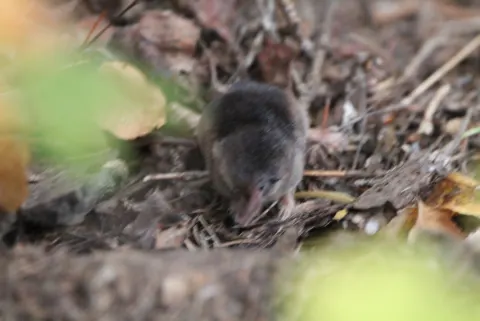
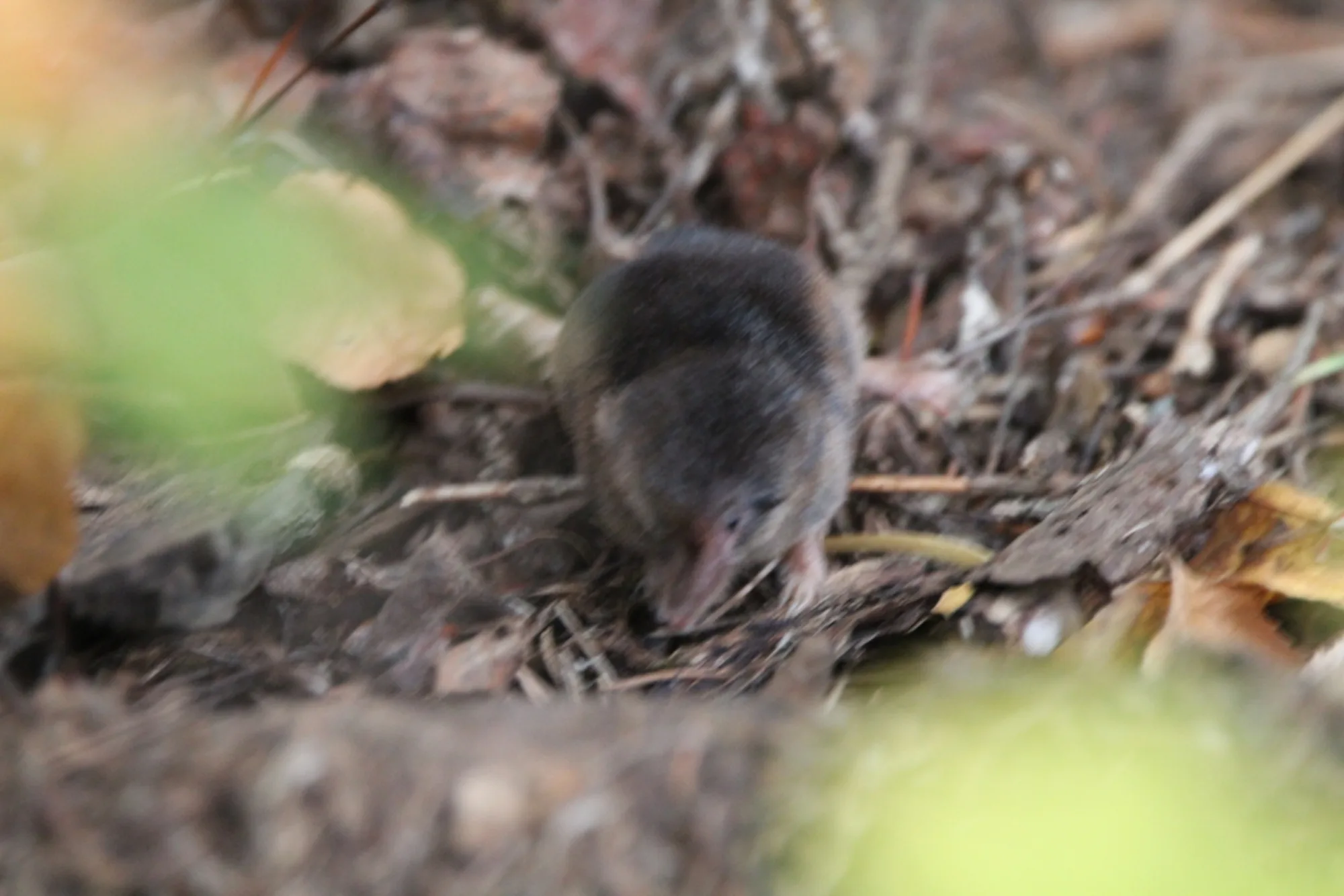
A dark back, pale flanks and a still lighter underside give the Arctic Shrew its distinctive three-coloured coat. Its back is dark brown or black, its sides are lighter brown, and its underside is greyish brown. The tail is two-coloured too, fading from dark brown above to lighter brown beneath. In winter the fur becomes greyer, thicker and brighter, and the three bands are most distinct from October to June. Including its 4 cm tail, the shrew measures 10 to 12 cm in body length and weighs 5 to 13 g.
Its range stretches across North America from the Arctic Circle to the northern United States, with eastern limits in Quebec and the Atlantic Maritime provinces and western limits in the southern Yukon and Mackenzie valleys. It is most numerous near water, including lakes, streams, marshes, bogs and ditches. In Michigan's Upper Peninsula, it is common in spruce and tamarack swamps, and it has also been found in boreal forest clearings, alder thickets and grassy areas near ditches.
Solitary and territorial as adults, Arctic shrews move quickly and are active both day and night. They eat insects, worms and other small invertebrates, with larch sawflies making up a large share of the diet. In Wisconsin, breeding runs from February to August, while farther north it runs from April to August. Females have one or two litters a year, each with 4 to 10 young, and care for them through weaning. Great horned owls are their only known predators.
Written from the English Wikipedia article Arctic shrew (CC BY-SA 4.0).
- Records
- 120
- Countries
- 2
No atlas park has a record of the Arctic Shrew in or around it yet.
These are open occurrence records, so they show where people looked for and recorded the Arctic Shrew as much as where it lives. Cells are up to 25 km across, and every location is generalised to its cell.
Generalised encounter areas, not exact locations. Each shape is a grid cell coloured by how likely the species is there.
- Very likelyUnited States25 km zone · medium confidence · 65 records · updated 80 days ago
- Very likelyCanada25 km zone · medium confidence · 55 records · updated 80 days ago
Conservation status not assessed here yet, so every location is generalised to its grid cell.