Greenland Shark
Somniosus microcephalus
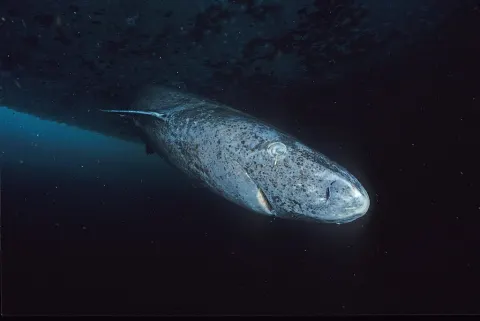
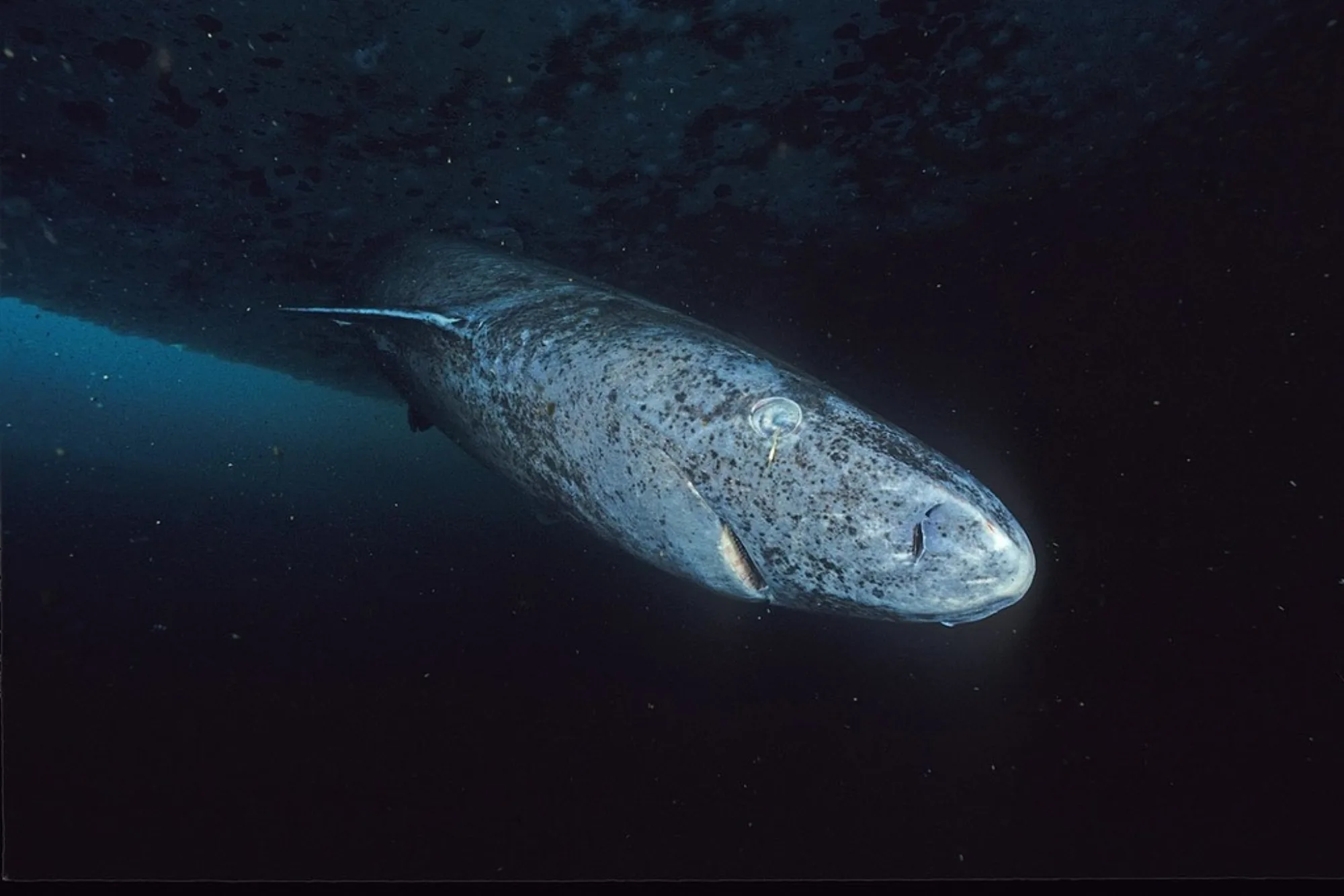
A thickset body, short rounded snout and small eyes give the Greenland Shark a distinctive profile. Adults grow to around 4 to 5 m, and the largest confirmed specimen reached 6.4 m. Its colour ranges from pale creamy-grey to blackish-brown, usually even across the body, sometimes with whitish spots or faint dark streaks on the back. Parasites often attach to its eyes and can cause almost complete blindness, but the shark relies strongly on smell and hearing.
This slow-moving shark inhabits the North Atlantic and Arctic Oceans, favouring cold, deep water. It also occurs farther south, including around the Mid-Atlantic Ridge and in the Gulf of Mexico. In the far north it is often found in relatively shallow water, while farther south it tends to live deeper. During winter, sharks gather in the shallows, moving separately into deeper water or farther south in summer. Both predator and scavenger, the Greenland Shark feeds mainly on fish and seals, and is drawn to the smell of rotting meat. Scientists are unsure how such a slow swimmer catches seals, though one suggestion is that it ambushes them as they sleep.
Greenland sharks are estimated to reach maturity at around 150 years, and their young are born alive after an estimated 8 to 18 years of gestation. Today, industrial fisheries catch them mainly as bycatch, and their slow reproduction may limit recovery from overfishing. Projected sea ice loss could affect their prey and give fishing fleets greater access to Arctic waters.
Written from the English Wikipedia article Greenland shark (CC BY-SA 4.0).
- Records
- 158
- Countries
- 4
No atlas park has a record of the Greenland Shark in or around it yet.
These are open occurrence records, so they show where people looked for and recorded the Greenland Shark as much as where it lives. Cells are up to 25 km across, and every location is generalised to its cell.
Generalised encounter areas, not exact locations. Each shape is a grid cell coloured by how likely the species is there.
- Very likelySvalbard & Jan Mayen25 km zone · medium confidence · 118 records · updated 80 days ago
- LikelyCanada25 km zone · medium confidence · 24 records · updated 80 days ago
- LikelyIceland25 km zone · medium confidence · 10 records · updated 80 days ago
- LikelyNorway25 km zone · medium confidence · 6 records · updated 80 days ago
Conservation status not assessed here yet, so every location is generalised to its grid cell.