Southern Sleeper Shark
Somniosus antarcticus
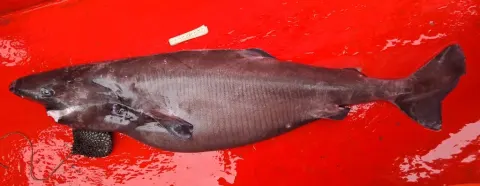
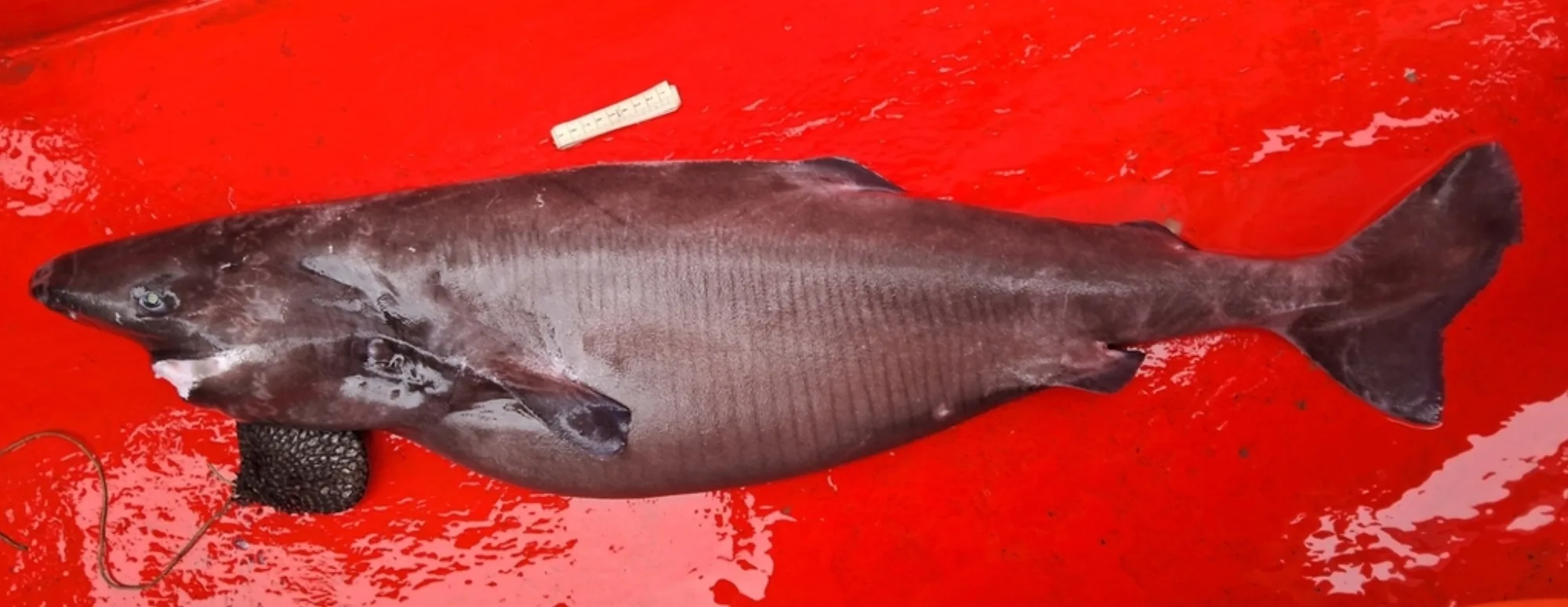
Reaching lengths of up to 6 m, this robust fish is a heavy, torpedo-shaped inhabitant of the deep. You can recognize the Southern Sleeper Shark by its small eyes, rounded snout, and dark grey or brownish-grey skin. It has a rough texture and lacks spines on its low dorsal fins. The tail is shaped like an asymmetrical paddle with a large upper lobe. While it resembles its relatives in the north, this species has more rows of teeth in its lower jaw and shorter dorsal fins.
These sharks roam the Southern Ocean and temperate waters near South Africa, southern Australia, New Zealand, and South America. They are typically found along continental slopes and underwater plateaus at depths between 300 and 1,440 m. Though they are rarely seen, a research camera recently filmed one at 490 m in the South Shetland Trough. This was a rare confirmed sighting of a shark in these freezing Antarctic waters.
Living as both a scavenger and a predator, the shark consumes a wide range of animals including fish, brittle stars, and seals. Squid are a major part of their diet, and they have been known to eat massive colossal and giant squid. They also take marine mammals, with one individual found to have consumed a southern right whale dolphin. Although they have few known enemies, these sharks are sometimes caught as accidental bycatch by commercial fishing vessels seeking Patagonian toothfish or orange roughy.
Written from the English Wikipedia article Southern sleeper shark (CC BY-SA 4.0).
- Atlas places
- 0
These are open occurrence records, so they show where people looked for and recorded the Southern Sleeper Shark as much as where it lives. Cells are up to 25 km across, and every location is generalised to its cell.
No encounter zones yet
Where and when you can expect to see Southern Sleeper Shark is calculated from observation density. No zones have been computed for this species yet.
Conservation status not assessed here yet, so every location is generalised to its grid cell.