King Eider
Somateria spectabilis
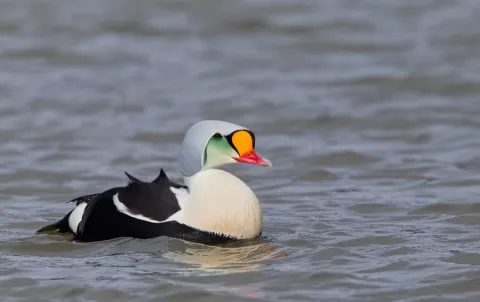
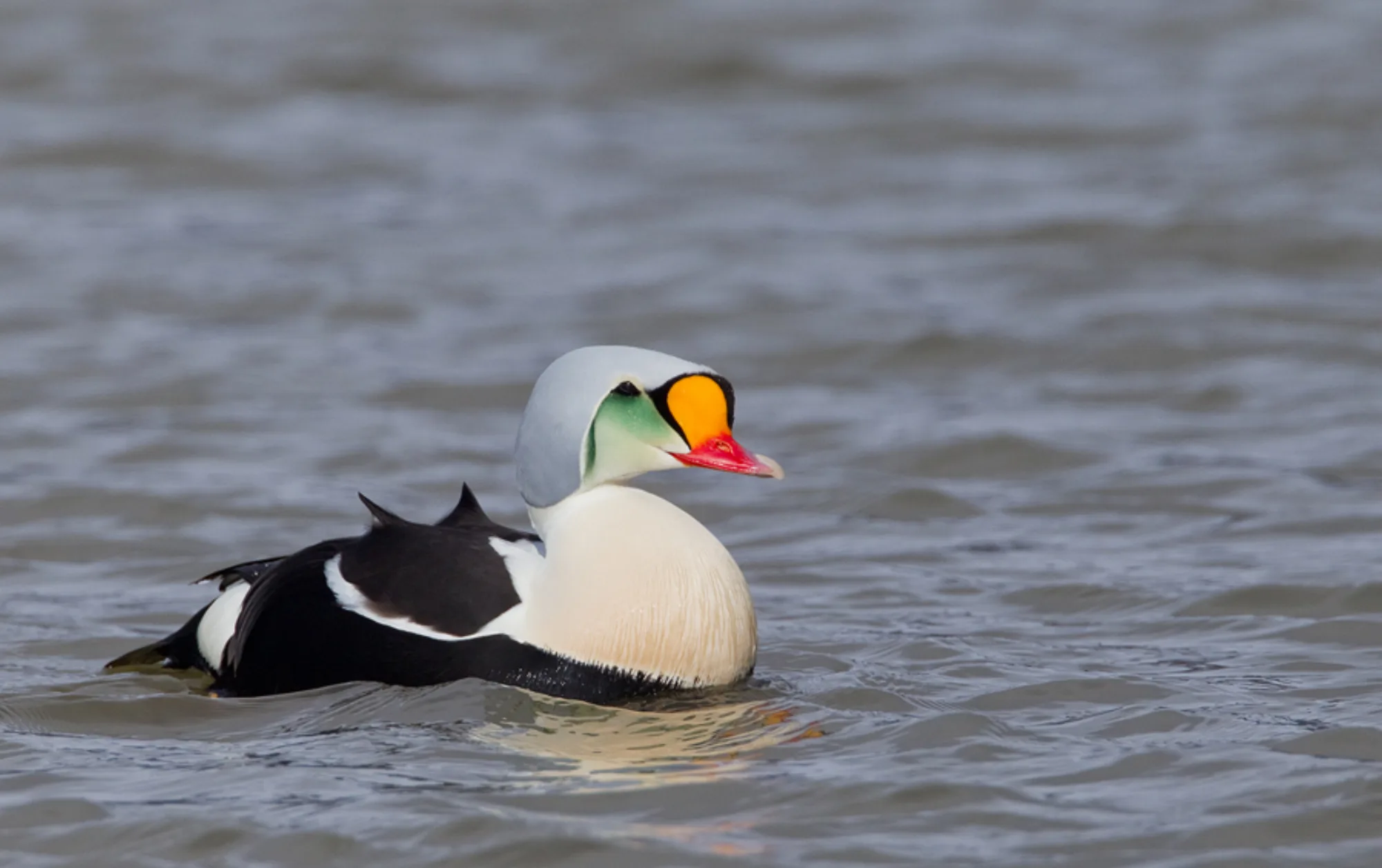
A large sea duck of the Arctic, the King Eider is easiest to recognise in the male's breeding plumage. His mostly black body contrasts with a pale breast, while his pale bluish grey head has green cheeks and a red bill topped by a prominent yellow knob. The female is warm brown, with dark chevron markings on her back and sides and a pale ring around her eye. Young birds are greyish brown, and males take three years to acquire their full adult plumage.
King Eiders breed in several tundra habitats along Arctic coasts, including those of Alaska, Canada, Greenland, Svalbard and Russia. They spend much of the year at sea, wintering in Arctic and subarctic waters, including the Bering Sea and the west coast of Greenland. On suitable coastal waters, winter flocks can exceed 100,000 birds. The species also occurs annually off Scotland, Kamchatka and the northeastern United States.
At sea, King Eiders dive for invertebrates on the seabed, including molluscs, crustaceans, sea urchins and starfish. During the breeding season they also feed on freshwater lakes and ponds, picking small invertebrates from the surface. The female makes a ground nest, usually near water, and lines it with vegetation and her own down. She incubates the eggs alone, while females later raise the young collectively. Eggs and young face predators including Arctic foxes, common ravens and glaucous gulls. King Eiders are also hunted in great numbers during their spring migration past the Yukon, Kuskokwim Delta.
Written from the English Wikipedia article King eider (CC BY-SA 4.0).
- Records
- 79,339
- Countries
- 8
No atlas park has a record of the King Eider in or around it yet.
These are open occurrence records, so they show where people looked for and recorded the King Eider as much as where it lives. Cells are up to 25 km across, and every location is generalised to its cell.
Generalised encounter areas, not exact locations. Each shape is a grid cell coloured by how likely the species is there.
- Very likelyUnited States25 km zone · high confidence · 48562 records · updated 80 days ago
- Very likelyCanada25 km zone · high confidence · 12392 records · updated 80 days ago
- Very likelyNorway25 km zone · high confidence · 11464 records · updated 80 days ago
- Very likelySvalbard & Jan Mayen25 km zone · high confidence · 5287 records · updated 80 days ago
- Very likelyIceland25 km zone · high confidence · 863 records · updated 80 days ago
- Very likelyUnited Kingdom25 km zone · high confidence · 530 records · updated 80 days ago
- Very likelyFinland25 km zone · high confidence · 123 records · updated 80 days ago
- Very likelySweden25 km zone · high confidence · 118 records · updated 80 days ago
Conservation status not assessed here yet, so every location is generalised to its grid cell.