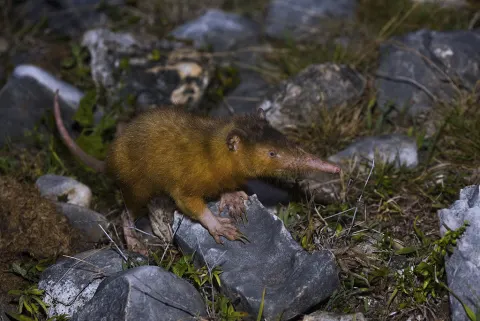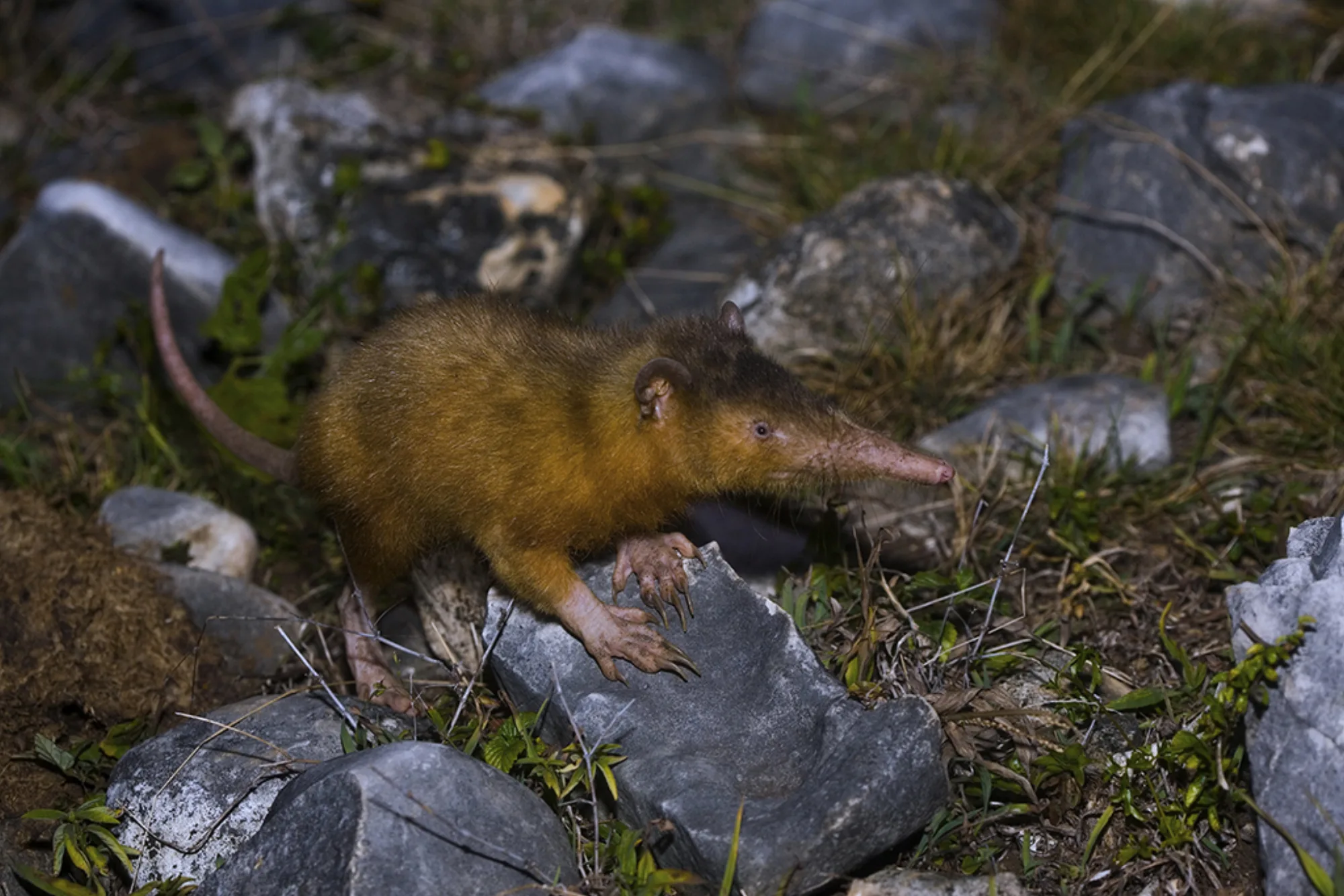
Hispaniolan Solenodon
Solenodon paradoxus
At night, the Hispaniolan Solenodon emerges from hiding to forage, moving across the ground in an erratic zigzag. This elusive, venomous mammal resembles an oversized shrew, with a long snout, tiny eyes and ears partly concealed by fur. Its coat is usually dusky brown with a paler belly, while reddish fur colours its head, throat and chest. The tail, legs and snout are hairless, while strong claws help it dig. Adults measure 49 to 72 cm in total length, including a tail of 20 to 25 cm, and weigh about 800 g on average.
Its patchy range is confined to Hispaniola, spanning the Dominican Republic and areas of southern Haiti. It usually inhabits undisturbed moist forest below 1,000 m, though it sometimes occurs higher up or near developed farmland. During the day it stays out of sight in burrows, trees, hollow logs or caves. A burrow can house an adult pair and up to six younger family members. Its diet is mainly arthropods, including millipedes and ground beetles, but it also eats worms, snails, mice and small reptiles. It searches with its snout in the soil and uses its claws to dig or tear into rotten logs.
Breeding takes place throughout the year, and litters contain one to three young. Newborns are blind and hairless, and their mother carries them for their first two months. Feral dogs and cats and introduced small Asian mongooses can prey on solenodons. Habitat loss is another threat, as forests in national parks in both countries are cleared for farms and charcoal making.
Written from the English Wikipedia article Hispaniolan solenodon (CC BY-SA 4.0).
- Records
- 6
- Countries
- 2
No atlas park has a record of the Hispaniolan Solenodon in or around it yet.
These are open occurrence records, so they show where people looked for and recorded the Hispaniolan Solenodon as much as where it lives. Cells are up to 25 km across, and every location is generalised to its cell.
Generalised encounter areas, not exact locations. Each shape is a grid cell coloured by how likely the species is there.
- Very likelyDominican Republic25 km zone · medium confidence · 6 records · updated 80 days ago
- PossibleHaiti25 km zone · low confidence · 0 records · updated 80 days ago
Conservation status not assessed here yet, so every location is generalised to its grid cell.