Ground Pangolin
Smutsia temminckii
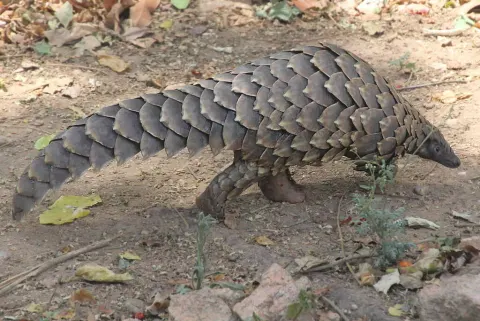
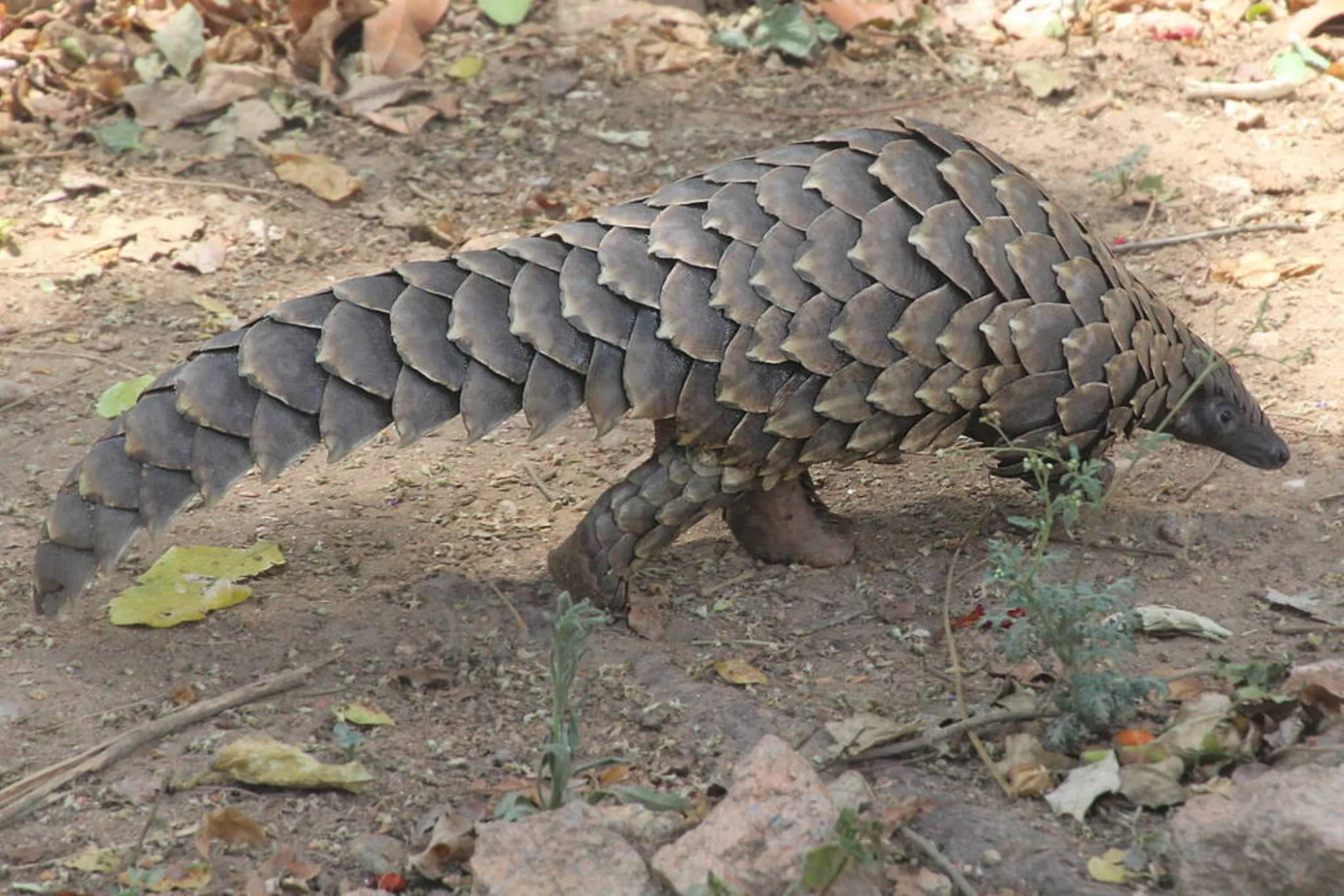
Clad in overlapping scales, the Ground Pangolin has a pinecone-like appearance, with a long, broad tail and a small head. Its underside has sparse fur instead of scales. Adults can be light brown, olive or dark brown, while young animals are pale brown or pink. It usually walks on its hind legs, sometimes using its forelegs and tail to balance.
Found in southern and eastern Africa, it favours low-elevation savannah woodland with a moderate amount of scrub. It is nocturnal and solitary, and its habits make it difficult to study in the wild. Although it can dig its own burrow, it prefers those abandoned by warthogs or aardvarks, or rests in dense vegetation. Its long claws help it break into ant and termite colonies, and its tongue reaches into cavities to gather its food. It eats only ants and termites, selecting particular species even where others are more abundant. When threatened, it can curl into a ball with its scales facing outwards, hiss, puff and lash its tail.
There is no known defined mating season, though pangolins tend to mate in summer and autumn. African pangolins usually give birth to one young, which rides at the base of its mother's tail and shelters beneath her when she curls up. The young are nursed for 3 to 4 months but start eating termites after one month. Habitat loss and illegal trafficking are the main threats to ground pangolins. Cultivation fragments their habitat, while their scales are used in traditional medicines and their meat is sold as a delicacy.
Written from the English Wikipedia article Ground pangolin (CC BY-SA 4.0).
- Records
- 0
- Countries
- 3
- Atlas places
- 1
These are open occurrence records, so they show where people looked for and recorded the Ground Pangolin as much as where it lives. Cells are up to 25 km across, and every location is generalised to its cell.
Generalised encounter areas, not exact locations. Each shape is a grid cell coloured by how likely the species is there.
- Very likelyNamibia25 km zone · low confidence · 0 records · updated 80 days ago
- LikelySouth Africa25 km zone · low confidence · 0 records · updated 80 days ago
- PossibleMozambique25 km zone · low confidence · 0 records · updated 80 days ago
Conservation status not assessed here yet, so every location is generalised to its grid cell.