Giant Pangolin
Smutsia gigantea
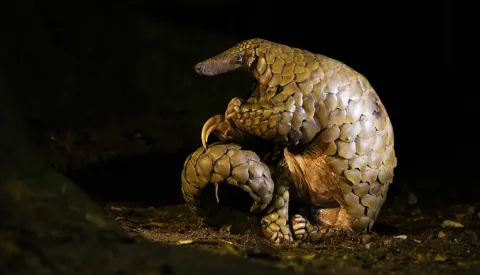
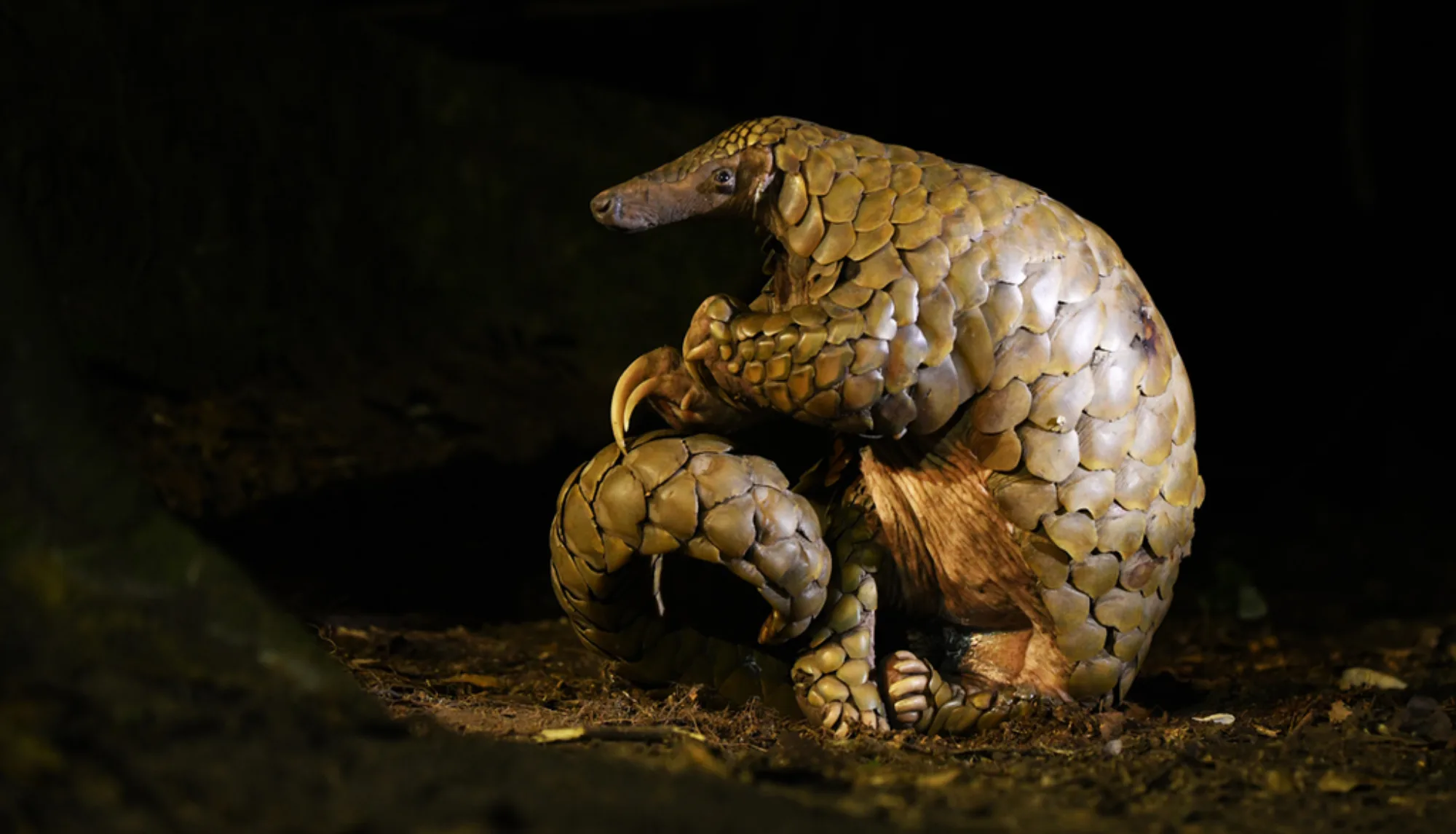
Armoured in large brown to reddish-brown scales, the Giant Pangolin is the largest living pangolin. Its long snout, thick tail and large front claws give it a distinctive outline. It carries most of its weight on its hind legs and curls its front paws under, walking on the outer sides of its wrists to protect those claws. Males are larger than females, reaching about 137 cm to 180 cm in body length, while females measure about 112.5 cm to 136.5 cm.
Its equatorial African range stretches from West Africa to Uganda, with the largest concentration in Uganda and Tanzania. It lives mainly in savanna, rainforest and forest where water and plentiful termites are available. Although it generally avoids high altitudes, a few sightings have been recorded in the East African montane forests of western Kenya. Giant pangolins are nocturnal and usually solitary, making them difficult to observe, though an adult has been seen sharing a burrow with a juvenile. They feed mainly on ants and termites, tearing open nests and gathering the insects with a sticky tongue. An adult can lean its weight against a termite mound, brace itself on its tail and rip into the mound with its front claws. Young pangolins follow their mothers until they are strong enough to do this themselves.
Little is known about breeding: two recorded litters were born in September and October, with young weighing around 500 g. Newborns have open eyes and soft scales that harden as they grow, and move on their bellies before they can walk on their legs. Habitat destruction, deforestation and hunting for the bushmeat trade threaten the species.
Written from the English Wikipedia article Giant pangolin (CC BY-SA 4.0).
- Records
- 0
- Countries
- 3
No atlas park has a record of the Giant Pangolin in or around it yet.
These are open occurrence records, so they show where people looked for and recorded the Giant Pangolin as much as where it lives. Cells are up to 25 km across, and every location is generalised to its cell.
Generalised encounter areas, not exact locations. Each shape is a grid cell coloured by how likely the species is there.
- Very likelyLiberia25 km zone · low confidence · 0 records · updated 80 days ago
- PossibleGabon25 km zone · low confidence · 0 records · updated 80 days ago
- UncommonCentral African Republic25 km zone · low confidence · 0 records · updated 80 days ago
Conservation status not assessed here yet, so every location is generalised to its grid cell.