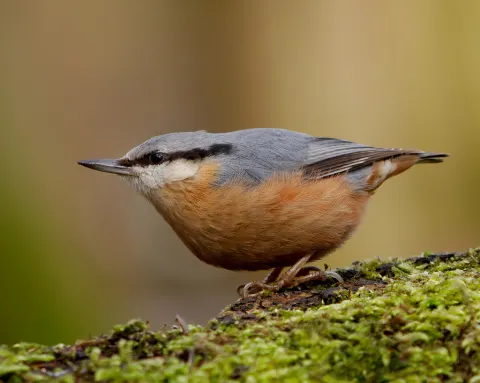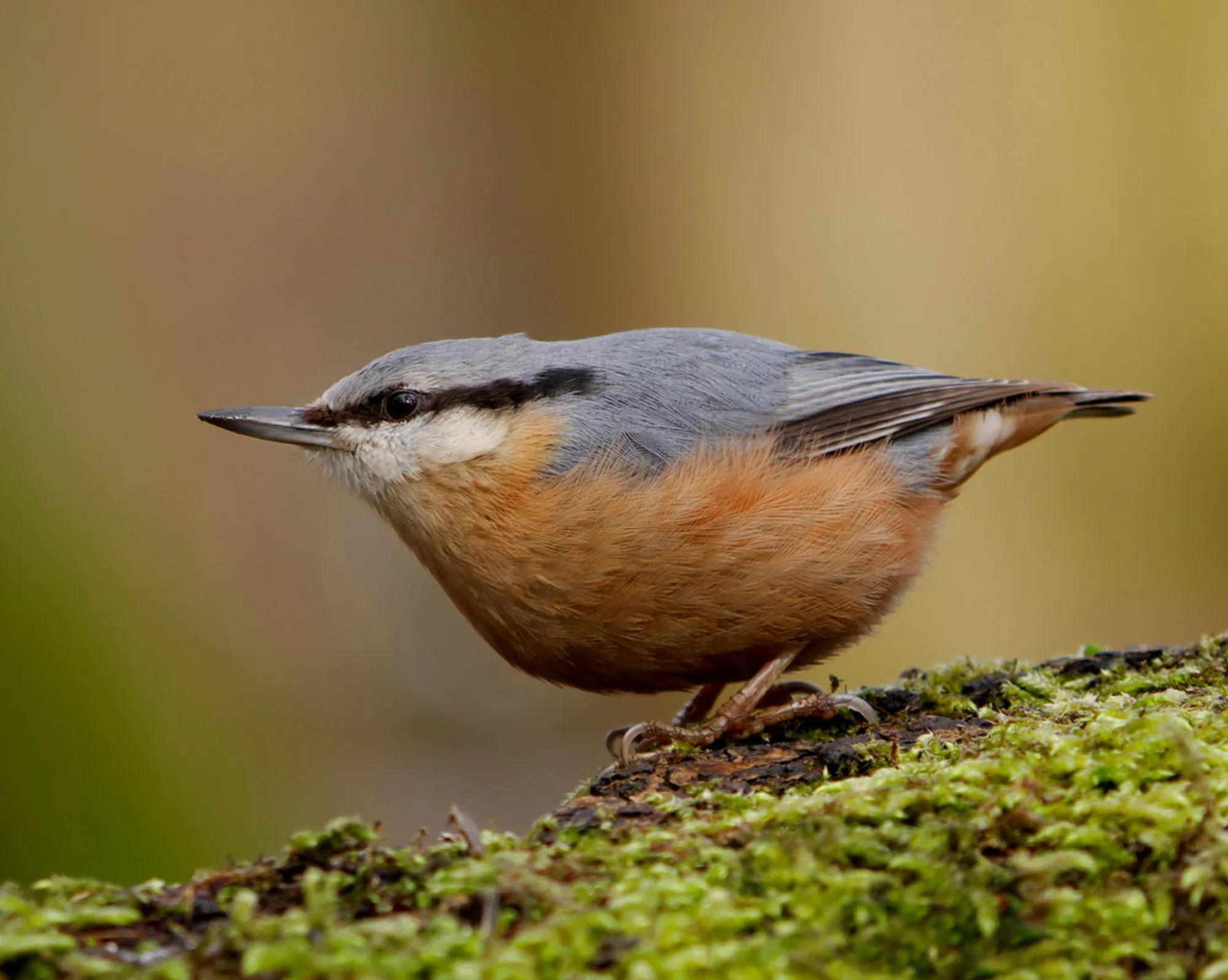
Eurasian Nuthatch
Sitta europaea
Look for the Eurasian Nuthatch moving in short leaps along a tree trunk, sometimes descending head first as it searches for food. This small, short-tailed bird has blue-grey upperparts, a long bill and a black stripe through the eye. Its underparts vary across its range: western birds have orange-buff below and a white throat, while birds in Russia are whitish underneath. Listen, too, for its frequent, loud, sharp dwip call, usually repeated twice.
The breeding range stretches across temperate Eurasia from Great Britain to Japan, though the bird is absent from Ireland. It favours mature woodland with large, old trees, especially deciduous or mixed forest containing oak in Europe. Parks and old orchards can also provide habitat where there is a suitable block of trees. Most populations stay in the same area, and pairs hold territories through both the breeding season and winter. Insects, especially caterpillars and beetles, make up most of the diet, with nuts and seeds added in autumn and winter. Birds search mainly on trunks and large branches, sometimes pulling away bark or rotten wood to reach insects. They also wedge nuts into bark crevices and break them open with their bills. Food is stored throughout the year, often hidden in bark and covered with moss, lichen or small pieces of bark.
Pairs usually nest in old woodpecker holes, although they also use natural tree cavities. The female may narrow an oversized entrance with mud, and the white eggs, speckled with red, lie on a deep bed of wood chips. Both adults feed the chicks and continue to feed them after they leave the nest. Sparrowhawks prey on nuthatches, while the felling or fragmentation of old woodland can cause local declines or losses.
Written from the English Wikipedia article Eurasian nuthatch (CC BY-SA 4.0).
- Records
- 667,276
- Countries
- 54
No atlas park has a record of the Eurasian Nuthatch in or around it yet.
These are open occurrence records, so they show where people looked for and recorded the Eurasian Nuthatch as much as where it lives. Cells are up to 25 km across, and every location is generalised to its cell.
Generalised encounter areas, not exact locations. Each shape is a grid cell coloured by how likely the species is there.
- Very likelyNorway25 km zone · high confidence · 202936 records · updated 86 days ago
- Very likelyUnited Kingdom25 km zone · high confidence · 106437 records · updated 86 days ago
- Very likelyFrance25 km zone · high confidence · 89549 records · updated 86 days ago
- Very likelyBelgium25 km zone · high confidence · 64164 records · updated 86 days ago
- Very likelyCzechia25 km zone · high confidence · 27236 records · updated 86 days ago
- Very likelyGermany25 km zone · high confidence · 21185 records · updated 86 days ago
- Very likelySpain25 km zone · high confidence · 18883 records · updated 86 days ago
- Very likelySweden25 km zone · high confidence · 16118 records · updated 86 days ago
- Very likelySwitzerland25 km zone · high confidence · 14465 records · updated 86 days ago
- Very likelyNetherlands25 km zone · high confidence · 14048 records · updated 86 days ago
Conservation status not assessed here yet, so every location is generalised to its grid cell.