Pygmy Rattlesnake
Sistrurus miliarius
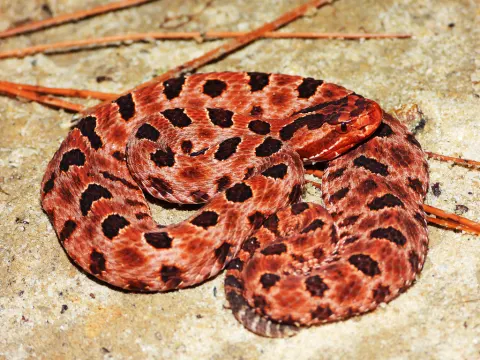
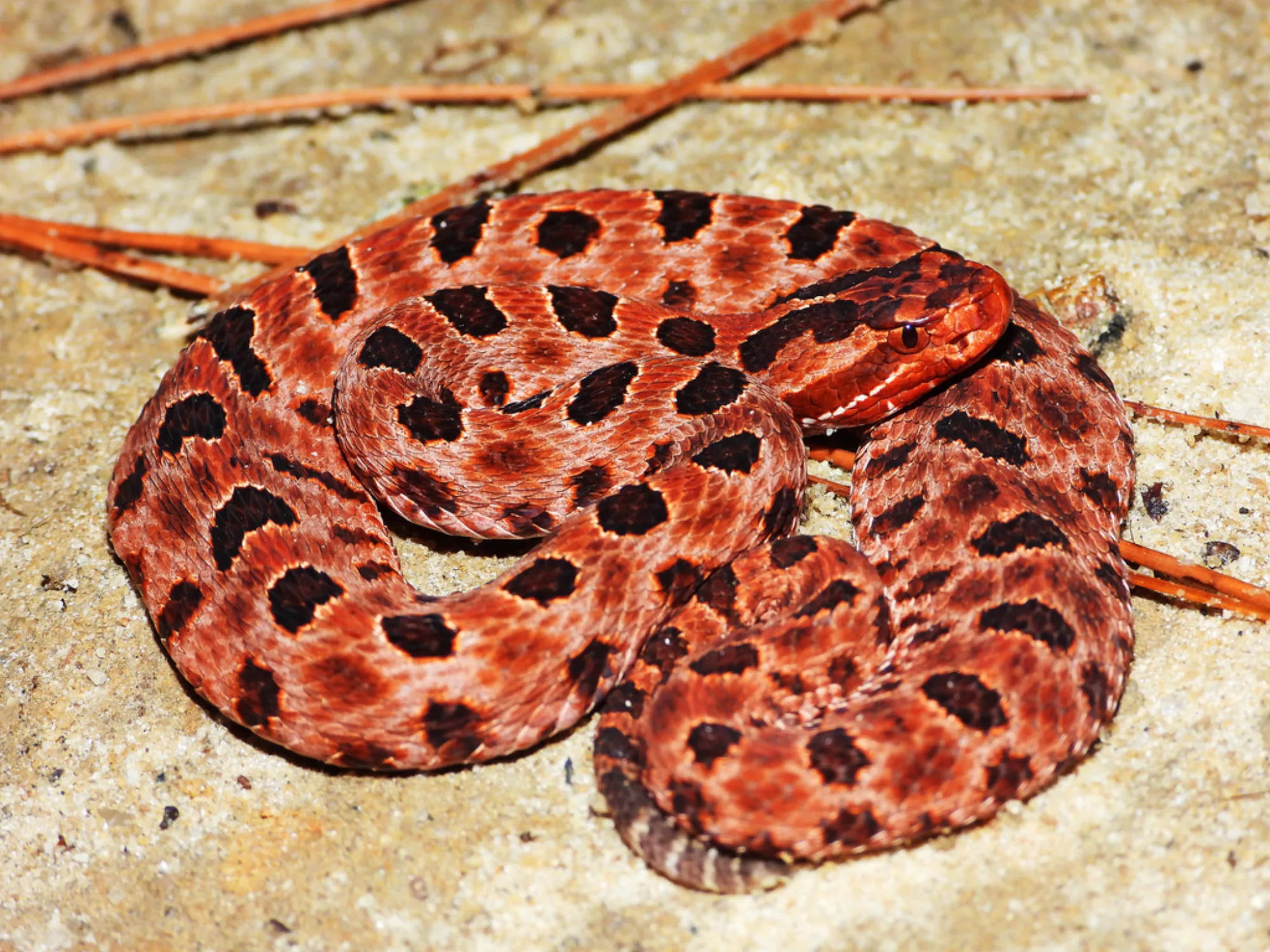
Small but broad-bodied, the Pygmy Rattlesnake is a venomous pit viper and the smallest rattlesnake in North America. Adults usually measure 40 to 60 cm in total length, including the tail. Oval or almost circular spots run along its back, while the spots on its sides are mostly round. Young snakes have a similar pattern to adults, sometimes paler or more vividly marked, with a yellow tail tip. Its tiny rattle makes a buzz audible only from a few feet away.
Its range spans the southeastern United States, reaching from southern and eastern North Carolina to peninsular Florida, East Texas and Oklahoma. It favours habitats that include flatwoods, sandhills, longleaf pine savannahs, scrub oak forests and floodplains, and also occurs near lakes and marshes. It may prefer dense vegetation, which provides cover. In summer, it is often seen basking or crossing a road late in the day. Individuals vary in their responses: some strike aggressively, while others seem sluggish and do not even try to rattle.
Generally solitary outside the breeding season, it shelters in burrows dug by small rodents or gopher tortoises and usually stays close to its home burrow. Its varied diet includes small mammals, birds, lizards, insects, frogs and other snakes. It can lure lizards with its tail, while its feeding strategy becomes a waiting game, with snakes remaining coiled for days. Females usually give birth to 3 to 13 live young between July and September. Snake fungal disease is a major cause of death, and affected snakes usually have poor body condition and reduced breeding success, although some recover in the wild.
Written from the English Wikipedia article Sistrurus miliarius (CC BY-SA 4.0).
- Records
- 37
- Countries
- 1
- Atlas places
- 1
These are open occurrence records, so they show where people looked for and recorded the Pygmy Rattlesnake as much as where it lives. Cells are up to 25 km across, and every location is generalised to its cell.
Generalised encounter areas, not exact locations. Each shape is a grid cell coloured by how likely the species is there.
- Very likelyUnited States25 km zone · medium confidence · 37 records · updated 80 days ago
Conservation status not assessed here yet, so every location is generalised to its grid cell.