Massasauga
Sistrurus catenatus
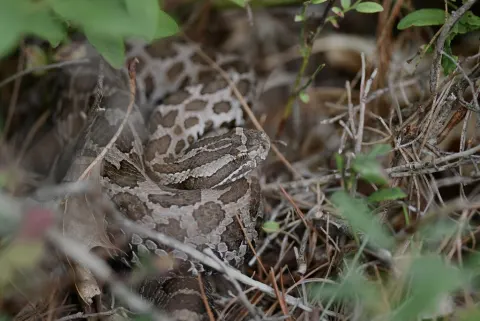
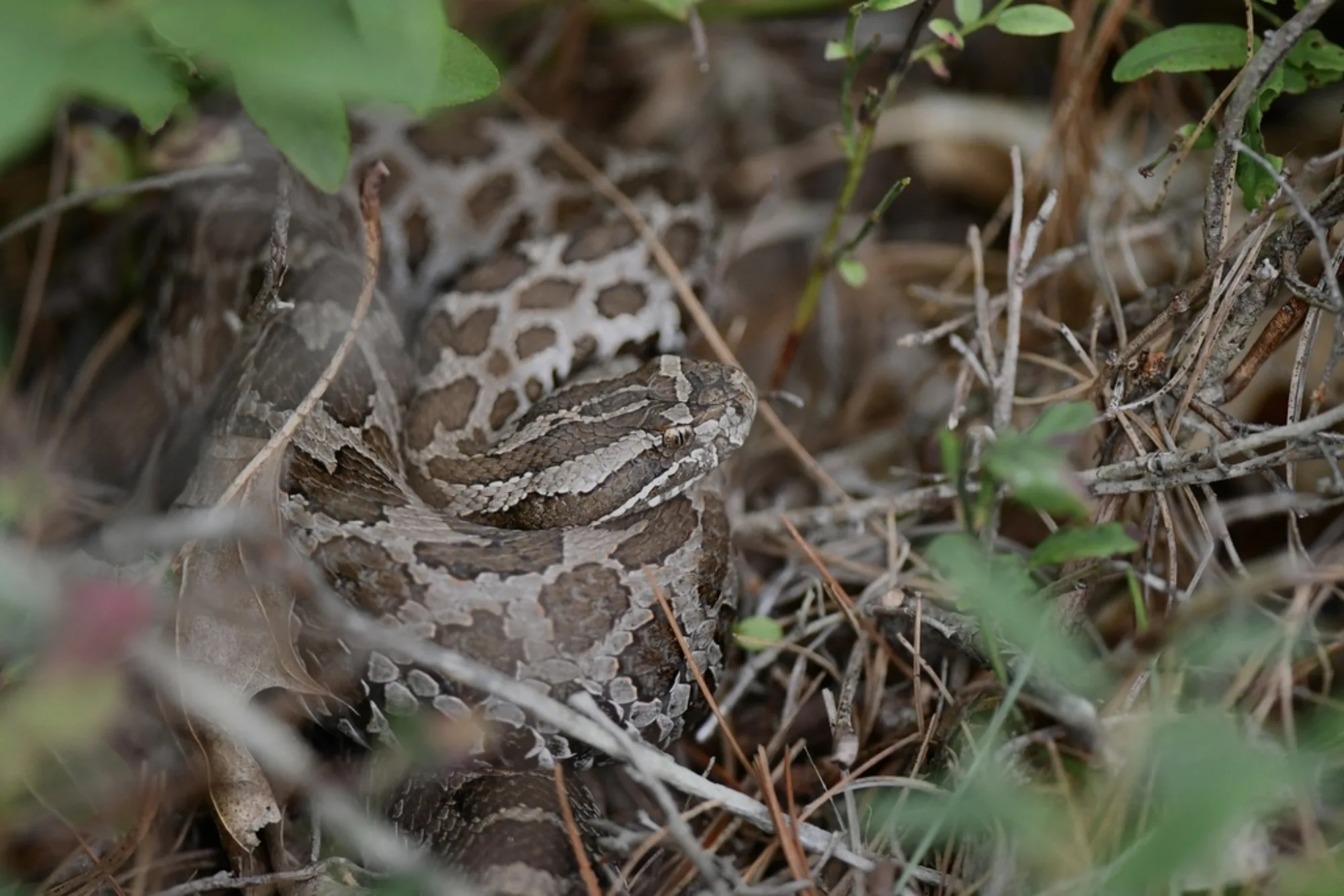
Quiet and inclined to avoid people, the Massasauga is a venomous rattlesnake of eastern North America. Adults reach 60 to 75 cm in total length and are usually grey or tan, with large rounded brown or black blotches down the back and smaller spots along the sides. Some are entirely black, while young snakes have paler, distinct patterns.
Its range includes southern Ontario and parts of the Great Lakes region and the eastern Midwest of the United States, though many populations are now small and isolated. In Canada, it occurs at Wainfleet Bog and Ojibway Prairie, as well as around Georgian Bay's eastern shore, the Bruce Peninsula and Lake Huron's north shore. Look for its habitat around wetlands, including swamps, marshes, bogs, wet meadows and floodplains. It may also occupy wetlands in prairies, meadows and coniferous forests. In spring and autumn it often stays near its winter shelter, sometimes using crayfish burrows; in summer it may move to drier ground, especially when carrying young.
Adults mainly eat small mammals such as voles, mice and shrews, while young snakes usually take reptiles. The wider diet also includes birds, eggs, frogs, insects and centipedes, with frogs more prominent in some northern and eastern populations. Females typically breed every two years and give birth in August or September. The mother and young stay together briefly, usually until the young first shed their skin. Wetland drainage, farming, roads and urban development have contributed to declines, while habitat loss and persecution have made the snake rare in Canada. Snake fungal disease is another threat.
Written from the English Wikipedia article Eastern massasauga (CC BY-SA 4.0).
- Records
- 272
- Countries
- 2
No atlas park has a record of the Massasauga in or around it yet.
These are open occurrence records, so they show where people looked for and recorded the Massasauga as much as where it lives. Cells are up to 25 km across, and every location is generalised to its cell.
Generalised encounter areas, not exact locations. Each shape is a grid cell coloured by how likely the species is there.
- Very likelyCanada25 km zone · medium confidence · 183 records · updated 80 days ago
- Very likelyUnited States25 km zone · high confidence · 89 records · updated 80 days ago
Conservation status not assessed here yet, so every location is generalised to its grid cell.