Scrub Python
Simalia kinghorni
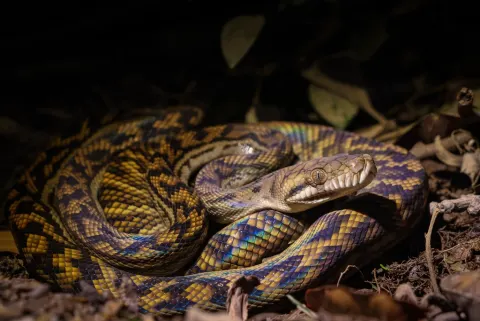
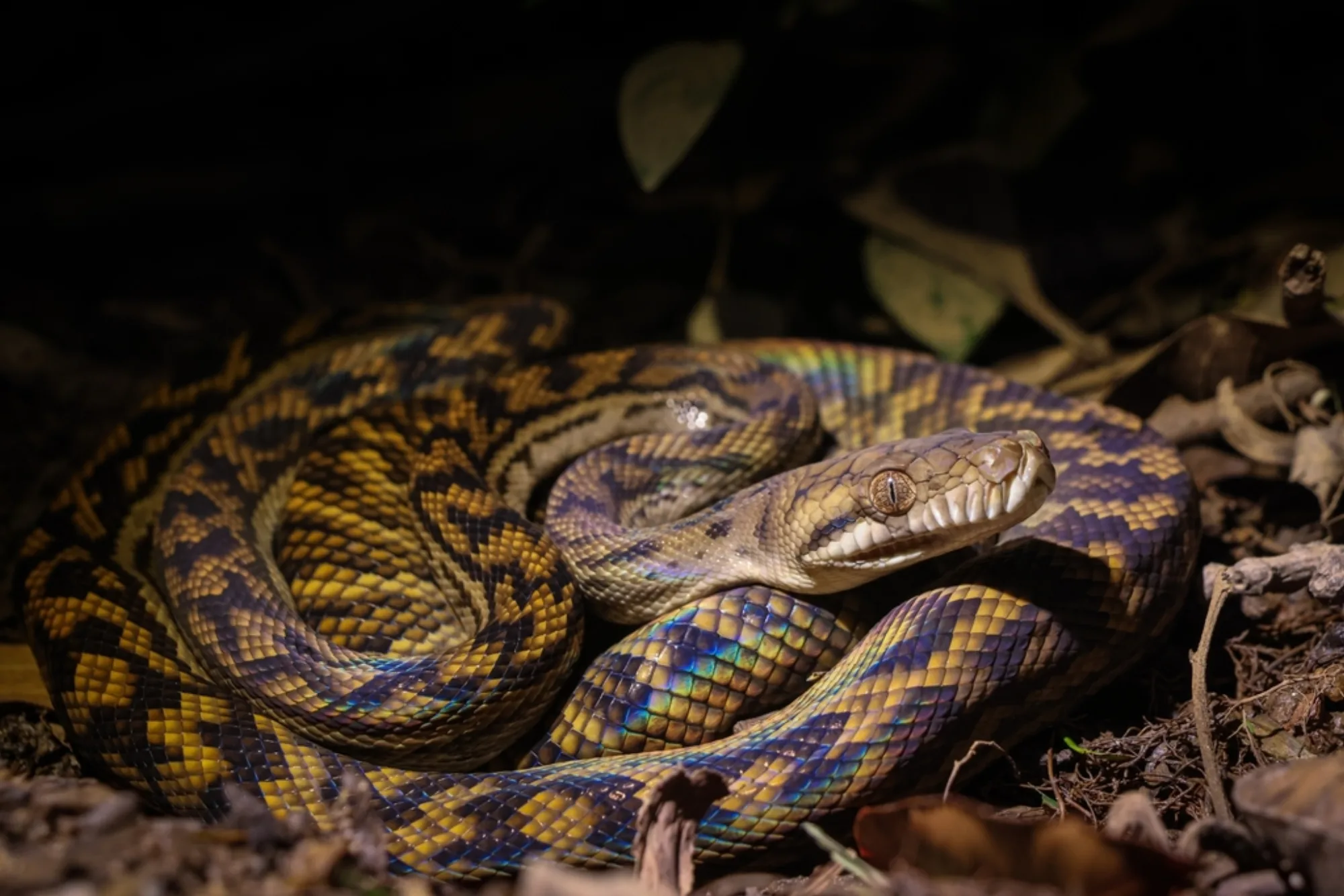
Among Australia's largest snakes, the Scrub Python, Simalia kinghorni, is a forest-dwelling python native to the north of the country. It has an ornate pattern of browns and tans across its back, with considerable variation between individuals and an iridescent sheen. The belly is usually white, sometimes with yellow, while large symmetrical shields cover the top of the head. The species is commonly considered tree-dwelling and is among the world's largest snakes associated with trees. One carefully measured female from Palm Cove near Cairns had a total length of 5.65 m and weighed 24 kg.
Its range includes Queensland and the Cape York Peninsula, as well as several islands in the Torres Strait. On the mainland, the range runs south from Cape York's tip through coastal rainforest and the Atherton Tableland, reaching wooded foothills on the eastern side of the Great Dividing Range. From Mount Speck, it follows the coast south to the Burdekin River, beyond Townsville. Farther south, a population in the Conway rainforest near Airlie Beach may have originated from adult snakes that escaped a local zoo in 1990, though its size and links to northern populations remain unknown.
Birds and mammals form the basis of its diet, but prey varies with the snake's habitat, age and size and can include reptiles and wallabies. Its recorded prey includes bush rats, northern quolls, flying foxes, bandicoots and striped possums. Near settlements, it also feeds on domestic poultry. Small wallaby species are taken relatively often, including agile wallabies, red-legged pademelons and Bennett's tree-kangaroos.
Written from the English Wikipedia article Australian scrub python (CC BY-SA 4.0).
- Records
- 287
- Countries
- 1
- Atlas places
- 1
These are open occurrence records, so they show where people looked for and recorded the Scrub Python as much as where it lives. Cells are up to 25 km across, and every location is generalised to its cell.
Generalised encounter areas, not exact locations. Each shape is a grid cell coloured by how likely the species is there.
- Very likelyAustralia25 km zone · medium confidence · 287 records · updated 80 days ago
Conservation status not assessed here yet, so every location is generalised to its grid cell.