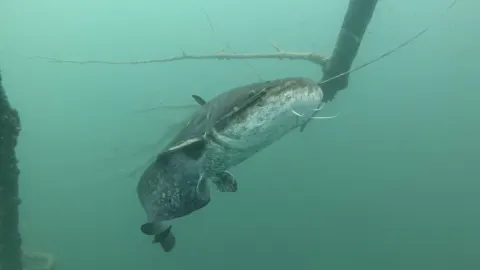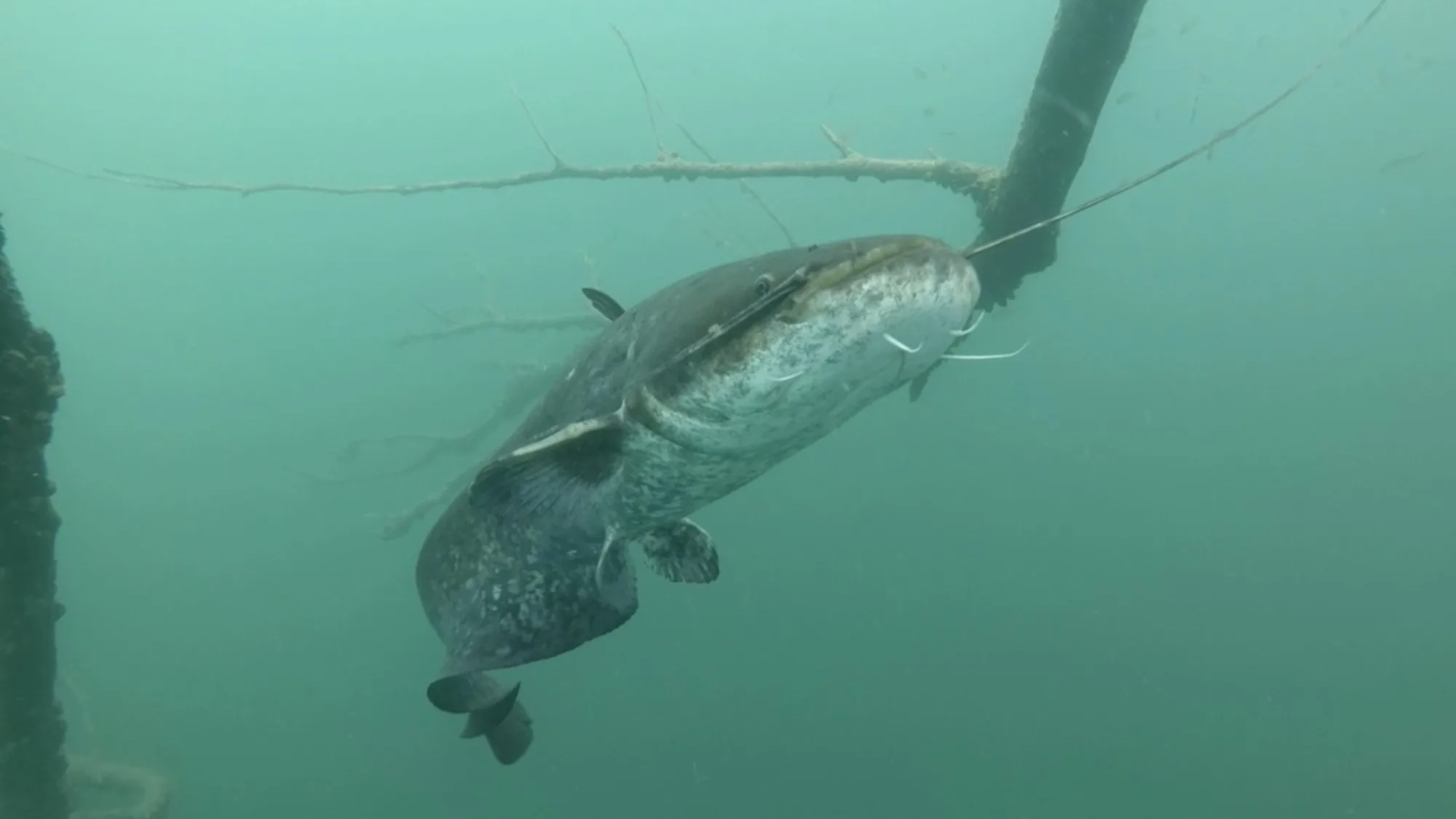
Wels
Silurus glanis
A broad mouth and long whisker-like barbels give the Wels its distinctive appearance. This large catfish has an elongated body and slimy skin, with colour that varies according to its surroundings: fish in clear water are black, while those in muddy water often turn green-brown. Its underside is pale yellow to white. Most adults measure about 1.3 to 1.6 m, and fish over 2 m are rare.
Native across much of central, southern and eastern Europe, the Wels comes from waterways draining into the Baltic, Black and Caspian Seas. Introductions have extended its range from the United Kingdom to western China. It favours spacious lakes with warm water and rivers that run deep and slowly, sheltering in places such as riverbed holes and sunken trees. Mainly active at night, it hunts largely by hearing and smell, taking prey in open water or at depth. Its varied diet includes worms, insects, crustaceans and fish, while larger individuals also eat animals such as frogs, rats and ducks. In France, introduced Wels have even been observed lunging from the water to catch pigeons at the edge. During breeding, the male guards the nest until the eggs hatch and may splash them with its tail if the water falls too far or too quickly.
The species has declined over centuries at the northern edge of its range and disappeared from Denmark and Finland. In Sweden, it survives in only a few lakes and rivers, where populations have low genetic diversity and are isolated from one another. Large Wels are also sought by sport fishers.
Written from the English Wikipedia article Wels catfish (CC BY-SA 4.0).
- Records
- 20,586
- Countries
- 8
No atlas park has a record of the Wels in or around it yet.
These are open occurrence records, so they show where people looked for and recorded the Wels as much as where it lives. Cells are up to 25 km across, and every location is generalised to its cell.
Generalised encounter areas, not exact locations. Each shape is a grid cell coloured by how likely the species is there.
- Very likelyFrance25 km zone · high confidence · 17453 records · updated 80 days ago
- Very likelyBelgium25 km zone · high confidence · 1986 records · updated 80 days ago
- Very likelySweden25 km zone · high confidence · 338 records · updated 80 days ago
- Very likelySwitzerland25 km zone · high confidence · 254 records · updated 80 days ago
- LikelyGermany25 km zone · medium confidence · 453 records · updated 80 days ago
- LikelyNetherlands25 km zone · medium confidence · 59 records · updated 80 days ago
- LikelyItaly25 km zone · medium confidence · 43 records · updated 80 days ago
Conservation status not assessed here yet, so every location is generalised to its grid cell.