Philippine Forest Turtle
Siebenrockiella leytensis
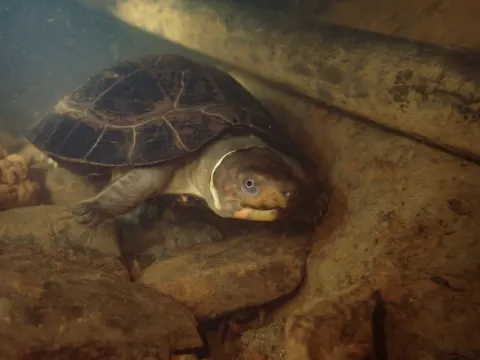
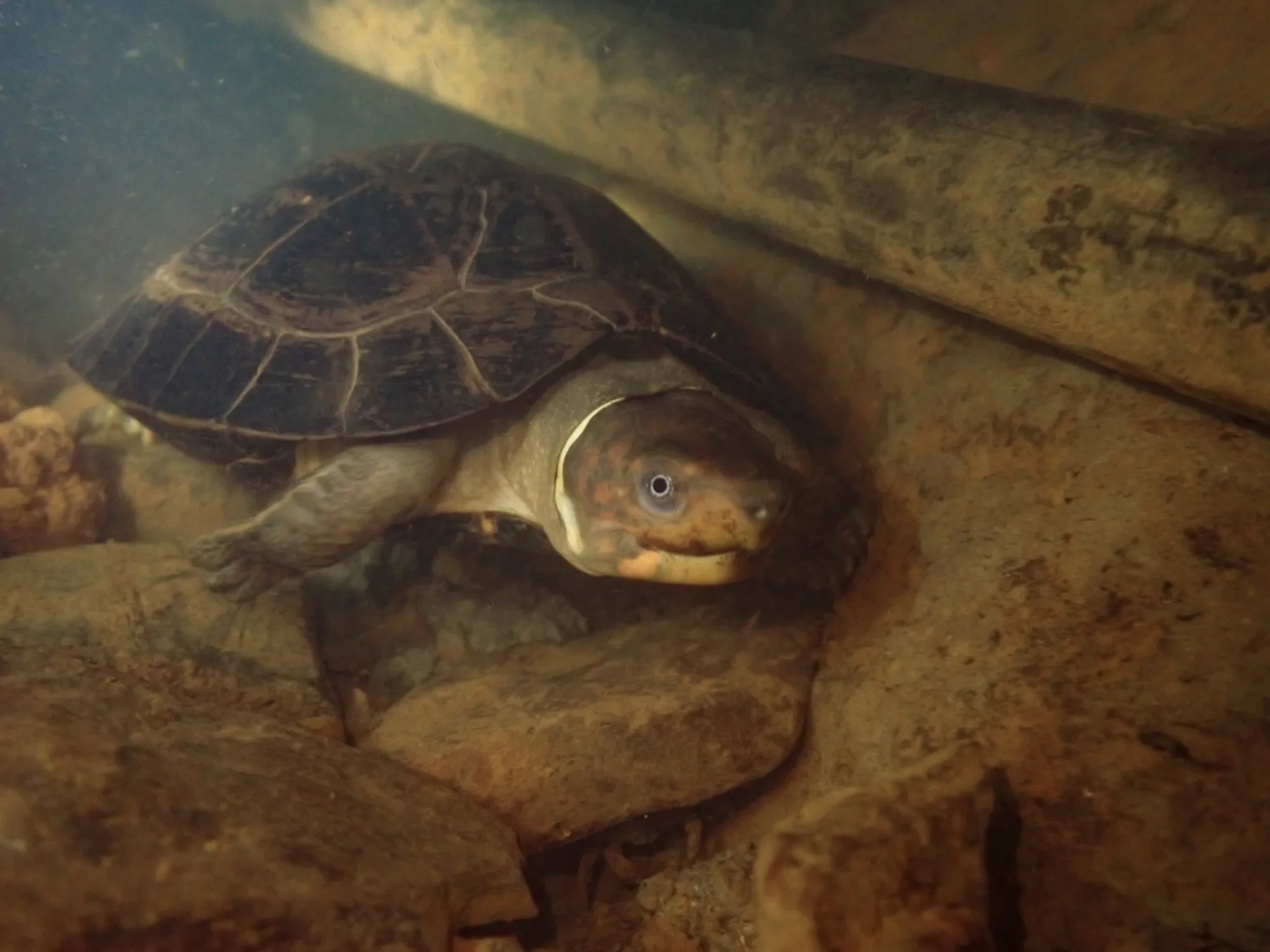
Often identified by a distinctive pale white or yellow stripe running across the head behind the ears, the Philippine Forest Turtle is a freshwater species native to the Palawan island group. This marking has earned it the nickname bowtie turtle. Its shell is typically brown, reddish brown, or black, reaching a length of 21 cm, though rare individuals grow to 30 cm. The front edge of the shell is serrated, and its scutes are shaped like ginkgo leaves. Rough skin covered in tiny tubercles covers its legs and neck, and its toes are fully webbed with large claws.
In the wild, these turtles inhabit northern Palawan and nearby islands like Dumaran, where they live in creeks and mud wallows. They are shy, retiring animals that hide during the day and become active during the night or in the early morning and late evening. Their diet is omnivorous, consisting of figs, aquatic plants, small fish, and crustaceans. While little is known about their life cycle, they appear to have long life spans and delayed sexual maturity.
Populations are declining sharply in certain areas due to several significant threats. Although they are found in a nationally protected area, they are frequently targeted by illegal collectors for the pet trade. Some local people also keep them in water troughs as good luck charms. Habitat loss and the species' aggressive territorial nature further complicate their survival, as they do not adapt well to being held in captivity.
Written from the English Wikipedia article Philippine forest turtle (CC BY-SA 4.0).
- Records
- 1
- Countries
- 1
- Atlas places
- 0
These are open occurrence records, so they show where people looked for and recorded the Philippine Forest Turtle as much as where it lives. Cells are up to 25 km across, and every location is generalised to its cell.
Generalised encounter areas, not exact locations. Each shape is a grid cell coloured by how likely the species is there.
- Very likelyPhilippines50 km zone · medium confidence · 1 record · updated 1 day ago