Eastern Bluebird
Sialia sialis
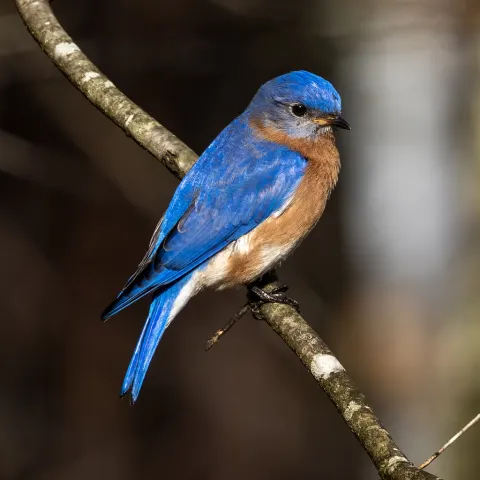
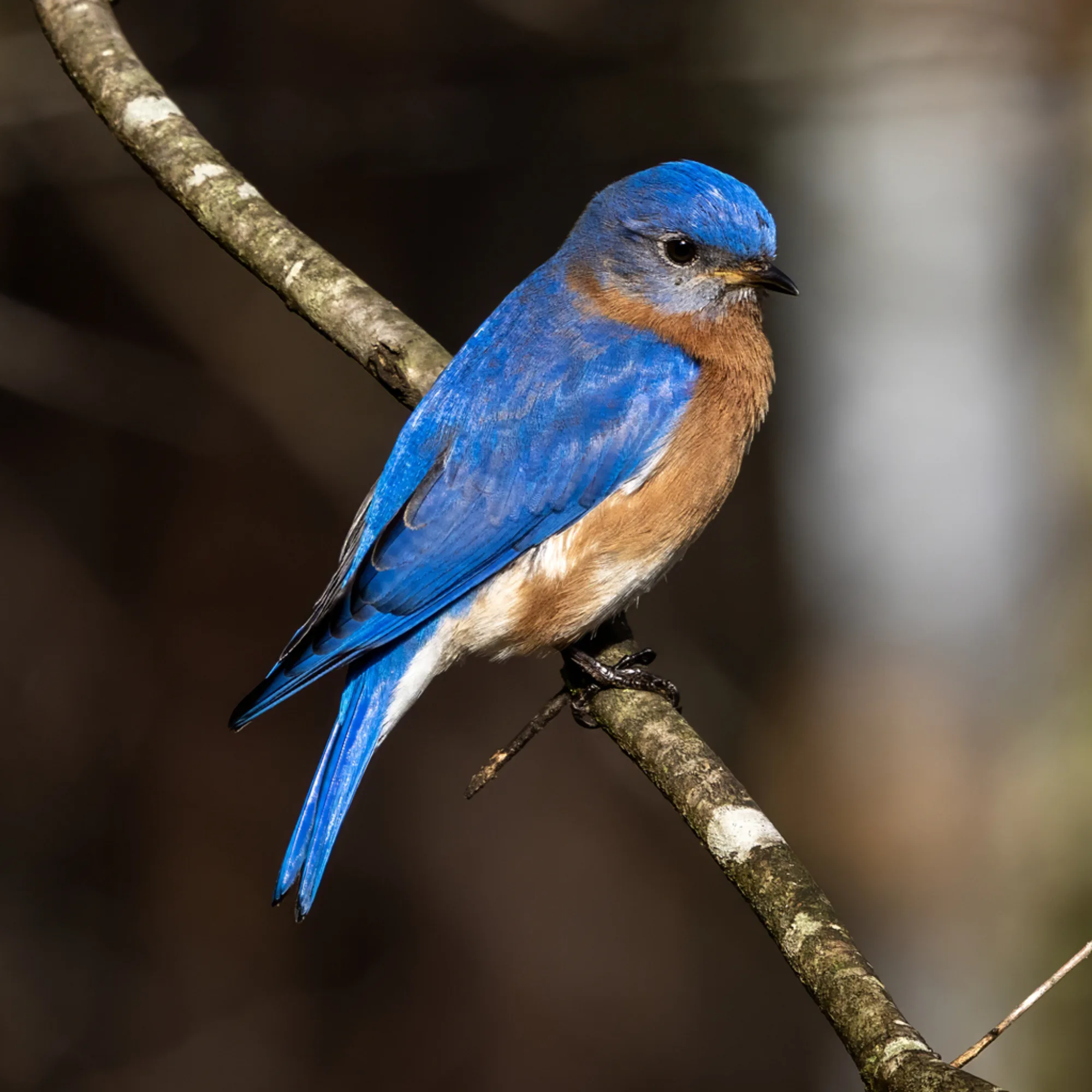
A flash of blue on a wire or open perch may be a male Eastern Bluebird, a small migratory thrush of North America. Males have bright blue heads, backs and wings, with brownish-red breasts; females are paler, with grey heads and backs, blue on the wings and tail, and a more orange breast. The male's voice includes soft warbles and a melodious song.
Look for bluebirds east of the Rockies, from southern Canada to the Gulf states, and from southeastern Arizona south to Nicaragua. An isolated population also lives on Bermuda, where the birds are a brighter blue than their mainland counterparts. They favour open country with trees, little undergrowth and sparse ground cover, and are often found around pastures, fields, suburban parks and backyards. These social birds can form groups of more than a hundred, although they defend territories during the breeding season. They hunt from a high perch, swooping down for insects on or near the ground. Insects and other invertebrates make up about two thirds of an adult's diet, with wild fruit and berries making up the rest. Winter food supplies can influence whether a bird migrates; those that stay seek food and shelter in places such as thickets and orchards.
In spring and summer, females usually raise two broods, nesting in abandoned woodpecker holes or other protected tree cavities. Both parents feed the chicks, almost entirely on insects, and some young remain to help raise another brood. Snakes, birds of prey and domestic cats threaten bluebirds, while introduced starlings and house sparrows compete for nest sites. On Bermuda, the loss of cedar forest removed most natural nesting habitat, and the birds now depend heavily on artificial nest boxes.
Written from the English Wikipedia article Eastern bluebird (CC BY-SA 4.0).
- Records
- 2,854,671
- Countries
- 9
- Atlas places
- 2
These are open occurrence records, so they show where people looked for and recorded the Eastern Bluebird as much as where it lives. Cells are up to 25 km across, and every location is generalised to its cell.
Generalised encounter areas, not exact locations. Each shape is a grid cell coloured by how likely the species is there.
- Very likelyUnited States25 km zone · high confidence · 2803124 records · updated 86 days ago
- Very likelyCanada25 km zone · high confidence · 29394 records · updated 86 days ago
- Very likelyBermuda25 km zone · high confidence · 8751 records · updated today
- Very likelyGuatemala25 km zone · high confidence · 6865 records · updated today
- LikelyMexico25 km zone · high confidence · 2751 records · updated today
- LikelyHonduras25 km zone · high confidence · 2737 records · updated today
- LikelyNicaragua25 km zone · high confidence · 890 records · updated today
- PossibleEl Salvador25 km zone · high confidence · 152 records · updated today
- RareBelize25 km zone · medium confidence · 7 records · updated today
Conservation status not assessed here yet, so every location is generalised to its grid cell.