Myrtle Warbler
Setophaga coronata
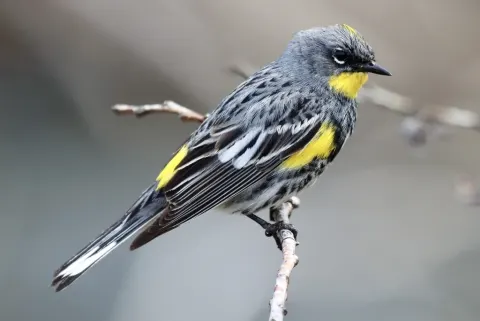
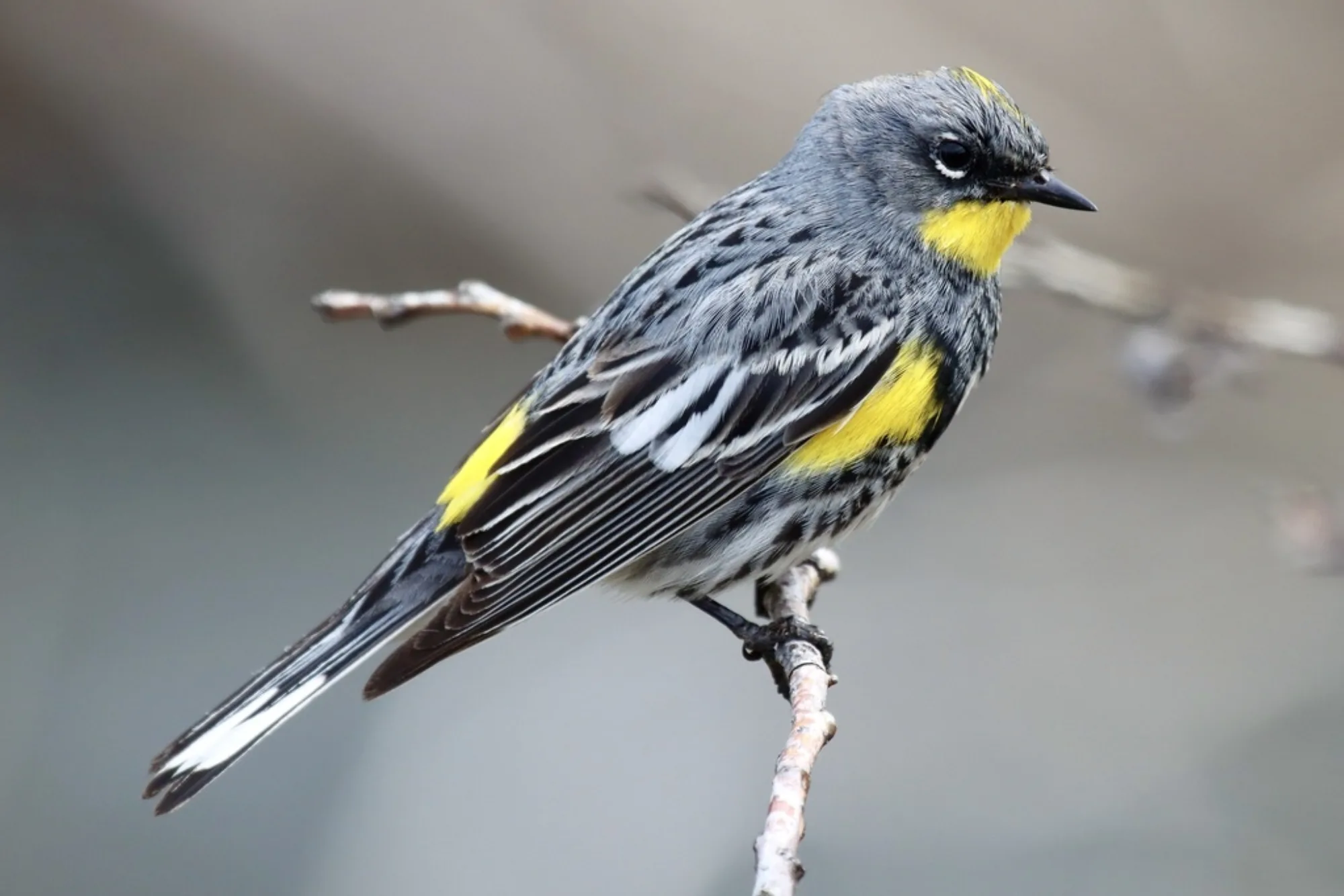
A flash of yellow on the rump can help identify the Myrtle Warbler, an eastern form of the North American yellow-rumped warbler. Breeding males have grey backs marked with dark streaks; females have brown backs and brown or grey cheeks. The myrtle form has a white throat and eye stripe, with a contrasting black cheek patch. Females are more subdued in colour, but still show a noticeable yellow rump.
Myrtle warblers breed from Alaska across Canada to Newfoundland, reaching south to Massachusetts and the mountains of Virginia. They also breed throughout the northern Great Lakes region, in coniferous and mixed woodland. For winter, they move south, with their range extending from southern British Columbia to Panama and across much of the southeastern United States. Yellow-rumped warblers often spend winter in open places with shrubs or scattered trees, including residential areas and shrublands where food is available.
Look for them picking insects from leaves or making short flights from a perch to catch insects in the air. Their food includes caterpillars, beetles, ants and spiders; when insects are scarce, myrtle warblers also eat fruit, including wax-myrtle berries. Females build a cup nest from materials including twigs, pine needles and grasses, usually on a conifer branch. They lay 4 to 5 eggs, and the young can fledge after 10 to 14 days. Predators threaten eggs, though nest linings can curl over them, helping to conceal them. Selective logging changes breeding habitat, but yellow-rumped warblers can maintain breeding densities where some mature nesting trees remain.
Written from the English Wikipedia article Yellow-rumped warbler (CC BY-SA 4.0).
- Records
- 3,931,324
- Countries
- 36
- Atlas places
- 4
These are open occurrence records, so they show where people looked for and recorded the Myrtle Warbler as much as where it lives. Cells are up to 25 km across, and every location is generalised to its cell.
Generalised encounter areas, not exact locations. Each shape is a grid cell coloured by how likely the species is there.
- Very likelyUnited States25 km zone · high confidence · 3593960 records · updated 86 days ago
- Very likelyCanada25 km zone · high confidence · 286083 records · updated 86 days ago
- Very likelyMexico25 km zone · high confidence · 29713 records · updated 86 days ago
- Very likelyBelize25 km zone · high confidence · 3907 records · updated today
- Very likelyGuatemala25 km zone · high confidence · 3679 records · updated today
- Very likelyBermuda25 km zone · high confidence · 3076 records · updated today
- Very likelyBahamas25 km zone · high confidence · 2948 records · updated today
- Very likelySt. Pierre & Miquelon25 km zone · high confidence · 815 records · updated today
- LikelyHonduras25 km zone · high confidence · 1116 records · updated today
- LikelyCuba25 km zone · high confidence · 1114 records · updated today
Conservation status not assessed here yet, so every location is generalised to its grid cell.